For more than 100 years Kenya has set the standard for African safaris. From the experience of witnessing two million wildebeest thunder over the Mara River during the Great Migration, to witnessing the sun rise at the edge of the Great Rift Valley, the country has experiences that live long in your memory. Understanding what you can expect, from the beat of the game drive to the arrangements of your room to the choice of parks for various travellers makes the difference between a trip that takes you by surprise, and one that takes you over. This guide will cover all the things you need to know before you arrive at Jomo Kenyatta International Airport.
When Is the Ideal Time to Do a Safari in Kenya?
The perfect to for a going to Kenya for a safari largely depends on your preferences but the best time to visit Kenya is normally during the dry seasons from July to October. According to Stanley from Majestic Kenya Safaris, “This window will coincide with the massive wildebeest migrations across the crocodile-filled Mara River in the annual Great Migration in the Masai Mara National Reserve, as they travel in and out of the park between the Serengeti National Park in Tanzania and the Kenyan savannah. The crossings do not have a fixed date. However, during these months, particularly in August, you have a higher chance of witnessing the migration.”
January and February are also good months. It’s a short dry season with clear skies, less tourist activity, and calving season that attracts large concentration of predators to the southern Masai Mara ecosystem. Some lodges close, while others offer great discounts during the long rains of April and May; this might be of interest to budget-conscious travellers who are not afraid of putrid roads, a few heavy afternoon showers, and a total lack of nearby restaurants and shops.
What wildlife can you expect to see on a Kenya Safari?
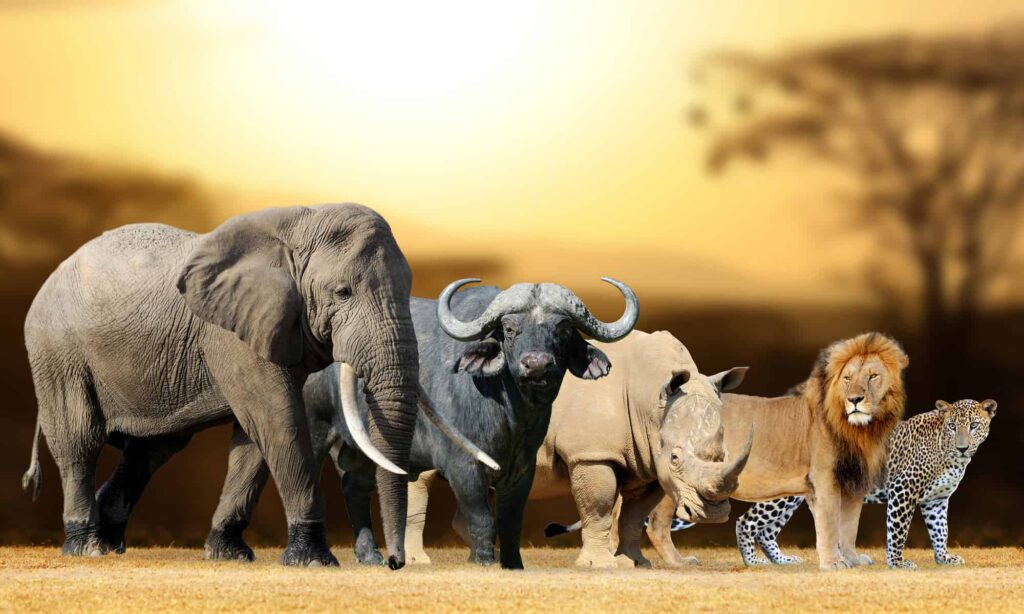
Kenya has some of the best opportunities in the world to see the Big 5 – lion, leopard, elephant, buffalo, and rhino – in their natural habitat. The Big Five is the original name from the days of big-game hunting and is used to describe the five most dangerous wild animals in Africa. Today it just simply refers to the animals that every safari guest desires to check.
The highlight of any Kenya safari is the Masai Mara National Reserve. Sightings are quite common and the density of lions here is one of the highest in Africa. Leopards, which are known to be elusive can also be frequently seen in the riverine forest around the Talek River.
Amboseli National Park is also another major highlight during a safari in Kenya. The scene of big bull elephants walking under the snow-capped peak of Mount Kilimanjaro beneath the trunks of their tuskers is one of the most memorable safari experiences. Here elephants are well documented and very placid around cars, so it’s possible to get up close and personal with them. Lions, cheetahs, and wildebeest are also present throughout the year.
In the northern part of Kenya, the cast of characters changes with the Samburu National Reserve. The reserve is renowned for the ‘Special Five’ – reticulated giraffe, Grevy’s zebra, beisa oryx, gerenuk and Somali ostrich, which are endemic to the arid northern ecosystem, and are not found in the southern parks. If you have seen the Masai Mara already, and want something a little different, Samburu has got you covered.
Ol Pejeta Conservancy is also an excellent safari destination. It is one of Laikipia’s largest black rhino sanctuary. Additionally, the last northern white rhino in East Africa dwell in the conservancy. It’s also the only location in Kenya where chimps can be found. The conservancy offers walking safaris and night drives (not available in the national reserves) to spruce up a multi-park tour.
How Does a Typical Safari Day Look Like?
Most of the Kenya safaris are organized around animal behaviour, and this translates to very early starts in the morning and long breaks during the afternoon. Your tour guide will wake you prior to dawn and lead you on a game drive around 5:30 or 6:00am, when predators are still active from the night and the light is soft and golden. Your journey will be three to four hours long and involve a lot of open savannah and riverbanks, as well as woodlands.
Midday is usually quiet. It’s normally hot, so the animals lie down in the shade and by noon most guides have come back to camp for lunch. The afternoon is spent resting, eating lunch and sometimes a short-guided walk until it gets cold and the game drive is up again by about 4:00pm when the sun sets. After the evening game drive, you will head back to your lodge or camp for dinner, a host of activities, such as a bonfire, to brighten up your evening.
It is also import to note that there are private conservancies around the Mara that allow activities not allowed in the Mara national park, including night drives with spotlights, off-road driving to track animals through thickets, and walking safaris with an armed guide, such as Mara North, Olare Motorogi, and Naboisho. The number of vehicles on these conservancies is limited, so it is not uncommon to see a lion kill with no other vehicles in sight, or a leopard with cubs present with no other vehicles.
What Accommodation Should You Expect on a Kenya Safari?
Kenya safari accommodation can be a simple tented camp up to one of the most luxurious camps in Africa. And there is not a clear distinction between the two. A luxury tented camp is usually a permanent structure – a large canvas tent on a wooden platform with a proper en suite bathroom, electricity, and a flush toilet that retains the feel of being in the bush. Your budget notwithstanding, you can still hear the sound of lions roaring at night.
In general, options fall in to 3 categories:
Luxury camps and lodges offer full board accommodations, private game drives with their own guide (optional), plunge pools, and, in a few instances, butler service. Rates are based on an all-inclusive package and the exclusivity of the concession. Private conservancies are likely to have these properties in most cases.
Mid-range camps and lodges offer good standard accommodation and give you a true bush experience without the high price tags. Numerous medium range camps in the Maasai Mara ecosystem have similar access to wildlife at a lower cost than luxury camps.
Budget camps and tented camp sites are viable alternatives especially for those travelling solo and don’t mind sharing facilities with other people. Wildlife does not know or care about the kind of camp you stay in. so yes, you can still get a positive safari experience even when staying in budget camps or lodges.
What to Pack for a Kenya Safari
You don’t need to pack too much for a safari in Kenya, but a few things do.
Layers are key. Mornings can be very cold in the Masai Mara and at Amboseli and afternoons are hot! In relation to colors, neutral colors such as Khaki, tan, and olive are practical since safaris are done in open vehicles where dust is always present. Using white and blue colored cloths is not advisable since they may attract insects and be conspicuous to animals. One of the best underrated pieces is a good pair of binoculars; your guide will be able to see the leopard but a pair of binoculars will allow you to see it properly.
Sunscreen and a hat are a must. If photography is important to you, the camera with the telephoto lens is worth every Kilo. Prophylactics are necessary for most Kenya safari destinations, and must be done at least six weeks before the trip; contact a travel health clinic for more information on some prophylactics that are necessary prior to the trip.
How Does Getting Around Kenya Work?
The majority of visitors arrive in Nairobi by plane through Jomo Kenyatta International Airport, which is connected to London, Amsterdam, Dubai and many other cities in Africa. There are 2 ways to get to the parks from Nairobi: road transfers, or bush flights.
The journey to the Masai Mara by road is about 5 to 6 hours long, crossing through the breathtaking and truly impressive Great Rift Valley. Bush flights land on grass airstrips, inside or near the reserve, and last approximately 45 minutes. Bush flying is used for most luxury safaris. Multi-park trips are no longer a day’s driving as internal flights, such as from Samburu to Amboseli and other short-distance routes, are available. So if you don’t want to spend much time travelling by road, you can always have your travel agent book the local flights for you. They are relatively cheap.
Is a Kenya Safari Worth It?
For those who truly wish to experience the thrill of close encounters with wild life in a natural environment that has scarcely been altered over thousands of years, a Kenya safari is a worthy experience. The country’s system of national parks, national reserves, and private conservancies protects an ecosystem that still functions close to its natural state. The Masai Mara–Serengeti ecosystem is home to the largest remaining terrestrial animal migration on Earth. That is not marketing copy – it is an ecological fact that most of the world has already lost. First-time safari goers often worry they will be disappointed. The near-universal experience is the opposite: the scale, the silence between game drive sightings, the way a morning can pivot from empty plains to a cheetah hunt in under a minute – none of it lands the way you expect it to from a screen. Kenya tends to reorder how people think about wildlife, about conservation, and about what travel is for.
Read More From Techbullion