Mass timber is one of the most important material innovations in modern construction because it turns wood into large-scale structural products for serious buildings, not just light framing. For anyone trying to connect the concept to real structural products, https://www.redbuilt.com/ shows how engineered wood systems move from theory into framing practice. Instead of relying on small dimensional lumber alone, mass timber uses layers, laminations, and fabrication methods that create strong panels, beams, and columns suitable for commercial construction, institutional design, and complex building systems.
Mass timber is an umbrella term for large engineered wood components
At its core, mass timber refers to a family of engineered wood materials made by bonding, fastening, or laminating smaller wood pieces into larger structural members. The best-known examples are cross laminated timber, usually shortened to CLT, and glulam, or glued-laminated timber. Cross laminated timber panels are built by stacking wood layers in alternating directions, which gives the panel two-way strength and dimensional stability. Glulam is made by laminating lumber in the same direction to create beams and columns with impressive strength and durability.
That is why mass timber is different from ordinary lumber. It is designed for structural performance, repeatable fabrication, and integration into complete framing packages. Architects, engineers, and contractors use it for roof decks, floors, walls, beams, and long-span structural elements in projects where efficiency, sustainability, and design flexibility all matter.
Mass timber combines wood with manufacturing precision
The phrase mass timber sometimes sounds old-fashioned because wood is one of the oldest building materials in architecture. In reality, it is a contemporary system built on manufacturing precision. Panels are cut offsite, connections are planned in advance, and coordination happens well before the jobsite sees the material. That prefabrication approach supports tighter project delivery, cleaner installation, and better control over waste.
This is also where mass timber overlaps with the broader engineered wood market. A company like RedBuilt is not simply selling raw lumber. It is known for proprietary structural wood products such as open-web trusses, Red-I joists for roof and floor systems, and RedLam LVL, which all sit in the same conversation about innovation in framing, structural materials, and building efficiency. WoodWorks also describes RedBuilt as part of the hybrid mass timber space, which is a useful reminder that many real-world buildings combine multiple engineered systems rather than depending on a single product type.
Mass timber is used as a structural system, not a decorative trend
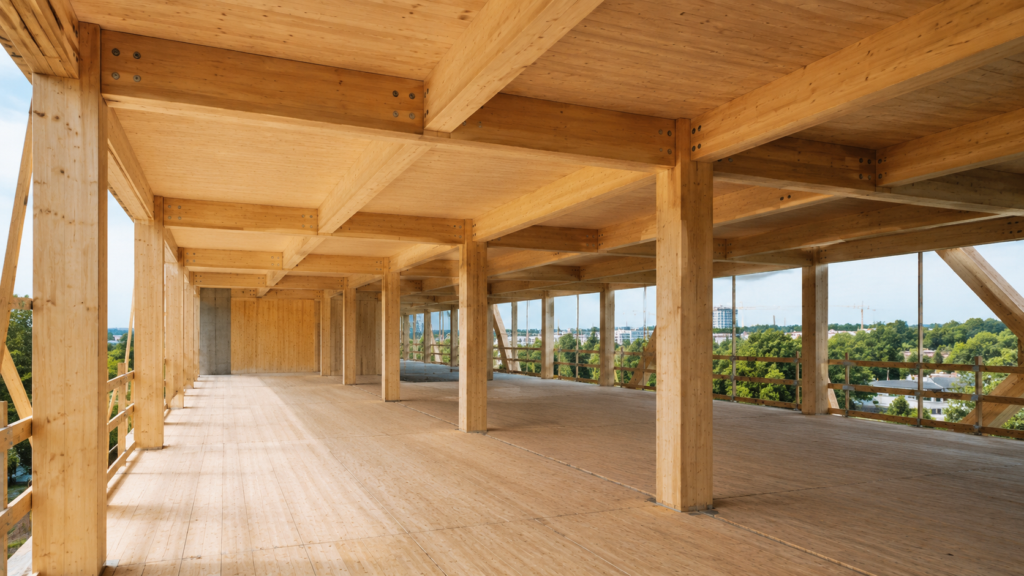
One reason the category matters is that mass timber is now used in genuine structural roles. Floors, roofs, bearing walls, beams, and columns can all be built with mass timber components. In low-rise and mid-rise buildings, the system may form most of the primary frame. In larger or taller projects, it is often used in hybrid systems that combine timber with steel or concrete.
That versatility helps explain why mass timber shows up in schools, offices, multifamily housing, civic buildings, and commercial construction. Designers like it because it supports creative architecture, clean spans, exposed structural expression, and coordinated mechanical routing. Builders like it because the parts arrive ready for assembly. Owners like it because the system can improve schedule certainty and reduce disruption on crowded jobsites.
Fire performance is one of the defining technical characteristics
Many people assume wood cannot be a serious option for major buildings because it burns. Mass timber performs differently from light wood framing. Large members develop a char layer on the outside during a fire, and that char helps protect the inner core by slowing combustion. Extensive fire testing has shaped code acceptance and design guidance for modern mass timber construction.
That does not mean fire performance is automatic. It still depends on member sizing, connection detailing, encapsulation where required, sprinkler strategy, and code-compliant design. But the point is important: mass timber is not used because engineers ignore fire, it is used because fire-resistant assemblies can be analyzed, tested, and designed with rigor.
Sustainability is one of the main reasons the market keeps growing
Mass timber is also tied closely to sustainable construction. Wood comes from renewable resources, and trees absorb carbon as they grow. When timber is harvested responsibly and kept in long-life building materials, a portion of that carbon remains stored in the finished structure. Research cited by EESI notes that building with mass timber instead of concrete and steel could reduce emissions associated with building materials by roughly 13 percent to 26.5 percent.
Those environmental benefits are part of a much larger shift in the market. EESI also reported 1,860 completed or planned U.S. mass timber projects as of June 2023, showing that the category has moved far beyond niche experimentation. Suppliers increasingly support that trend with environmental product declarations, responsible sourcing, and lower-waste fabrication practices. RedBuilt, for example, publishes sustainability information for products such as Red-I joists, RedLam LVL, and open-web trusses, including documentation that can support LEED v4 work.
Mass timber also fits current demand for better building efficiency in ways that go beyond carbon accounting alone. Because panels and framing packages are coordinated early, teams can make smarter decisions about insulation interfaces, acoustics, enclosure detailing, and mechanical routing. That systems mindset is part of why mass timber continues to influence both design innovation and day-to-day commercial construction practice.
Building performance goes beyond carbon alone
A good definition of mass timber should include building performance, not just environmental messaging. These systems can support strong strength-to-weight ratios, potentially lighter foundations, faster dry-in, and better installation efficiency. Depending on the assembly, they can also contribute to acoustics, enclosure performance, and coordination advantages when compared with slower site-built approaches.
In other words, mass timber is not simply wood used at a larger scale. It is a structural, engineered, prefabricated way of building that connects material science, project delivery, sustainability, and architectural ambition. When people ask what mass timber is, the most accurate answer is that it is a family of advanced wood-based systems that help modern buildings become more efficient, more renewable, and more intentional in how they are designed and assembled.