
Why Is Warehouse Optionality the Key to Surviving Supply Chain Disruption?

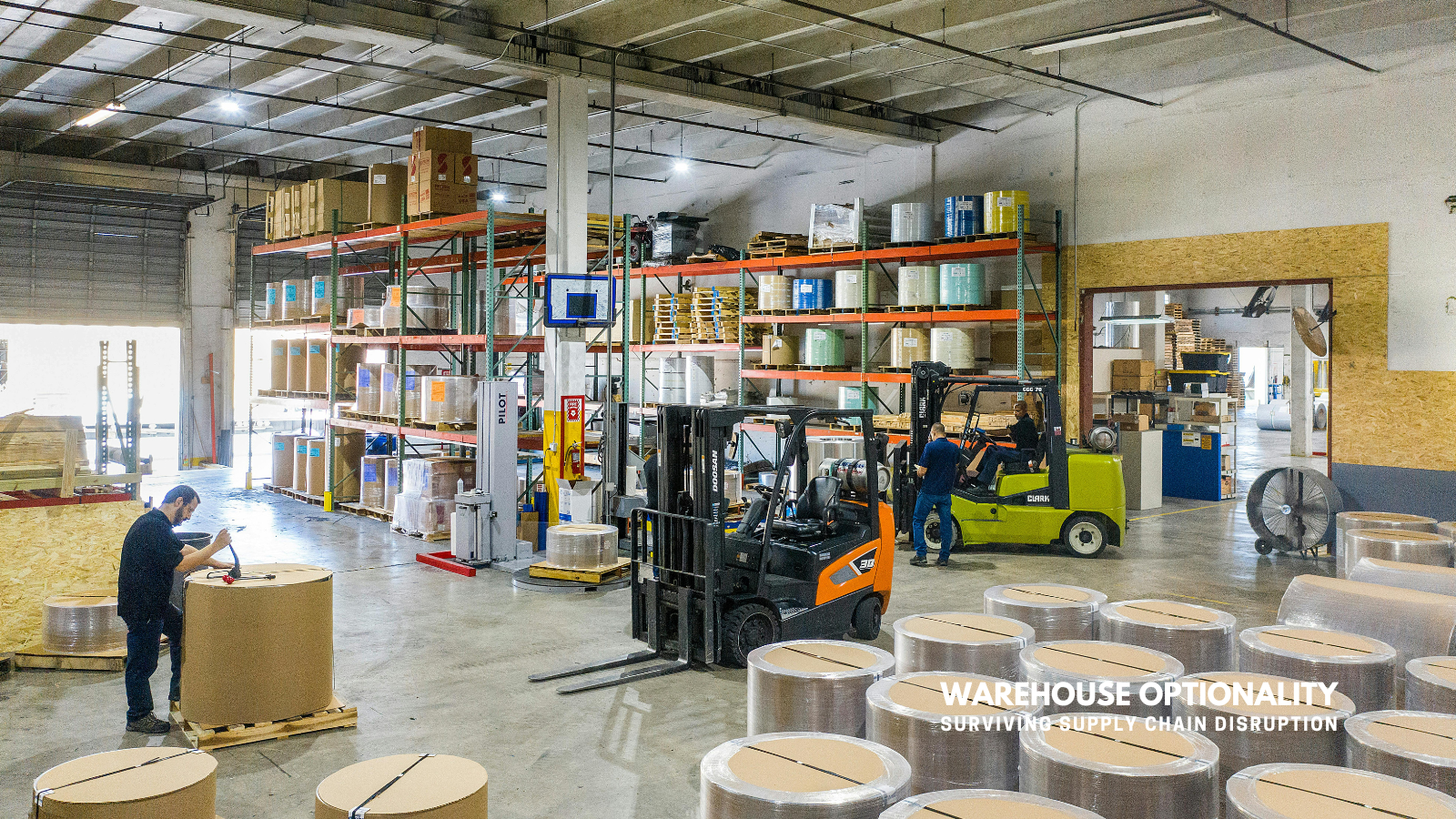
Warehouse optionality is the strategic application of financial “real options” theory to physical supply chain infrastructure, providing organizations with pre-negotiated, flexible pathways for storage and distribution to absorb market volatility. By treating warehousing as a dynamic capability rather than a fixed asset, supply chains can proactively adapt to disruptions rather than reacting with costly emergency measures.
What Are the Key Takeaways?
- Fixed Networks Are Vulnerable: Supply chains engineered exclusively for low-cost efficiency under stable conditions lack the agility to manage modern, recurring disruptions.
- The “Core and Flex” Transition: Leading organizations are adopting real estate models that utilize a baseline of fixed “core” assets, supplemented by variable “flex” capacity that scales according to demand.
- Pre-Disruption Execution: Building optionality through cross-docking, short-term overflow, and project-based warehousing must be secured structurally before crises occur.
- Favorable Real Estate Dynamics: With national industrial vacancy rates reaching cyclical highs of over 7% in 2025 and 2026, the current market provides optimal leverage for tenants to secure flexible capacity terms.
What Is the Strategic Flaw in Fixed Warehouse Networks?
For decades, standard supply chain design prioritized ultra-efficient, lean operations. Organizations carefully planned transportation routes, diversified sourcing geographies, and calculated exact inventory buffers. However, warehouse capacity was traditionally treated as a rigid, long-term fixed asset. The underlying structural vulnerability of this approach is that supply chains engineered to be inexpensive and efficient for stable conditions fundamentally lack the flexibility needed when operations become volatile.
The consequences of rigid, fragmented operations become immediately apparent during macro-level disruptions, such as sudden tariff implementations, port strikes, or geopolitical conflicts. When capacity is fixed, disconnected systems slow communication, complicate decision-making, and force logistics teams to rely on manual workarounds to keep goods moving. Reliance on reactive measures, such as frantically searching for overflow storage only after a container ship is rerouted, exponentially increases the financial impact of disruptions and damages customer trust.
Consequently, the logistics sector is undergoing a structural reset. The operational paradigm has shifted from avoiding disruption to practicing “managed volatility,” where agility, rather than pure scale, has emerged as the defining competitive advantage. The organizations positioned to succeed are those fundamentally redesigning how they operate, integrating resilience and adaptability into the core of their network architecture.
Did You Know?
The transition toward managed volatility is physically reshaping capital allocation. While massive, capacity-hungry sectors like pharmaceuticals are still building end-to-end fixed infrastructure, consumer brands and retailers are actively rationalizing legacy nodes in favor of multi-use, flexible facilities that can adapt to rapid market changes.
How Do We Define Warehouse Optionality?
In financial terms, a “real option” provides the right-but not the obligation-to undertake a specific business decision in the future. Applied to supply chain risk management, warehouse optionality refers to proactively structuring a fulfillment network so that an organization possesses multiple predefined pathways to store, process, and distribute inventory when conditions deviate from forecasts.
This concept is most frequently executed through a “Core and Flex” warehousing strategy. Originally pioneered in asset-intensive industries and corporate real estate to manage economic cycles, the core-and-flex model separates capacity into two distinct categories.
| Asset Type | Primary Function | Contractual Structure | Operational Focus |
| Core Capacity | Fulfills the baseline, predictable demand at the bottom of an economic cycle or seasonal trough. | Long-term leases (5-10 years) or owned facilities. | Maximum efficiency, heavy automation, and cost minimization per unit. |
| Flex Capacity | Absorbs demand spikes, seasonal peaks, and unexpected supply chain disruptions. | Short-term leases, 3PL agreements, on-demand warehousing, or project-based terms. | Agility, rapid deployment, risk mitigation, and geographical fluidity. |
Setting up a demand-based footprint allows an organization to remain profitable at different volume levels. Predefined asset scenarios help operators pivot seamlessly between core and flex configurations without the operational paralysis that typically accompanies sudden crises.
What Are the Core Strategies for Building Flexible Capacity?
Building optionality into a fulfillment network requires moving beyond traditional ten-year mega-warehouse leases. Supply chain executives utilize multiple mechanisms to secure flexible capacity before disruptions manifest.
How Does Short-Term Storage Mitigate Risk?
Inventory is increasingly serving as the primary line of defense against uncertainty. Companies are actively using buffer stock as a shock absorber against tariffs, labor strikes, and demand fluctuations. To support this without overcommitting capital to real estate, logistics planners utilize short-term overflow capacity. By pre-negotiating terms with third-party logistics (3PL) providers or utilizing on-demand warehousing marketplaces, organizations secure the right to drop inventory into temporary facilities for three to six months. This prevents main distribution centers from becoming gridlocked by nonproductive SKUs, ensuring that high-velocity goods continue to move efficiently.
Why Use Cross-Docking and Transloading?
Cross-docking is a specialized warehouse process where freight is transferred directly from inbound transportation to outbound transportation with little or no storage time in between. Goods are unloaded, sorted, and reloaded, often within 24 hours. Transloading operates similarly but focuses on moving goods between different modes of transport, such as from ocean containers to domestic full truckloads.
Integrating cross-docking into a logistics network reduces the reliance on long-term warehouse space, lowers labor costs associated with picking and packing, and drastically accelerates the speed of the supply chain. When a primary warehouse experiences a localized disruption-such as a power outage or a cyberattack-cross-docking facilities provide an immediate release valve to keep inventory flowing directly to end-users.
What Is the Role of Regional Distribution Points?
Relying on a single, centralized fulfillment center creates a critical single point of failure. Modern retail logistics face growing demands for flexible delivery, with shoppers expecting fast, reliable options. To adapt, supply chains are transitioning toward hub-and-spoke models, placing regional distribution points closer to population centers. By keeping a smaller footprint of inventory distributed across multiple geographies, an organization maintains a seamless transition capability if one specific region is heavily affected by localized disruptions, weather events, or carrier embargoes.
When Is Project-Based Warehousing Effective?
Not all disruptions are entirely unforeseen. Tariff implementations, geopolitical realignments, and major global holidays, such as the Chinese New Year, create massive, predictable waves in supply and demand. Project-based warehousing allows companies to spin up dedicated operations for a finite period. For example, importers frequently pull forward significant amounts of inventory in the months preceding the Chinese New Year shutdown to avoid stockouts. Rather than permanently expanding a real estate footprint to accommodate a temporary inventory surge, organizations contract project-based space specifically designed to house and bleed off this seasonal stock.
How Do Robotics and Automation Enable Fluidity?
While physical space is critical, operational capacity within that space is equally important. Warehouses are adopting autonomous mobile robots (AMRs), robotic picking arms, and AI-driven software to create internal operational agility. Unlike bolted-down legacy conveyor systems, AMRs can be easily scaled, reprogrammed, or physically moved to different facilities as demand shifts. This technology eliminates long pick paths and congestion, allowing a facility to flex its internal throughput capacity significantly without requiring additional human labor.
Pro Tip:
When negotiating with 3PLs or industrial landlords, supply chain leaders should embed optionality clauses directly into the contract. Establishing predefined rates for short-term overflow pallets or securing the right of first refusal on adjacent empty warehouse suites prevents predatory pricing during regional logistics crises.
How Do Real Estate Market Dynamics Impact Flexible Capacity?
The ability to successfully implement a core and flex strategy relies heavily on macro industrial real estate conditions. Following a historic surge in construction driven by the pandemic-era e-commerce boom, the U.S. industrial real estate market entered a period of structural rebalancing in 2025 and 2026. The unprecedented wave of new deliveries temporarily outpaced demand, pushing national warehouse vacancy rates from a record low of under 4% in 2022 to roughly 7.4% by mid-2025.
This macroeconomic shift transferred bargaining power back to occupiers, presenting a rare opportunity to build optionality into supply chains at favorable terms. Big-box logistics facilities (properties over 200,000 square feet) experienced the sharpest slackening, reaching vacancy rates above 10% in some Western U.S. markets by 2026.
| Major Logistics Market | Q2 2026 Vacancy Rate | Asking Rent (NNN) | Market Insight |
| Los Angeles, CA | 4.2% | $15.83 / SF | Remains exceptionally tight due to port proximity and land constraints, requiring advanced planning for flex space. |
| Dallas-Fort Worth, TX | 8.1% | $9.19 / SF | Serves as the national leader in leasing volume; provides a healthy balance of supply and demand for regional hubs. |
| Phoenix, AZ | 10.8% | $13.41 / SF | Exhibits high vacancy driven by massive speculative construction waves, offering strong tenant leverage. |
| Chicago, IL | 4.8% | $7.55 / SF | Demonstrates steady performance at the nation’s primary freight and rail crossroads, keeping flex capacity at a premium. |
| Reno, NV | 13.0% | N/A | Has reached a cyclical peak in vacancy; highly favorable for tenants seeking regional overflow space. |
As construction pipelines contract sharply throughout 2026, this window of elevated vacancy provides logistics operators the ideal leverage to secure short-term leases, demand flexible break clauses, and execute core-and-flex strategies before the market tightens again in subsequent years.
What Are the Conclusions for Supply Chain Leaders?
The era of hyper-optimized, rigid supply chains has passed, replaced by an environment where managed volatility is the standard operating condition. Treating warehouse capacity as an inflexible constraint forces organizations into reactive, high-cost mitigation efforts when macro-level shocks occur. Conversely, by embracing warehouse optionality – through core and flex modeling, cross-docking, and the strategic deployment of regional distribution points – organizations can build highly resilient networks. Securing this flexible capacity before disruptions hit ensures that a supply chain remains a reliable engine for growth and customer satisfaction, rather than a structural vulnerability waiting to be exposed.
People Also Ask
What is warehouse optionality?
Warehouse optionality is a supply chain risk management strategy where organizations proactively design logistics networks with multiple, flexible pathways for storage and distribution. It allows companies to scale capacity up or down rapidly in response to market volatility, disruptions, or seasonal demand without being tied exclusively to rigid, long-term real estate contracts.
What is the “core and flex” warehouse strategy?
The core and flex strategy divides a company’s real estate footprint into two parts. The “core” consists of long-term leased or owned facilities that handle baseline, predictable volume with maximum efficiency. The “flex” capacity utilizes short-term leases, 3PLs, or on-demand warehousing to absorb temporary volume spikes, preventing the core network from becoming overwhelmed.
How does cross-docking improve supply chain resilience?
Cross-docking improves resilience by allowing freight to be transferred directly from inbound to outbound transportation with minimal or no storage time. This bypasses the need for large warehouse space, reduces inventory holding costs, and provides an alternative routing method to keep goods moving swiftly if traditional distribution centers face localized disruptions.
Why is flexible warehouse capacity important during supply chain disruptions?
During events like port strikes, geopolitical conflicts, or sudden tariff changes, inventory flow is often delayed or violently accelerated. Flexible warehouse capacity acts as a shock absorber, providing immediate physical space to divert rerouted cargo or hold buffer stock without shutting down operations or paying exorbitant spot-market storage rates.
What role does regional distribution play in risk management?
Regional distribution replaces the vulnerable single-point-of-failure model of a massive centralized warehouse. By utilizing a hub-and-spoke model with inventory dispersed across multiple geographies, a supply chain can continue fulfilling orders from unaffected regions even if one specific facility experiences a weather emergency or power outage.
How is flexible warehousing different from overflow warehousing?
Overflow warehousing primarily adds temporary storage when an existing facility lacks capacity. Flexible warehousing is broader and may include overflow storage, cross-docking, regional distribution, temporary handling, and project-based facilities
Author Bio:
This article was authored by Roqhaiyeh Eghbali, a Digital Marketing and content creator Specialist at OLIMP Warehousing. OLIMP Warehousing provides innovative warehousing and logistics solutions, helping businesses streamline their operations and improve efficiency.
Alt text:
Modern logistics yard with multiple U.S. trucks at warehouse docks, showing flexible warehouse capacity, active freight movement, and regional distribution operations.







Comment