AI video generation is moving from one-off demonstrations into repeatable creative workflows — ad variants, product explainers, social clips, and internal training footage. The more consequential shift is not only higher visual quality, but greater control over the references and constraints that shape each generation.
Alibaba’s Wan 3.0 Video is one of the newest models pushing that shift, with longer video generation and richer multimodal reference inputs. Alibaba currently describes Wan 3.0 as being in public beta, but APIXO users can already explore the model in the platform’s browser-based Playground on apixo.ai or integrate the Wan 3.0 Video API into websites, applications, and AI agents. APIXO’s published pricing starts at $0.07 per second.
What Wan 3.0 Video Actually Changes
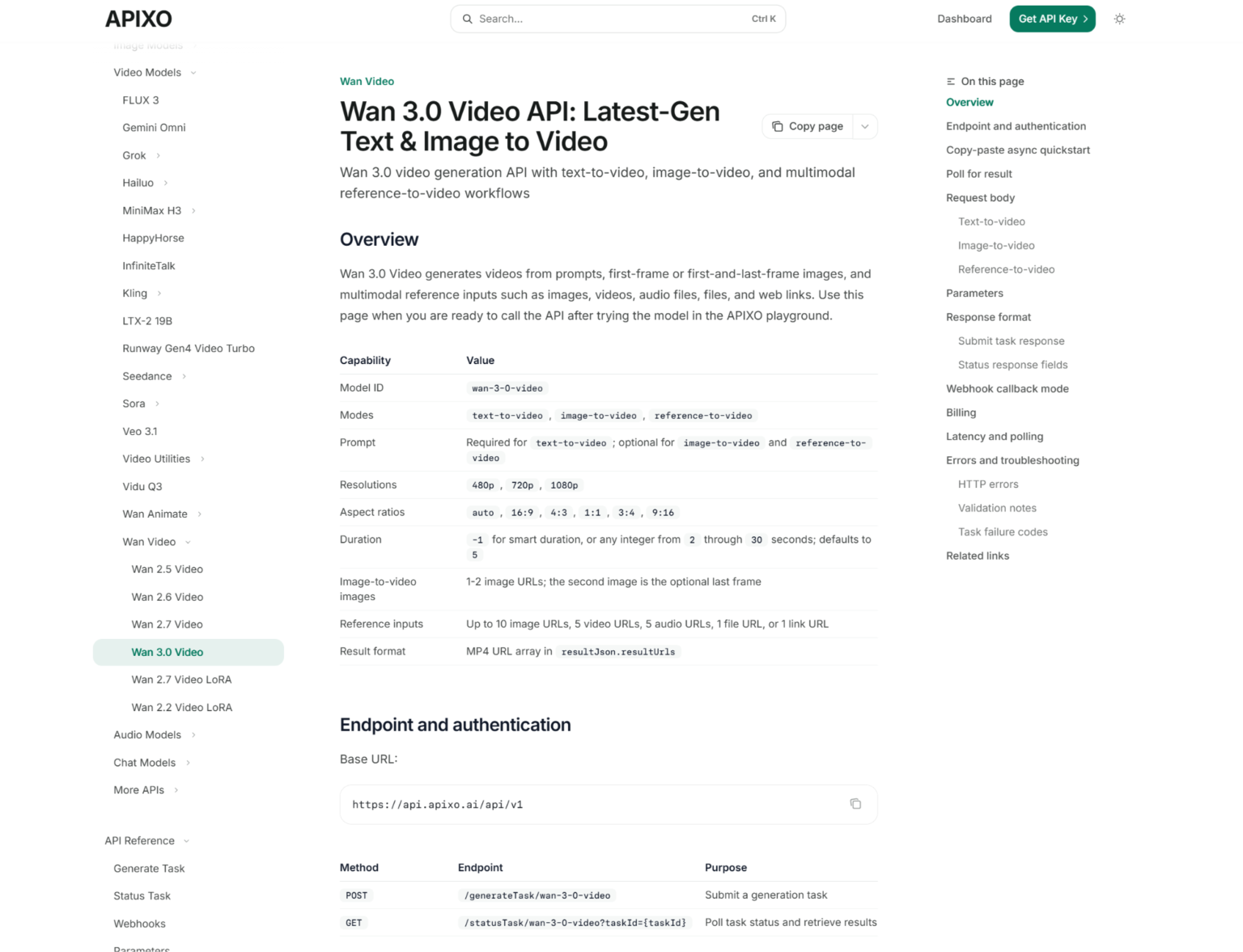
The headline improvement is not just raw fidelity — it is control. APIXO’s current Wan 3.0 Video integration exposes three generation modes: text-to-video, image-to-video, and reference-to-video. The reference workflow is especially useful when a production brief cannot be expressed reliably through a prompt alone.
Five reference channels instead of one prompt
In reference-to-video mode, APIXO accepts image, video, and audio references, plus either one publicly accessible file URL or one web link. Images, video clips, and audio can contribute to the same creative brief, but the file and link options are mutually exclusive and cannot be submitted together. The current APIXO schema supports up to ten image URLs, up to five reference-video URLs of 1–15 seconds each with no more than 15 reference-video seconds in total, and up to five audio URLs per request.
First-and-last-frame control
In image-to-video mode, APIXO lets you provide a starting frame and, optionally, an ending frame — useful when a clip needs to move between two known visual states. Reference-to-video mode accepts more images, giving the model clearer subject, composition, and visual-direction cues across a sequence.
Audio references without a separate input fee
On APIXO, audio references can provide timing, tone, rhythm, or voice cues without adding a separate audio-input charge. That makes them practical to include during iterative reference-to-video testing, especially when sound is part of the creative brief rather than an afterthought.
Smart duration
Set duration to -1 and Wan determines the output length within the available duration budget, or choose any whole number from 2 to 30 seconds for a controlled pass. In reference-to-video mode, total reference-video seconds count toward the 30-second combined limit, so smart duration uses only the remaining allowance. For example, five seconds of reference video leave up to 25 seconds for the generated output. Smart duration is useful during exploration; a fixed duration is better suited to predictable production batches and cost estimates.
Resolution that scales with the job
APIXO currently exposes 480p, 720p, and 1080p output. Not every deliverable needs 1080p, so teams can use a lower resolution for drafts or high-volume social variations before moving selected concepts to a higher-resolution pass.
Where Reference-to-Video Adds More Control
There is a ceiling to what a sentence can specify. Tell a model “a person walks through a sunlit market, then sits at a cafe,” and the result may be plausible but generic. Add a starting frame for the subject, a short clip that demonstrates the desired lighting or motion, and an audio sample for atmosphere, and the model receives concrete creative constraints instead of relying entirely on prompt interpretation.
Reference inputs do not guarantee perfect consistency, but they can reduce prompt-only iterations and give creators more direct control over subjects, visual direction, timing, and tone. For teams producing content at volume, that can make the difference between repeatedly describing an idea and supplying the assets that already define it.
Using Wan 3.0 in the Browser or Through an API
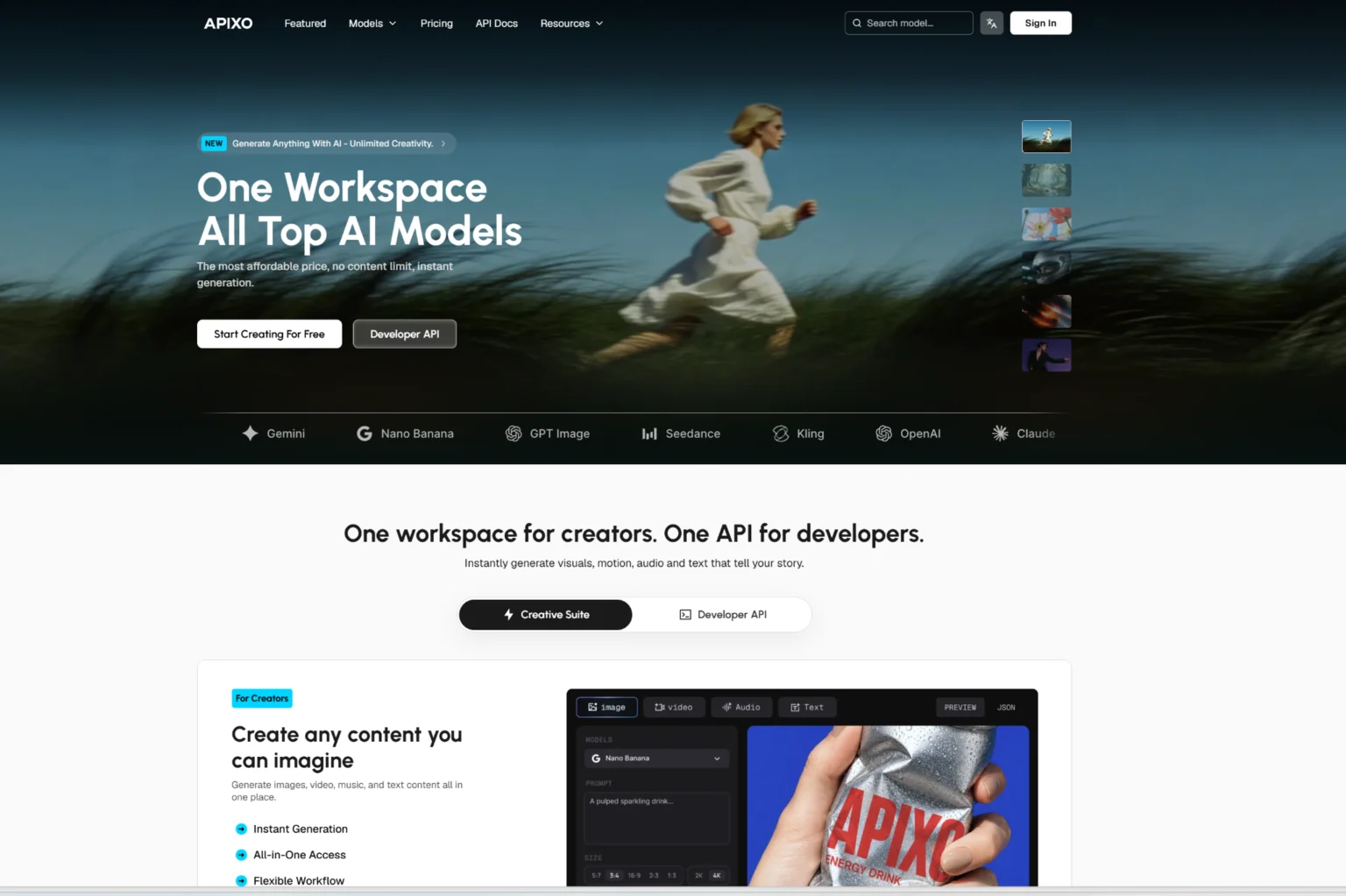
Creators who do not need to build an integration can use the APIXO Playground directly on apixo.ai to choose a generation mode, enter a prompt, set resolution and duration, configure sound, add reference assets where supported, and generate from the model page.
For developers and agent teams, APIXO provides a documented asynchronous task API that can be connected to websites, applications, backend services, and AI agents. The platform uses a shared account, API key, and billing balance across multiple model categories. Its task lifecycle is broadly consistent across image, video, and audio generation, although model-specific fields, limits, and supported modes still vary.
Where multiple upstream routes are available, platform routing and failover can reduce provider-management overhead. That does not make every model a drop-in replacement, but it can make a multi-model stack easier to operate without requiring creators or small teams to provision and maintain their own GPU infrastructure.
The Pricing Reality
APIXO bills Wan 3.0 Video per generated second, with the rate increasing by resolution. Text-to-video, image-to-video, and reference-to-video use the same published per-second rate matrix:
| Mode | Resolution | Price / second |
| Text to video | 480p | $0.07 |
| Text to video | 720p | $0.12 |
| Text to video | 1080p | $0.225 |
| Image to video | 480p | $0.07 |
| Image to video | 720p | $0.12 |
| Image to video | 1080p | $0.225 |
| Reference to video | 480p | $0.07 |
| Reference to video | 720p | $0.12 |
| Reference to video | 1080p | $0.225 |
Reference-video seconds are billed at the same selected rate as output seconds, while image, audio, file, and link inputs do not add separate billable seconds. For a fixed positive duration, requested output seconds plus total reference-video seconds cannot exceed 30 seconds; requests beyond that limit fail validation. With smart duration (-1), APIXO initially reserves an amount based on 30 output seconds plus the submitted reference-video duration. Wan then selects the output length from the portion of the 30-second combined budget that remains after accounting for those reference-video seconds. After a successful generation, final billing is reconciled to the actual output duration plus the reference-video duration, and any unused reserved amount is refunded.
A 10-second 1080p output with no reference video costs $2.25. If the same request also uses five seconds of reference video, it is billed for 15 seconds at $0.225 per second, or $3.375. Sound is enabled by default, while watermarking is disabled by default.
Compared with managing separate subscriptions, balances, and provider accounts, per-second billing makes the cost of each generation easier to estimate. It will not be the cheapest option for every workload, but it keeps experimentation accessible and avoids paying for idle infrastructure.
Who Actually Benefits
Solo creators and editors. The reference toolkit can turn a moodboard, a short sample clip, and an audio reference into a more directed first draft. For frequent publishing, that can reduce the number of prompt-only iterations before a usable concept emerges.
Development and agent teams. API access allows websites, backend services, and multimodal agents to submit generation tasks, poll for results, or use callback delivery. A shared account and task pattern can simplify operations, while each model’s specific schema and constraints remain explicit.
Agencies and brand teams. Reusing subject, product, visual, and audio references can improve consistency across variations and help a team communicate a brief more precisely. Longer or more complex sequences can still drift, so commercial outputs should be reviewed before publication.
AI video generation is moving from experimentation toward repeatable production use. Wan 3.0 Video’s practical contribution is broader reference control: instead of relying only on text, creators and developers can guide a generation with the visual, motion, audio, document, or web context they already have. By making the model available in both its browser-based Playground and API, APIXO gives teams a direct path from interactive testing to product integration.
APIXO users can already access Wan 3.0 Video through the in-browser Playground and API. Pricing, parameters, and availability reflect APIXO’s published pages at the time of writing and may change as the model and service evolve.