
Top OpenRouter Alternatives in 2026: Why Developers Are Comparing AI Gateway Fees

An AI API gateway is a switchboard: your application uses one endpoint, the gateway connects it to a model or provider, and the operational work is consolidated into one place. The category is no longer only about convenience. Teams now compare the fee, the capacity model, the control surface, and the cost of leaving.
The fee question is easy to miss because model prices and platform fees are different things. OpenRouter’s current pricing page lists a 5.5% platform fee for its pay-as-you-go plan while passing through underlying provider pricing without an inference markup. That distinction is the baseline for the calculations below.
Why the fee line matters
| Monthly AI spend | 5.5% platform fee | Cost per year |
| $2,000 | $110 | $1,320 |
| $10,000 | $550 | $6,600 |
| $50,000 | $2,750 | $33,000 |
The arithmetic is simple, but the decision is not. A fee can be reasonable if it buys a feature a team would otherwise build and operate. It becomes expensive when the platform does not solve the reliability, policy, or billing problem that brought the team there in the first place.
The gateway landscape is really four different choices
‘OpenRouter alternative’ can mean different things. The labels below are practical categories for this comparison, not an industry-standard taxonomy.
| Pattern | What you are buying | What you still own | Best fit |
| Hosted multi-provider gateway | One API, model catalog, consolidated billing | Vendor policy, provider availability, account terms | Teams that want speed and breadth |
| Self-hosted proxy | A common interface and routing controls | Deployment, keys, monitoring, scaling, incidents | Teams with platform capacity |
| Platform-layer gateway | Observability, caching, rate limits, retries, fallbacks | Provider accounts and platform integration | Teams already committed to a cloud stack |
| Open-model inference host | Hosted access to a selected open-model catalog | Model fit and portability decisions | Teams whose workloads fit open models |
| Cloud-backed zero-top-up-fee gateway | One key plus a different commercial model | Vendor trust, capacity terms, exit plan | Teams comparing total cost and capacity |
LiteLLM’s official documentation is a useful reference for the self-hosted option: it describes a unified OpenAI-format interface, routing and fallback logic, and a proxy that the customer operates. That is not ‘free’ in the business sense; the software fee may be zero while engineering time, hosting, and incident responsibility remain yours.
Where MixRoute fits
MixRoute sits in the last category. Its pricing page lists 250+ AI models, an OpenAI-compatible API, 0% markup, and no top-up fee on its regular plans. It is a different economic model from a platform that takes a percentage of credit purchases. Smart Routing is an optional feature with a separate 5% service fee on routed requests after its launch window, so a fair comparison keeps regular access and routing fees separate.
Price is only the first filter. For production workloads, the more important questions are how the vendor handles capacity, whether a failure can move to another provider, what data is retained, and whether the application can leave without a large rewrite.
On capacity, MixRoute’s Reserved AI Capacity description says it pre-commits throughput with upstream providers and pools demand across regions. That is a vendor claim that should be tested against the endpoints and traffic profile that matter to you. It is not a reason to assume every gateway has the same reliability profile.
Five questions to ask any vendor
| What to ask | Why it decides the choice |
| What percentage do you take above provider pricing? | A small fee compounds as spend grows. |
| Is traffic best-effort or reserved? | It determines how the system behaves when demand peaks. |
| What happens when a provider has an outage? | Fallback behavior can decide whether your product keeps serving requests. |
| Do you store prompts, responses, or only operational metadata? | The gateway sits in the path of sensitive application traffic. |
| How long would it take to switch away? | OpenAI-compatible interfaces reduce migration work, but policy and data dependencies can remain. |
A credible comparison separates verified platform facts from vendor promises. Pricing pages can confirm fees. Documentation can confirm interfaces and controls. Reliability claims need a workload test, and security claims need the actual retention and access policy rather than a reassuring adjective.
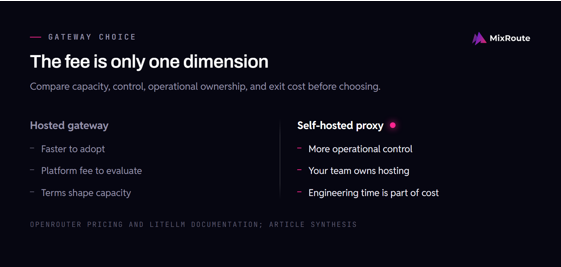
Figure: Hosted gateways and self-hosted proxies trade adoption speed, control, capacity terms, and operating responsibility differently.
Trying an alternative without committing
The fastest comparison is a controlled migration of one non-critical workload. Keep the model, prompt, token limits, and success criteria fixed. Change only the endpoint and key, then compare cost, error rate, latency, and output quality. That creates evidence a generic comparison table cannot.
There is no universal cheapest OpenRouter alternative. Self-hosting may remove a platform fee while adding operations. An open-model host may win on a specific workload while not offering the model family you need. A cloud-backed gateway may make sense when the fee structure and capacity contract solve a problem that software alone cannot.
Common questions
Which OpenRouter alternative is cheapest? It depends on what you count. Compare provider pricing, platform fees, engineering time, capacity, and the cost of a failed request instead of comparing one percentage in isolation.
Is a gateway slower than calling a provider directly? It adds a network hop. A gateway that also classifies or auto-routes requests adds more work. Direct calls remain the cleanest latency baseline, while a gateway may earn its place through control, billing, or capacity.
Can I keep using an OpenAI-compatible SDK? Often yes, but check the target gateway’s supported endpoints, streaming behavior, tool calling, and model naming before treating a base-URL change as a complete migration plan.
What happens to unused credit? This is vendor-specific. Read the current terms before depositing a large balance, and test the refund and expiry rules with a small amount first.







Comment