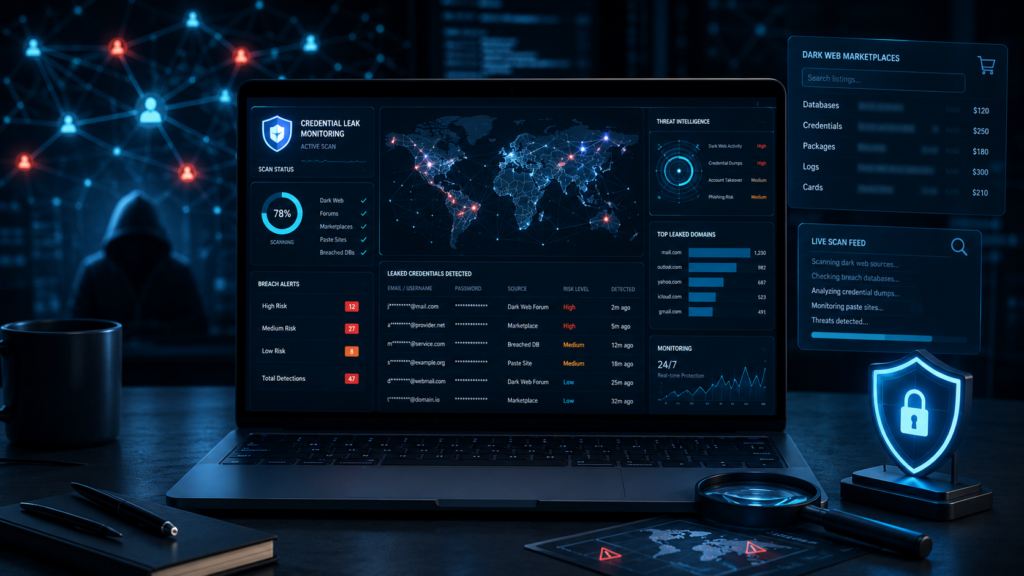
A stolen password is the quietest way into an organization. There is no exploit, no malware execution, no alarm. An attacker simply logs in with credentials someone else already harvested.
Verizon’s 2025 Data Breach Investigations Report found that credential abuse remains a leading way attackers get in, appearing in 22% of breaches. Stolen credentials were involved in 88% of basic web application attacks. CloudSEK’s Quarterly IAV Roundup, drawn from more than 300 incident investigations, describes the same pattern from the supply side: stolen credentials and access marketplaces fuel the initial-access economy, with brokers packaging and reselling logins at scale.
The credentials that end up for sale are circulating before anyone inside the organization knows. Detecting them early, in the window between exposure and exploitation, is what credential leak detection tools are built for. This guide compares seven of them.
How a Leaked Credential Becomes a Breach
Understanding the path a credential travels explains what these tools need to catch and when.
- Harvesting. Infostealer malware on an employee’s or contractor’s device copies saved browser passwords, session cookies, and tokens, or a phishing page captures them directly.
- Market. The credentials are bundled into combolists, posted on criminal forums and Telegram channels, or sold on dark web marketplaces, within days of theft.
- Weaponization. An attacker or broker uses the credentials for account takeover, business email compromise, or as an initial access vector chained into a full intrusion.
Detection at the market stage, while the credential circulates but before it is used, is where a leak tool earns its value.
What to Look For in a Credential Leak Detection Tool
The tools below vary on a few dimensions that decide how useful they are in practice.
- Source breadth. Coverage spans dark web markets, criminal forums, paste sites, Telegram channels, and infostealer malware logs, where fresh credentials appear first.
- Freshness and noise control. A tool that surfaces credentials within days of theft and filters out stale, already-public leaks lets teams act on exposures that still matter.
- Remediation. Effective tools do more than alert. They enable a password reset, a session invalidation, or a takedown of the exposed data.
- Prioritization. Ranking exposures by exploitability and covering executives and VIPs whose personal accounts fall outside corporate controls keeps analysts focused.
7 Tools for Detecting Dark Web Credential
1. CloudSEK XVigil
CloudSEK XVigil is an AI-native digital risk protection platform built for security teams that need to catch leaked credentials on the dark web before attackers turn them into access.
XVigil continuously monitors the deep, dark, and surface web, including criminal forums, paste sites, leaked-data marketplaces, and encrypted channels, for an organization’s exposed credentials, code, and data. It prioritizes findings by exploitability and attacker intent, so teams work on the credentials most likely to open a path in, and it provides end-to-end takedown support to pull exposed assets out of circulation. CloudSEK Threat Intelligence adds context on the infostealer or campaign behind an exposure, and Nexus AI correlates a leaked credential into the wider attack path it could feed.
What it detects: leaked credentials, exposed code and secrets, and data across deep, dark, and surface web sources, prioritized by exploitability and attacker intent.
2. Recorded Future
Recorded Future’s Identity Intelligence module is built specifically around compromised credentials.
It monitors credentials across the dark web, paste sites, Telegram, and infostealer malware logs sourced from more than 30 malware families, and filters out stale leaks so teams focus on fresh, usable exposures. Each detection carries context such as malware family and host details, and the module integrates with IAM and SOAR tools to automate password resets and MFA challenges when a credential surfaces.
What it detects: employee, customer, and executive credentials from infostealer logs and credential marketplaces, enriched with malware and host context.
3. Flashpoint
Flashpoint draws on a deep primary-source collection to monitor for compromised credentials.
It indexes billions of stealer logs and exposed account pairs from dark web marketplaces, illicit communities, and Telegram channels, and parses many infostealer logs within one to two days of infection. It flags stolen session cookies that attackers use to bypass MFA, so teams can invalidate the session before it is abused.
What it detects: compromised employee and customer credentials and active session cookies from infostealer logs and breach data.
4. CrowdStrike (Falcon Adversary Intelligence Recon)
Falcon Adversary Intelligence Recon is CrowdStrike’s digital risk protection feature.
It monitors the open, deep, and dark web, criminal forums, and encrypted channels for exposed credentials and data leaks. When exposed passwords surface, it can integrate with Falcon Identity Protection to force resets automatically, rendering the credentials useless to an attacker, and its Recon+ managed tier adds analyst triage and takedowns.
What it detects: compromised credentials and data leaks across the criminal underground, with automated reset for Falcon customers.
5. Group-IB
Group-IB pairs Digital Risk Protection with Threat Intelligence built on one of the largest dark web data libraries in the industry.
It detects stolen credentials, including executives’ personal accounts, from infostealer logs, breached databases, and combolists traded across forums and marketplaces. Detected passwords are masked to protect the user, and CERT-GIB handles takedowns of the infrastructure behind the leaks.
What it detects: compromised corporate and executive credentials from dark web markets, forums, and infostealer logs.
6. Cyberint (Check Point External Risk Management)
Cyberint, now delivered as Check Point External Risk Management on the Argos platform, combines dark web monitoring with digital risk protection.
It detects compromised credentials and leaked data across dark web forums and marketplaces, and its integration with the Check Point ecosystem can automatically reset exposed employee credentials once a leak is confirmed, with managed services available.
What it detects: compromised credentials and leaked data across dark web forums and marketplaces, with automated reset via Check Point.
7. Digital Shadows (ReliaQuest GreyMatter DRP)
Digital Shadows, now delivered through ReliaQuest’s GreyMatter DRP, monitors the open, deep, and dark web for credential compromise.
It checks findings against a repository of more than 15 billion breached credentials to show whether an exposed login is still exploitable, correlates leaked passwords with internal asset data for context, and offers a managed takedown service. It fits teams that want dark web monitoring wrapped into a managed security operations service.
What it detects: exposed credentials and accounts for sale, checked against a large breached-credential database, and correlated with internal assets.
Coverage at a Glance
| Tool | Sources monitored | Credential focus | Action on a find | Best fit |
| CloudSEK XVigil | Deep, dark, surface web, forums, paste sites, marketplaces | Org-specific leaked credentials, code, and data | Prioritization by intent, end-to-end takedown, attack-path context via Nexus AI | Teams wanting DRP plus takedowns and attack-path context |
| Recorded Future | Dark web, paste sites, Telegram, infostealer logs (30+ malware families) | Employee, customer, and executive credentials | Automated reset and MFA via IAM and SOAR | Teams wanting infostealer-log depth and auto-remediation |
| Flashpoint | Dark web markets, illicit communities, Telegram | Credentials and session cookies from stealer logs | Session invalidation, reset workflows | Teams wanting stealer-log scale and cookie detection |
| CrowdStrike | Open, deep, dark web forums, encrypted channels | Compromised credentials and data leaks | Automated reset via Falcon Identity Protection, managed takedowns | Organizations in the Falcon ecosystem |
| Group-IB | Large dark web library, forums, infostealer logs, breached DBs | Corporate and executive credentials | Masked passwords, CERT-GIB takedowns | Teams wanting broad dark web coverage and exec monitoring |
| Cyberint (Check Point) | Dark web forums and marketplaces | Compromised credentials and leaked data | Automated reset via Check Point, managed services | Teams in the Check Point ecosystem |
| Digital Shadows (ReliaQuest) | Open, deep, dark web, code, and file-sharing sites | Exposed credentials and accounts for sale | Checked against 15B+ breached records, managed takedowns | Teams wanting managed SOC-delivered monitoring |
How to Choose
Match the tool to how the team works.
CloudSEK XVigil is the strongest fit for broad digital risk protection with takedowns and the ability to see which leaked credentials sit on a real attack path. Recorded Future leads on depth of infostealer-log coverage and automated resets, while Flashpoint stands out for stealer-log scale and session-cookie detection. Teams already running Falcon or Check Point get tight remediation loops from CrowdStrike and Cyberint. Group-IB suits teams that want one of the largest dark web libraries plus executive account coverage, and Digital Shadows fits those that want monitoring delivered as a managed service, checked against a large breached-credential database.
The deciding question is not who detects a leak, since all seven do, but what happens next. A tool that turns a detection into a reset, a session kill, or a takedown closes the window an attacker needs. A tool that only alerts leaves that work to the team.
Frequently Asked Questions
What is an infostealer?
An infostealer is malware that copies saved passwords, session cookies, and tokens from an infected device and sends them to an attacker. The stolen data is then sold or shared on dark web markets, forums, and Telegram channels.
How quickly do stolen credentials appear on the dark web?
Stolen credentials reach dark web markets, forums, and Telegram channels within days of theft. Infostealer logs are parsed and resold quickly, which is why early detection matters in the window before the credentials are used.
Are stolen session cookies as dangerous as passwords?
Yes. Stolen session cookies let an attacker resume an authenticated session and bypass multi-factor authentication, so they are as dangerous as passwords. Invalidating the session ends the attacker’s access.
What is dark web monitoring for credentials?
Dark web monitoring for credentials is the continuous, automated search of dark and deep web sources for an organization’s exposed login credentials. Search engines do not index these sources, so security teams use dedicated platforms to collect, filter, and prioritize exposures.
Can leaked credentials be removed from the dark web?
No. Leaked credentials can rarely be removed once circulating on the dark web. The practical response is to neutralize the exposure: reset the password, invalidate sessions, enforce MFA, and request a takedown where possible.
What is an initial access vector?
An initial access vector is the entry point an attacker uses to gain a first foothold in an organization. Leaked credentials are one of the most common, letting an attacker log in rather than exploit a vulnerability.