Bitcoin mining has undergone a dramatic transformation over the past decade. What once started as a hobbyist activity, where enthusiasts could run mining software on a personal computer, has matured into a sophisticated global industry powered by specialized hardware, industrial-scale infrastructure, and carefully engineered operational strategies. In bitcoin mining 2026, the landscape is far more competitive, and profitability depends less on luck and far more on efficiency, cost control, and long-term planning.
Modern mining is no longer about simply purchasing a machine and plugging it into a wall outlet. Successful miners now evaluate a broad set of operational variables before deploying capital. These include ASIC efficiency, electricity pricing, hosting environments, network difficulty trends, and hardware uptime. Each of these factors interacts with the others, meaning that small inefficiencies can compound quickly and erode profitability over time.
As a result, the most successful participants treat mining as a structured financial and infrastructure investment rather than a speculative experiment. Professional miners analyze energy contracts, optimize cooling environments, and monitor machines in real time to maintain consistent performance. Meanwhile, individual investors exploring mining opportunities must increasingly rely on thoughtful strategy rather than simple hardware ownership.
This guide explores the Top Bitcoin Mining Strategies to Maximize Profit in 2026, focusing on the practical decisions that influence mining outcomes today. By understanding how modern operations balance hardware efficiency, electricity costs, and operational reliability, readers can develop a clearer perspective on how profitable bitcoin mining works in the current market environment.
Is Bitcoin Mining Still Profitable in 2026?
The most common question among newcomers is straightforward: Is bitcoin mining still profitable in 2026? The honest answer is yes, but only when miners approach the process strategically and with realistic expectations.
Bitcoin’s economic design intentionally increases competition over time. Approximately every four years, a protocol event known as the halving reduces the block reward miners receive for validating transactions. This mechanism slows the creation of new Bitcoin and strengthens the asset’s scarcity, but it also means miners must operate more efficiently with each cycle.
Following the most recent halving event, block rewards declined again, putting additional pressure on mining operations to optimize costs and performance. While mining revenue still exists, inefficient setups are quickly pushed out of the market, leaving only the most optimized operations able to remain consistently profitable.
Another factor shaping the 2026 mining environment is network difficulty, which adjusts automatically to maintain Bitcoin’s roughly 10-minute block production schedule. As more powerful hardware joins the network globally, difficulty increases, requiring miners to deploy even more computational power to earn the same share of rewards.
This dynamic has created a clear separation between amateur mining setups and professional-grade operations. Amateur miners often struggle with high residential electricity prices, limited cooling capabilities, and unreliable uptime. In contrast, professional environments are built around efficient energy sourcing, advanced infrastructure, and continuous monitoring systems designed to maximize operational stability.
Ultimately, bitcoin mining in 2026 remains viable, but it rewards those who view it as an engineering and financial discipline rather than a passive activity.
What Determines Bitcoin Mining Profitability?
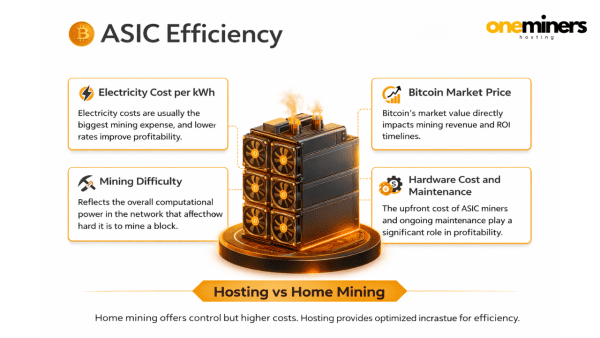
Understanding bitcoin mining profitability requires analyzing several key variables that together determine whether a mining operation generates meaningful returns. Each factor may appear small in isolation, but their combined impact can significantly influence long-term performance.
ASIC Efficiency
The backbone of modern Bitcoin mining is the Application-Specific Integrated Circuit, commonly referred to as an ASIC miner. Unlike general-purpose computer hardware, ASICs are engineered specifically for Bitcoin’s SHA-256 hashing algorithm. This specialization allows them to perform trillions of calculations per second while maintaining relatively optimized energy consumption.
Efficiency is typically measured in joules per terahash, which represents how much energy a machine uses to produce a certain amount of computational power. Lower energy consumption per terahash means the machine can generate more hash power while spending less electricity, directly improving profitability.
Electricity Cost per kWh
Among all operating expenses, bitcoin mining electricity costs are usually the most significant. Even a highly efficient machine can become unprofitable if the electricity powering it is too expensive.
Residential electricity rates in many regions range from moderate to very high, while industrial energy contracts—often used by professional mining facilities—can provide significantly lower pricing. Over months or years of continuous operation, a difference of just a few cents per kilowatt-hour can translate into a large financial gap between two otherwise identical mining setups.
Bitcoin Market Price
Mining revenue ultimately depends on the market value of the Bitcoin produced. When Bitcoin prices rise, mining rewards become more valuable, which can shorten ROI timelines. Conversely, during periods of lower market prices, miners must rely even more heavily on operational efficiency to remain profitable.
Mining Difficulty
Mining difficulty reflects the overall amount of computational power participating in the Bitcoin network. As more miners join, difficulty rises, reducing the share of rewards each individual machine can earn.
This means mining hardware must continuously improve in efficiency and performance to remain competitive in the long term.
Hardware Cost and Maintenance
The upfront purchase price of ASIC miners significantly affects bitcoin miner ROI calculations. Machines with higher efficiency often come at higher prices, but they may still provide better returns if they reduce ongoing energy costs.
In addition to hardware cost, miners must account for maintenance, cooling systems, and replacement components, all of which influence total operating expenses.
Hosting vs Home Mining
Where mining equipment operates can influence nearly every variable mentioned above. Mining at home provides control but often results in higher electricity costs and limited cooling capacity. Professional hosting facilities, on the other hand, offer industrial infrastructure designed specifically for continuous mining operations.
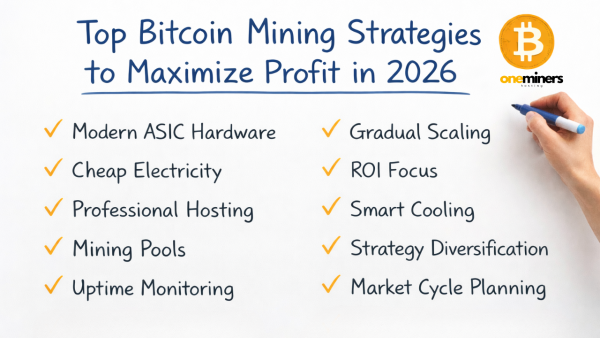
Top Bitcoin Mining Strategies to Maximize Profit in 2026
Success in modern mining rarely comes from a single decision. Instead, it emerges from a combination of strategic choices that optimize performance, cost efficiency, and operational reliability.
Below are some of the most important strategies miners use today.
1. Use Only Modern High-Efficiency ASIC Miners
The pace of technological advancement in mining hardware means older machines quickly become less competitive. Modern ASIC miners deliver significantly higher hash rates while consuming less energy per unit of computational output.
By choosing newer hardware, miners can maintain stronger profitability even as network difficulty rises. Efficient machines also tend to remain viable for longer periods, reducing the need for constant hardware replacement.
2. Secure the Lowest Possible Electricity Costs
Electricity pricing remains one of the most powerful determinants of mining success. Many professional operations actively search for regions with abundant energy supply—such as hydroelectric or geothermal power—because these locations can offer significantly lower rates.
When electricity prices remain low, miners gain a crucial advantage during periods of market volatility. Lower operating costs allow them to continue mining even when less efficient competitors are forced offline.
3. Use Professional Mining Hosting Facilities
Operating ASIC miners at home presents several practical challenges. These machines generate significant heat and produce loud fan noise, making them difficult to run comfortably in residential environments. In addition, residential electricity rates often exceed the energy costs available in industrial environments.
Professional bitcoin mining hosting facilities address these challenges by providing infrastructure specifically designed for large-scale mining operations. These facilities offer industrial power systems, optimized cooling, reliable internet connectivity, and on-site technical support.
Companies such as Oneminers have emerged to simplify this process for individuals interested in mining but who may not want to manage the physical infrastructure themselves. Services like these allow users to access professional hosting environments while maintaining ownership of their hardware.
4. Join Established Mining Pools
Solo mining is technically possible but highly unpredictable. Even powerful machines may go long periods without discovering a block independently.
Mining pools solve this problem by combining the computational power of thousands of participants. When the pool successfully mines a block, rewards are distributed among members according to their contributed hash rate.
This system creates consistent payouts and smoother revenue streams, which makes financial planning easier for miners.
5. Focus on Uptime and Operational Monitoring
Continuous uptime is essential for maximizing mining output. Even short periods of downtime reduce the total amount of Bitcoin a machine can produce over time.
Professional miners rely on monitoring systems that track machine temperature, hash rate performance, and connectivity status in real time. Early detection of issues allows operators to address problems quickly and restore mining operations before significant revenue loss occurs.
6. Scale Mining Operations Gradually
Rapid expansion can introduce significant financial risk, particularly for new miners. Instead of deploying large amounts of capital immediately, experienced operators often scale operations gradually.
By starting with a small number of machines, miners can analyze real-world performance metrics—such as electricity consumption, uptime reliability, and maintenance requirements—before expanding their operations further.
7. Think in Terms of ROI, Not Daily Revenue
Many beginners evaluate mining profitability by looking only at daily earnings. While daily output is important, the more relevant metric is return on investment over time.
Miners must consider hardware cost, electricity expenses, and expected network difficulty changes when calculating their payback period. A machine that produces slightly less daily revenue but consumes far less electricity may ultimately deliver a better ROI.
8. Implement Smart Cooling and Heat Management
Cooling is often an overlooked factor in mining profitability. ASIC miners generate large amounts of heat during operation, and without proper cooling systems, machines may experience reduced efficiency, higher failure rates, or automatic shutdowns.
Professional mining environments typically use advanced airflow systems, immersion cooling, or hydro cooling solutions to maintain optimal temperatures. Efficient cooling not only protects hardware but also allows miners to operate machines at full capacity without performance throttling.
In some cases, excess heat can even be reused productively—for example, heating buildings, greenhouses, or industrial spaces. This approach can further improve overall operational efficiency.
9. Diversify Mining Strategies When Possible
Although Bitcoin mining remains the most established segment of the industry, experienced miners often diversify their strategies to reduce risk and adapt to market changes.
This may include mining different cryptocurrencies with specialized hardware, allocating part of the operation to emerging networks, or switching between coins when profitability conditions shift. Diversification can help miners remain flexible and maintain steady revenue streams during periods of market volatility.
A balanced mining portfolio can provide additional resilience when network difficulty or coin prices fluctuate.
10. Plan for Long-Term Market Cycles
Cryptocurrency markets operate in cycles, and mining profitability naturally follows these broader trends. Periods of strong market growth are often followed by corrections, which can temporarily reduce mining returns.
Successful miners take a long-term perspective. Rather than reacting to short-term price movements, they structure their operations so they can remain profitable across different market conditions.
Maintaining efficient hardware, securing competitive electricity rates, and carefully managing operational costs allows miners to continue operating through market downturns and benefit when the next growth cycle begins.
Home Mining vs Hosted Mining in 2026
The debate between home mining and hosted mining has become increasingly relevant as mining hardware grows more powerful.
Home mining offers certain advantages, such as full hardware control and direct access to machines. However, it also introduces significant challenges including noise, heat generation, and high residential electricity costs.
Hosted mining facilities provide a more structured alternative. These environments offer industrial-grade infrastructure designed specifically for mining operations, allowing machines to operate efficiently under controlled conditions.
For many individuals researching how to mine bitcoin in 2026, hosted environments offer a practical path to participate in mining without managing the physical infrastructure themselves.
The Role of ASIC Miners in Modern Bitcoin Mining
ASIC miners dominate the Bitcoin mining ecosystem because they provide unmatched computational efficiency. Their specialized architecture allows them to perform the SHA-256 hashing process far more effectively than general-purpose hardware.
Selecting the right ASIC miner involves balancing several considerations, including hash rate performance, energy efficiency, purchase cost, and expected operational lifespan.
In a network where difficulty continues to increase, hardware efficiency has become one of the most critical strategic decisions miners can make.
Why Electricity Costs Matter More Than Ever
Electricity is the foundational resource that powers the entire Bitcoin mining ecosystem. Every hash calculation requires energy, meaning electricity costs directly determine whether a mining operation can remain profitable over time.
Consider two identical mining machines operating in different locations. If one miner pays double the electricity price of the other, their profitability profiles may diverge dramatically—even though their hardware and performance are identical.
This is why many mining facilities are built near renewable energy sources or regions with abundant power production. Access to affordable electricity allows miners to maintain competitiveness as network difficulty evolves.
Risk Factors Every Miner Should Understand
Despite its potential, mining carries inherent risks that must be considered carefully.
Bitcoin’s market price can fluctuate significantly, affecting the value of mined coins. Network difficulty may rise faster than expected, reducing mining rewards. Hardware may become obsolete as newer models enter the market. Operational disruptions, such as power outages or equipment failures, can also interrupt mining activity.
For these reasons, mining should be approached as a long-term operational investment with both potential rewards and measurable risks.
What a Smart Bitcoin Mining Operation Looks Like in 2026
A well-designed mining operation in 2026 typically includes several core components working together:
- High-efficiency ASIC miners
- access to low-cost electricity
- professional hosting infrastructure
- reliable mining pool participation
- continuous monitoring systems
- secure Bitcoin payouts
This integrated approach allows miners to maintain consistent performance and adapt to evolving network conditions.
Conclusion: Top Bitcoin Mining Strategies to Maximize Profit in 2026
Bitcoin mining has evolved into a highly competitive and technically sophisticated industry. While opportunities remain, profitability now depends on careful planning, infrastructure quality, and operational efficiency rather than simple hardware ownership.
The Top Bitcoin Mining Strategies to Maximize Profit in 2026 emphasize selecting efficient ASIC miners, securing affordable electricity, maintaining reliable uptime, and participating in well-established mining pools. Miners who approach the process with a long-term strategy and disciplined cost management stand the best chance of achieving sustainable results.
FAQ
Is bitcoin mining profitable in 2026?
Yes, bitcoin mining can still be profitable in 2026 if miners use efficient ASIC hardware, access low electricity costs, and maintain high uptime.
What is the best bitcoin mining strategy today?
The most effective strategy focuses on energy-efficient ASIC miners, low electricity prices, reliable mining pools, and professional hosting infrastructure.
How much electricity does bitcoin mining require?
Electricity consumption varies depending on the ASIC model, but mining operations typically consume significant power, making energy cost a key profitability factor.
Should beginners mine bitcoin at home?
Home mining is possible but often limited by electricity costs, noise, and cooling challenges. Many miners choose hosted mining environments instead.
How long does bitcoin miner ROI take?
ROI timelines depend on hardware price, electricity cost, mining difficulty, and Bitcoin’s market price. Payback periods can vary widely.