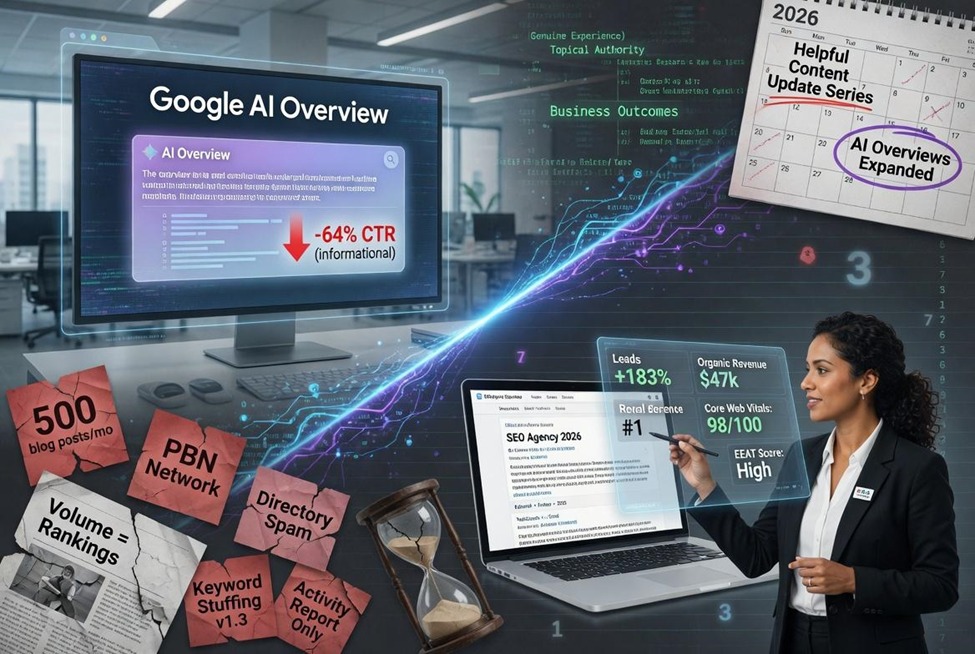
The search engine optimization industry entered 2026 carrying the accumulated weight of four years of disruption. Large language models collapsed the cost of content production. Google’s Helpful Content Update series culled thousands of sites that had built their traffic on volume rather than substance. AI Overviews reshaped the search results page itself, inserting synthesized answers above the organic listings that SEO companies had spent years optimizing for. The operators who survived this compression are running fundamentally different businesses than the ones who entered 2022.
For business owners evaluating whether to hire an SEO company, the landscape has never been more difficult to navigate. The same disruptions that eliminated weak providers also made the remaining ones harder to differentiate. The terminology is the same. The service descriptions look similar. The proposals arrive in the same polished format. But the gap between an SEO company that understands the current environment and one still operating on a 2021 playbook has never been wider, and that gap determines whether the engagement produces compounding returns or expensive inactivity.
What an SEO Company Actually Does Now
The core function has not changed. An SEO company improves a website’s visibility in organic search results. The execution underneath that function, however, has shifted in ways that separate current operators from legacy ones.
Content production remains central, but the standard has risen. Before 2023, an SEO company could publish keyword-targeted articles at volume, build a reasonable backlink profile, and watch rankings accumulate. That approach relied on a content ecosystem where most competing pages were similarly thin. The Helpful Content Updates changed the calculus. Google’s systems now evaluate whether content demonstrates genuine expertise and first-hand experience with the subject matter, whether the site maintains quality consistently across its pages, and whether the content exists primarily to help the reader or primarily to capture search traffic. The evaluation is site-wide, not page-by-page, which means a handful of low-quality pages can suppress the performance of otherwise strong content.
Technical optimization has grown more granular. Core Web Vitals matured from a theoretical ranking signal into a practical differentiator. Page speed, layout stability, and interaction responsiveness are measurable, and the measurement tools are built directly into Google Search Console. An SEO company that cannot diagnose and resolve technical performance issues is missing a layer of optimization that directly affects both rankings and user experience.
Link building survived every prediction of its decline but the quality threshold tightened. The links that move rankings in 2026 come from editorially independent sources with topical relevance to the linked site. Directory submissions, comment spam, private blog networks, and bulk outreach to irrelevant sites produce either nothing or active harm. The SEO companies still building links through these channels are operating on borrowed time, spending client budgets on assets that Google’s systems are increasingly efficient at identifying and discounting.
The SEO Agency Model Under Pressure
The traditional SEO agency model faces structural pressure from multiple directions simultaneously, and the agencies that will dominate the next five years are the ones adapting fastest.
The first pressure point is AI-driven efficiency. Tasks that previously required junior staff hours, keyword research compilation, initial content drafts, technical audit reports, competitive analysis summaries, can now be completed in minutes with AI tools. This compresses the labor component of the retainer model, which forces agencies to either reduce pricing, increase the strategic value of the hours they bill, or both. Agencies that absorbed AI tools into their workflow without rethinking their value proposition are discovering that clients can replicate the AI-assisted portions independently. The defensible value is in the strategic layer: knowing which keywords to target, which content formats to produce, which technical issues to prioritize, and how to sequence the work for maximum impact. That layer requires experience and judgment that AI tools do not yet replicate.
The second pressure point is Google’s own AI Overviews feature. When Google generates a synthesized answer at the top of the search results page, the organic listings below it receive fewer clicks. For informational queries, the click-through rate reduction is substantial. This changes the keyword strategy an SEO agency must build for clients. Pure informational content still has value for building topical authority and earning featured snippet placement, but the commercial return on informational rankings has decreased. The agencies adapting to this shift are focusing more heavily on commercial and transactional keywords where AI Overviews are less prevalent and the searcher’s intent to act is stronger.
The third pressure point is accountability. The tools available to business owners for evaluating SEO performance have improved considerably. Google Search Console provides granular data on impressions, clicks, average position, and indexing status. Third-party rank tracking is inexpensive and accessible. The information asymmetry that once allowed SEO agencies to maintain client relationships on the strength of professional-looking reports rather than measurable outcomes has narrowed. Agencies that produce results retain clients. Agencies that produce activity reports lose them faster than at any point in the industry’s history.
How the Best Operators Differentiate
The SEO companies and agencies that are growing in 2026 share several observable characteristics that distinguish them from providers still operating on legacy models.
They diagnose before they prescribe. The initial engagement begins with an audit that examines the site’s technical health, content gaps, competitive positioning, and backlink profile. The strategy follows from the diagnosis, not from a template. A provider that sends a proposal before examining the site is selling a package, not building a strategy. The distinction is visible in the specificity of the deliverables: “four blog posts per month targeting keywords from the approved strategy” versus “content creation services.”
They demonstrate their own competence through their own organic presence. An SEO company that ranks well for competitive terms in its own market is providing the strongest possible evidence that its methods work. The company’s website, its content depth, its technical implementation, and its backlink profile are all publicly auditable. Business owners evaluating providers can learn more from examining the provider’s own site than from any sales presentation.
They build E-E-A-T into the content they produce rather than treating it as a separate compliance exercise. Experience, Expertise, Authoritativeness, and Trustworthiness are the quality framework Google’s systems are trained to evaluate. Content produced without attention to these signals faces a structural disadvantage that no amount of technical optimization or link building overcomes. The operators who understand this embed author attribution, source citation, transparency infrastructure, and genuine subject matter depth into every piece they produce.
They report on business outcomes rather than activity metrics. Rankings, traffic, and impressions are intermediate metrics. The terminal metrics are leads generated, revenue attributed to organic search, and customer acquisition cost relative to other channels. An SEO company that reports exclusively on rankings and traffic without connecting those numbers to business outcomes is either unable or unwilling to demonstrate the commercial impact of its work.
The Pricing Landscape
SEO pricing in 2026 reflects the bifurcation of the market. The middle tier has compressed. Providers charging $800 to $1,200 per month are squeezed between free AI tools that business owners can use directly and professional-grade agencies delivering measurable ROI at higher price points.
The effective range for small to midsize businesses sits between $1,500 and $5,000 per month. Below that threshold, the math does not support enough skilled labor hours to execute a comprehensive strategy. Above it, the additional investment buys broader scope, not necessarily better execution. Enterprise engagements exceeding $7,500 per month are appropriate for large sites competing nationally or internationally, where the technical complexity, content volume, and competitive intensity justify a team-level resource allocation.
The pricing model itself has shifted toward retainer-based engagements, with approximately 80 percent of agencies structuring their services as monthly retainers rather than project-based or hourly billing. The retainer model aligns with how SEO produces results: incrementally, over months, through sustained execution. Project-based pricing works for bounded deliverables like site audits or migrations. Performance-based pricing remains rare and problematic, incentivizing providers to target easy wins rather than commercially valuable keywords.
The most reliable predictor of whether a given price point will produce results is not the number itself but the ratio of strategic labor hours to monthly fee. A $3,000 retainer that allocates 20 hours of senior-level attention produces fundamentally different outcomes than a $3,000 retainer where 3 hours of actual work are supplemented by automated reporting. Both appear identical on the invoice.
What Business Owners Should Actually Evaluate
The evaluation criteria that matter most are the ones least likely to appear in a sales presentation.
Ask who will work on your account. Not the firm’s capabilities. The specific people. Their experience. Their workload. The strategist who builds the plan should be identifiable, reachable, and accountable. If the sales conversation cannot produce names, the team may be assembled after the contract is signed from whoever is available.
Ask to see links they have built. Not link counts or domain authority averages. Actual URLs. Visit the linking pages. Verify they are real editorial sites with real content. The quality of a provider’s link building is the single best predictor of whether their broader methodology is sound or superficial.
Ask what happens at month six if the strategy is not producing results. This question reveals whether the provider has a diagnostic process for underperformance or whether the default response is “SEO takes time,” which, while true, is insufficient as a strategy for addressing stagnation.
Ask about their content process in the context of AI. Every SEO company uses AI tools in 2026. The question is whether they use AI as a drafting accelerator with genuine editorial oversight and subject matter input, or as a replacement for expertise. The distinction determines whether the content ranks and holds or ranks briefly before being overtaken by competitors whose content demonstrates the depth and originality that AI-assisted drafts alone cannot provide.
The Industry’s Direction
The SEO industry is consolidating around operators who combine technical precision with editorial quality and strategic depth. The era of SEO as a purely technical discipline ended when Google’s systems became sophisticated enough to evaluate content quality at scale. The era of SEO as a content volume play ended when the Helpful Content Updates demonstrated that publishing more was not the same as publishing better.
What remains is the intersection: technically sound sites publishing substantive content on a consistent schedule, earning authentic authority from external sources, and maintaining the transparency infrastructure that supports trust evaluation. The SEO companies and agencies that operate at this intersection are producing results that compound over time, building organic visibility that grows more defensible with every month of sustained execution.
The business owners who will benefit most from SEO in the coming years are the ones who evaluate providers against these operational standards rather than against proposal polish, pricing alone, or promises that no legitimate operator would make. The industry has matured past the point where any provider can guarantee specific outcomes. What the best providers can guarantee is a methodology built on the principles Google rewards and a track record of executing that methodology for businesses with real commercial objectives.
The search landscape will continue evolving. AI Overviews will expand. Algorithm updates will arrive. New ranking signals will emerge. The operators who build on quality fundamentals will adapt to each shift from a position of strength. The ones who built on shortcuts will rebuild from scratch, again, the way they always have.