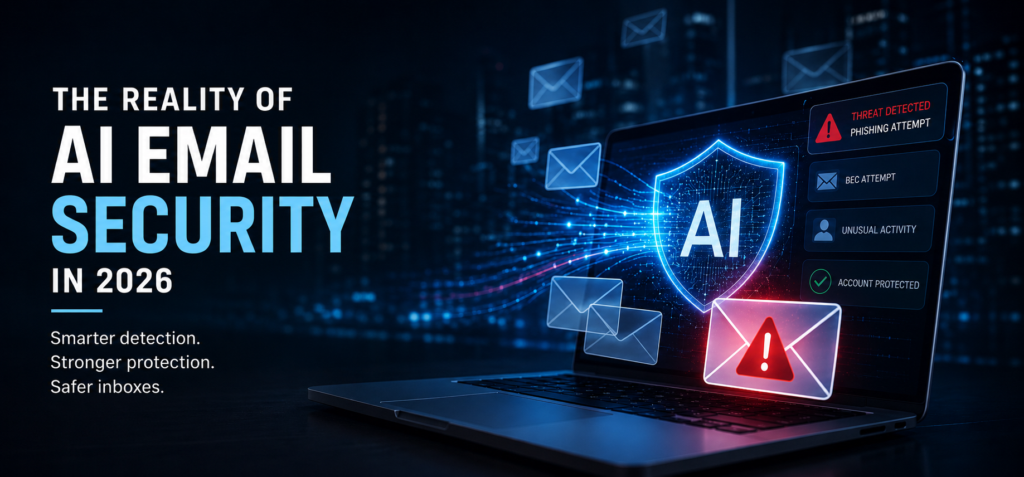
Most email attacks work the same way. Someone receives a message that feels ordinary enough to ignore their instincts. A password reset request. A shared Microsoft 365 document. A note from an executive asking for a quick favor before a meeting.
Nobody stops to analyze those messages because they’re not supposed to be memorable. The best phishing emails blend into everything else sitting in the inbox.
The obvious phishing emails haven’t disappeared. What’s changed is the baseline quality. Messages that once stood out because of broken grammar or strange formatting now look like ordinary business communication. Users lose one of the easiest warning signs they used to rely on.
Why AI Email Security Matters
Most organizations spend significant time patching systems, reviewing firewall policies, and hardening endpoints. Email remains the easiest path to initial access.
In many investigations, the compromise starts with a login page, not malware. Stealing credentials is often easier than developing code or finding a vulnerability.
A well-crafted phishing message can achieve the same objective as a technical exploit. The difference is that it attracts far less attention during the early stages of an attack. Credentials get handed over. An account gets compromised. Access expands from there.
The same pattern shows up in business email compromise attacks. No malicious attachment. No ransomware payload. The message itself may look routine. An invoice approval request, a contract update, or a note from a supplier. Nothing unusual enough to trigger suspicion during a busy workday.
Maybe it’s a request to review an invoice. Maybe it’s an urgent wire transfer before the end of the day. By the time anyone questions it, the money is already gone, or sensitive information has already been shared.
Many high-impact attacks today aren’t broad spam campaigns. Many successful phishing attempts are researched in advance. Attackers review company websites, social media profiles, vendor relationships, and organizational charts before sending the first email. The goal is simple. Make the message feel familiar enough that nobody questions it.
Static controls still catch plenty of threats. The problem is that modern attacks don’t trigger obvious alarms. The sender domain might be legitimate because the mailbox is already compromised. There is no malware. The links pass reputation checks.
That is where machine learning earns its keep. It analyzes behavior, context, and communication patterns—signals that are impossible to evaluate manually.
How Machine Learning Improves Detection
Machine learning isn’t a magic engine; it is a triage layer. It processes high volumes of communication—content, sender reputation, authentication, login telemetry—that no human analyst could review manually.
- Adaptive Learning: Attackers rarely reuse the same infrastructure for long. Domains change. Language changes. Delivery methods change. Detection systems that focus only on known indicators eventually fall behind, which is why behavioral analysis has become more important.
- Behavioral Baselines: Most users develop predictable habits over time. They sign in from familiar locations, communicate with the same groups, and follow consistent workflows. When activity suddenly falls outside those patterns, it deserves a closer look.
- Contextual Intelligence: An email from the CFO isn’t unusual. Context matters. A message from a senior executive is normal. A request to ignore established payment procedures or rush a financial transaction is not.
Operationalizing AI-Powered Detection
Email security doesn’t stop once a message reaches the inbox. Many incidents become visible only after credentials are used, accounts are accessed, or suspicious activity begins inside the environment.
Automated Threat Triage
Machine learning models churn through thousands of messages to catch phishing lures and BEC attempts. Most noise is discarded instantly. The high-risk signals that remain are prioritized for security teams.
Post-Delivery Behavioral Analytics
Most account compromises look benign initially. The login succeeds; the credentials pass. Then the account starts scraping address books, forwarding mail to external addresses, or firing requests at 3 a.m. Behavioral analytics flags this post-login drift to trigger an automatic account lock.
Attachment Detonation
Modern malware obfuscates code to slip past gateway checks. AI-powered platforms use sandbox environments to execute suspicious files. When a file begins reaching out to external infrastructure, modifying system settings, or attempting to maintain access, it raises immediate concern and can be isolated before users interact with it further.
Predictive Risk Scoring
Security teams deal with far more alerts than they can investigate individually. Prioritization matters. A message targeting a finance employee from a newly registered domain deserves more attention than a routine spam message.
Building Stronger Enterprise Email Protection
Most email compromises succeed because several small weaknesses line up at the same time. A missing authentication control, an overlooked account, or a trusted process that nobody verifies anymore. Strengthening those areas usually has more impact than deploying another security product.
- Enforce DMARC (p=reject): A domain without a strict DMARC policy remains vulnerable to spoofing and brand impersonation.
- Audit Authentication: MFA is now table stakes. Where push-fatigue attacks are a concern, FIDO2 and hardware-backed security keys provide a stronger layer of assurance.
- Evaluate Mail Hygiene: Not every email gateway delivers meaningful visibility. Review whether your platform can monitor internal mail flow rather than only filtering inbound traffic.
- Correlate Telemetry: Email alerts carry more value when viewed alongside authentication and network data. A suspicious message followed by a login from an unfamiliar ASN should not be treated as separate events.
- Run Targeted Drills: Generic phishing exercises rarely reflect real-world conditions. Training scenarios should mirror the BEC and impersonation tactics most likely to target your executives and finance teams.
Final Thoughts
Attackers evolve because the economics make sense. Email remains cheap, scalable, and effective. Generative AI has given threat actors new ways to build convincing phishing attacks, automate spear phishing, and scale social engineering.
Defenders have to adapt.
AI email security and machine learning platforms help security teams identify suspicious behavior, detect account takeover earlier, reduce false positives, and respond faster. They don’t replace human analysts. They give them a fighting chance against an inbox that never stops growing.