The PoW L1 Hiding in Plain Sight
For well over a decade now, cryptocurrency projects have surged into the upper echelons of CMC and CoinGecko riding on finite waves of speculation, hype, marketing blitzes, and community fervor. In a moment, however, they can collapse, with only the light breeze of a narrative shift toppling them.
Head over to CoinMarketCap or CoinGecko and see for yourself. Beyond the top 100, the leaderboard is littered with former darlings, once-shiny objects, and nearly-chains, all of which have had their fifteen minutes of fame and are now seen as low-volume relics with abandoned repositories and silent forums. Yet, not all of these chains are cemeteries.
Awakening a Ghost
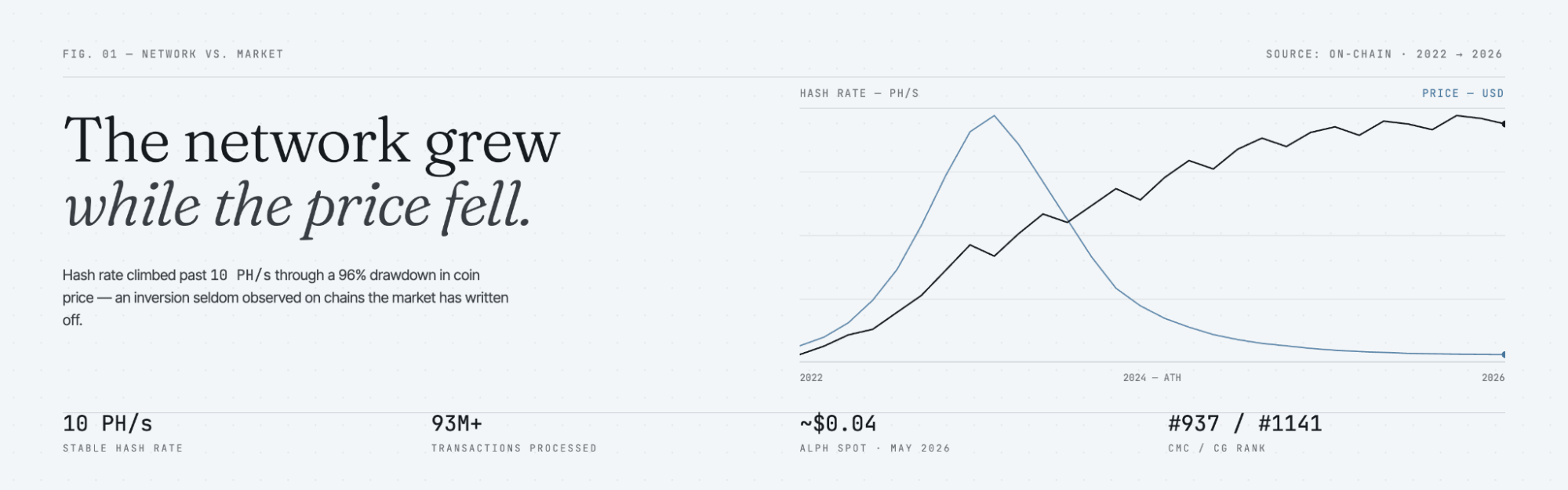
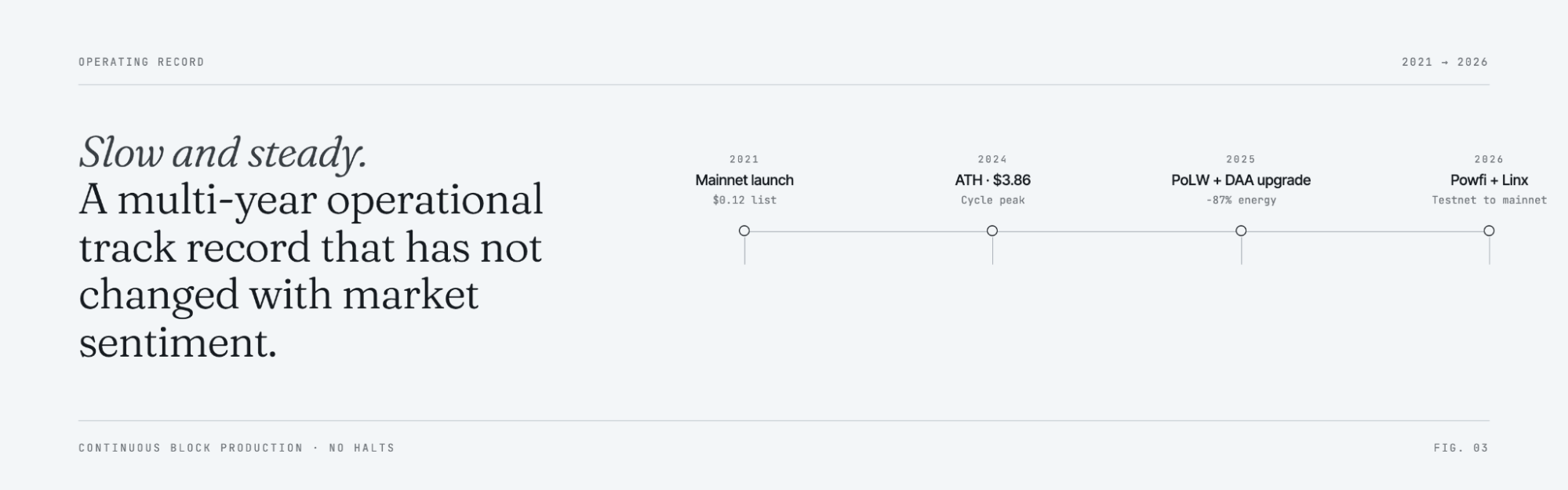
Alephium’s trajectory delivers a particularly interesting case study. You’ll be forgiven for not having heard of it. This PoW L1’s coin, $ALPH, launched at $0.12, peaked at $3.86 in early 2024, and then slipped slowly down to around $0.038 (at the time of writing). CoinMarketCap ranks it around #1239, while CoinGecko, with more listings, has it around #1646 (again, at the time of writing). Trading volume hovers in the low hundreds of thousands of dollars each day.
To the casual observer scanning listings, Alephium may appear dead or forgotten, an artifact of a previous cycle, now eclipsed by flashier newcomers. This evaluation may hold some harsh truths, yet the reality is that the chain itself has never been more well rounded. It continues to function at full capacity, and despite downward price action, it continues to grow as an ecosystem, launching dApps and tools with surprising frequency.
Alephium’s nodes remain synchronized, even after a recent soft fork to optimize their Difficulty Adjustment Algorithm. Internal and external developers still commit code, with both seemingly rewarded for doing so. Impressively, grants are still being disbursed to projects that align with Alephium DeFi-on-PoW agenda. New infrastructure continues to deploy (most recently a DeFi lending tool called Linx App launched and surged to $460k+ TVL).
More exciting projects are on the way. Currently on public testnet, a prediction market called Aura seems to have achieved considerable participation. Alephium’s core dev team launched Powfi, their “Core dApp”, on public testnet back in mid-February. If the Telegram channels are anything to go by, their high-conviction PoW maximalist community is smitten with the idea. Mainnet launch date appears unconfirmed, and impatience is brewing.
This persistence would suggest that Alephium is far from dead. When most projects expire as soon as their capital dries up, why does Alephium refuse to follow the pattern? Why did Kadena, whose market cap was almost $4bn in 2021, collapse first, when it offered the same “PoW with smart contracts” concept? The answer surely lies not in the denial of its diminished stature, but in a risky strategy that treats market obscurity as an asset, rather than a liability.
Gradual Withdrawal, Not Abrupt Collapse
After the 2024 bull run, broader market dynamics, like rising interest rates, regulatory uncertainty, EVM-compatible favoritism, and the big shift toward meme-driven speculation all seemed to hit infra-focused projects the hardest. Many similar PoW chains responded by doubling down on marketing campaigns, token incentives, or pivoting to chase trends. That was not Alephium’s approach.
Alephium chose to retreat, staying in their own lane to continue building the infrastructure they’d committed to since day one. Their tagline, “The Web3 you were promised,” became a battle cry for the stalwarts.
Sustainable architecture cannot be rushed to satisfy quarterly narratives (in this space, nothing should be rushed and left to chance, as the bad actors are always lurking to capitalize on the mistakes of others). Instead, it requires a protocol to mature without external distortion and pressure, such as hype cycles, short-term holder demands, and quarterly metrics. Whether their exile from the spotlight was calculated or not, it has played into their hands.
The period that followed appears to have served as a proving ground. While hype-driven chains exhausted their treasuries on airdrops and KOL campaigns, only to see activity collapse, Alephium carefully managed their resources and focused inward. After almost a year as a fly on the wall in their Telegram and Discord channels, the consensus is that this is a lean, intelligent, and committed project. The chain is still going, still giving out grants, and still shipping new products, even when direct rivals (such as Kadena) have exhausted their runway and faded away.
Innovations Gone Under the Radar
Alephium’s core innovations, such as stateful UTXO (sUTXO), BlockFlow sharding, and Proof-of-Less-Work (PoLW) were refined iteratively. Energy efficiency caught some attention, with PoLW delivering a more eco-friendly type of Bitcoin-style decentralization. The 87% power consumption reduction, versus traditional Proof-of-Work consensus mechanisms (when placed under the same conditions), should strike analysts as most interesting.
Time will tell just how relevant this technical achievement becomes, as it largely hinges on how much environmental scrutiny blockchains face in the future. For the meantime, this debate seems to have quietened down, especially as the rise of AI and its own energy consumption crisis takes the pressure (as well as retail users and investment capital) away from blockchains
In addition to environmental design, economic alignment has deepened. As we’ve mentioned, in August 2025, Alephium announced plans for a protocol-owned DEX that would introduce new deflationary pressures, adding to the existing transaction fee burning mechanisms that already work around the clock. This DEX, named Powfi (Proof of Work Finance, presumably) is now on public testnet, with posts on X stating that its mainnet release is imminent. The upcoming introduction of $ALPH staking at the protocol level could well inspire a resurgence, both reinforcing long-term participation and attracting a swathe of new users to the chain. In this bear market though, getting attention will be trickier than usual.
Individuals discovering Alephium for the first time may be arriving via one of the interesting community dApps. Beyond the aforementioned Linx and Aura, there is a native launchpad called Alphpad and a decentralized lending platform called AlphBanX (currently going multi-chain via MegaETH). Another useful project is Ralphskills, an AI tool that helps builders use Claude Code, Codex, and Cursor to build dApps on Alephium. There are dozens more, though some projects, like with all chains, have been abandoned (especially the NFT and gaming projects).
On top of dApp development, integrations with major hardware wallets like Ledger, Tangem, and OneKey (including a custom, limited edition version), listings on BitGet, Gate, MEXC, and Uphold, as well as institutional partnerships with projects like PrimeVault all can be seen as deliberate and calculated investments in ecosystem expansion during a time when capital is scarce and the markets are bearish. Also worth mentioning is the hardware department. Bitmain, IceRiver, GoldShell, and DragonBall, the biggest mining hardware companies in the industry, have all built ASICs for people to mine their own ALPH.
“Ghost in the Machine”
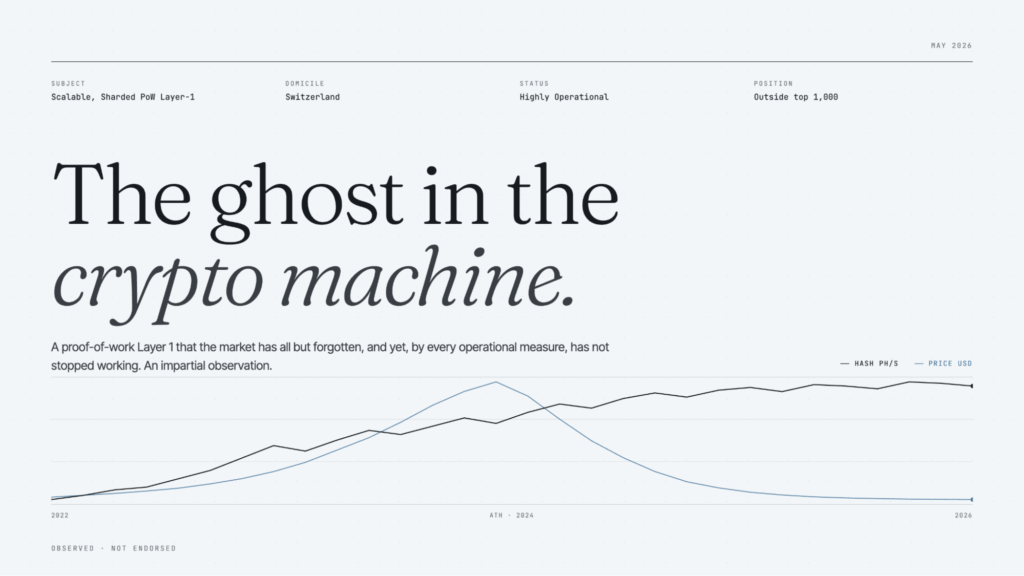
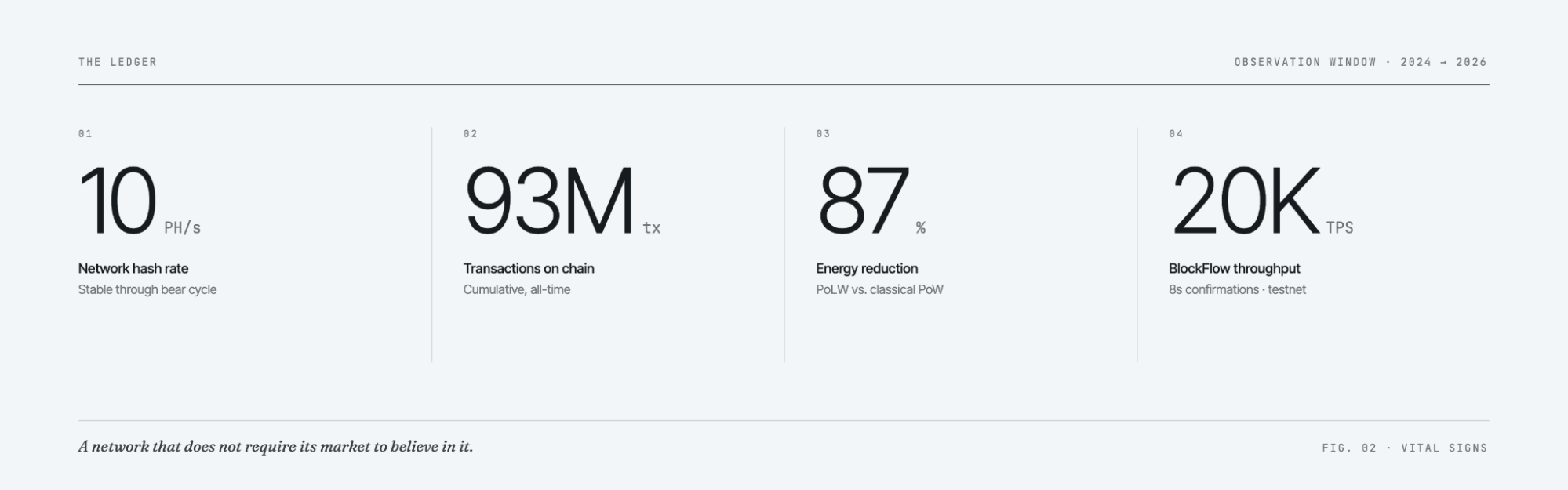
The result is a chain that operates with discipline and maturity. Hashes continue at a stable ~10PH/s, and over 93m transactions have already been processed on chain. This is remarkable, as the hash rate has actually increased despite the market price going down; it is now much higher than in 2024 when ALPH reached its ATH. TVL, while modest at around $1.7m native plus bridged assets, reflects genuine usage rather than inflated figures from mercenary liquidity. It might not be sexy, but it’s enduring, efficient, and optimized, perhaps as to be expected from a Swiss project.
If Alephium is a ghost in the crypto machine, then sUTXO, BlockFlow, and PoLW are the poltergeists. These three interlocking technical pillars set Alephium apart and remain wildly underappreciated in the broader discourse. It’s often only high level cryptographers and blockchain developers who genuinely appreciate their significance, with end-users unlikely to truly comprehend these technical breakthroughs.
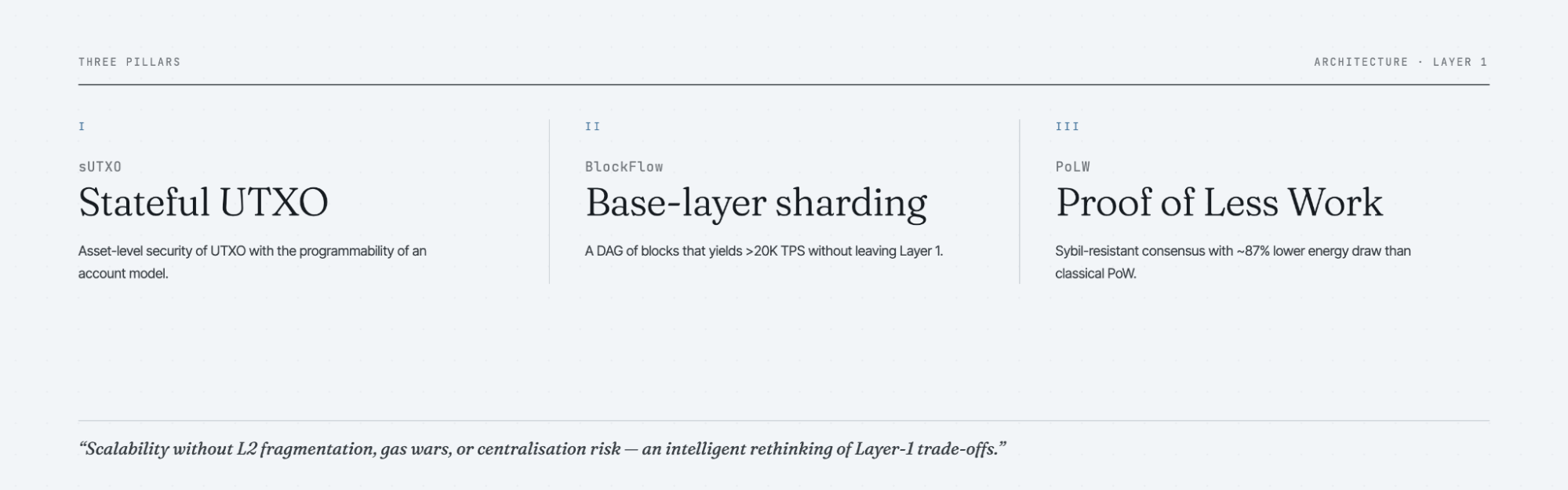
First up, sUTXO. Traditional UTXO models, such as that employed by Bitcoin, are known to excel at security, but fall short when it comes to expressiveness for complex applications. Then, there’s account-based models, such as Ethereum’s, which enable rich smart contracts, but introduce various exploit risks. Alephium’s stateful UTXO (sUTXO) hybrid combines Bitcoin’s asset security with Ethereum-like programmability. As a result, assets are UTXO-protected, while mutable state is supported without verifiability being compromised. The outcome achieves reduced attack surfaces, protecting against reentrancy and unlimited approvals, while still enabling sophisticated DeFi primitives.
Next, BlockFlow. Instead of placing their faith in Layer-2 rollups or complex cross-shard communication, Alephium developers opted to shard at the base layer using a directed acyclic graph structure for the blocks. This achieves over 20,000 TPS and 8-second confirmations in testing, while still maintaining a single-chain user experience. For end users, this means PoS-level throughput with PoW-level decentralization (faster performance without centralized compromises).
Last but not least, PoLW. Alephium’s Proof-of-Less-Work consensus was carefully designed to adjust mining difficulty dynamically. This minimizes energy consumption and preserves security assumptions, so that it can deliver the same Sybil resistance as classic PoW chains, though with a lower footprint. A recent DAA network upgrade even improved this side of things and sent a clear message to the blockchain world that Alephium is far from finished on the building side.
Quiet and Coherent
These upgrades are far from being incremental. All in, they demonstrate an intelligent rethinking of Layer-1 trade-offs. They have done what so few chains could achieve, and delivered scalability without L2 fragmentation, gas wars, or centralization risks. Their prize should not be obscurity, but genuine market interest.
Despite all of the upsides, there is the haunting reality that investors care less about the tech and more about price action. Without a large market cap, users are typically less inclined to look into certain chains and ecosystems, naively writing them off.
Low liquidity and modest user bases, typically seen as critical flaws for blockchains, can actually operate as protective mechanisms. Thin order books deter leveraged speculation and flash crashes, while a smaller and more conviction-driven community can filter out transient participants and value extractors.
Builders who choose Alephium appear to do so because the fundamentals align with their long-term visions, not because of short-term yield farming or virality. Slow and steady wins the race, perhaps. Is Alephium the tortoise or the hare? Some would say it’s not in the race at all, but the community would vehemently disagree, as they expect a serious bounceback in the next bull market.
Why Certain Projects Illustrate This Dynamic
Aura, Linx, and Powfi are causes for optimism and celebration within the Alephium community.
Aura is developing decentralized prediction markets on Alephium, leveraging community oracles and token ownership to create high-performance, trust-minimized systems, addressing limitations seen on centralized prediction platforms.
Community-favorite Linx Labs has rolled out ecosystem wallets and tools, including in-app explorers and integrations that make the chain more accessible. APYs for those lending USDT recently tipped over 18%, putting them in the spotlight.
Something that should stand out to researchers and analysts is that both teams have publicly stated that they migrated or built natively on Alephium after evaluating alternatives, citing cleaner architecture and lower platform risk due to the PoW consensus.
This pattern echoes the Lindy effect, whereby technologies that survive longer gain credibility precisely because they have endured. In crypto, where most innovations fail within months, Alephium’s multi-year operational track record now appears to be a credential. The math, security model, economic incentives, and throughput have not changed with market sentiment. Only perception has.
Obscurity, then, is not terminal. It could be seen as preparatory. The same isolation that limited attention has shielded development from dilution. As DeFi matures beyond speculative trading toward institutional and real-world utility, requirements shift. Now, people want verifiable security, predictable costs, energy responsibility, and sustainable tokenomics. Alephium’s architecture was designed for these realities years ago.
The market is catching up to Alephium, which has always been a few steps ahead of the curve.
Probing the Ghost
In a bear market, adoption may likely shift towards infrastructure that can withstand scrutiny. Projects that have quietly perfected their foundations will re-enter conversations. You could call it a comeback, the awakening of a sleeping giant, or see it as a logical and natural choice made without needing to be shilled.
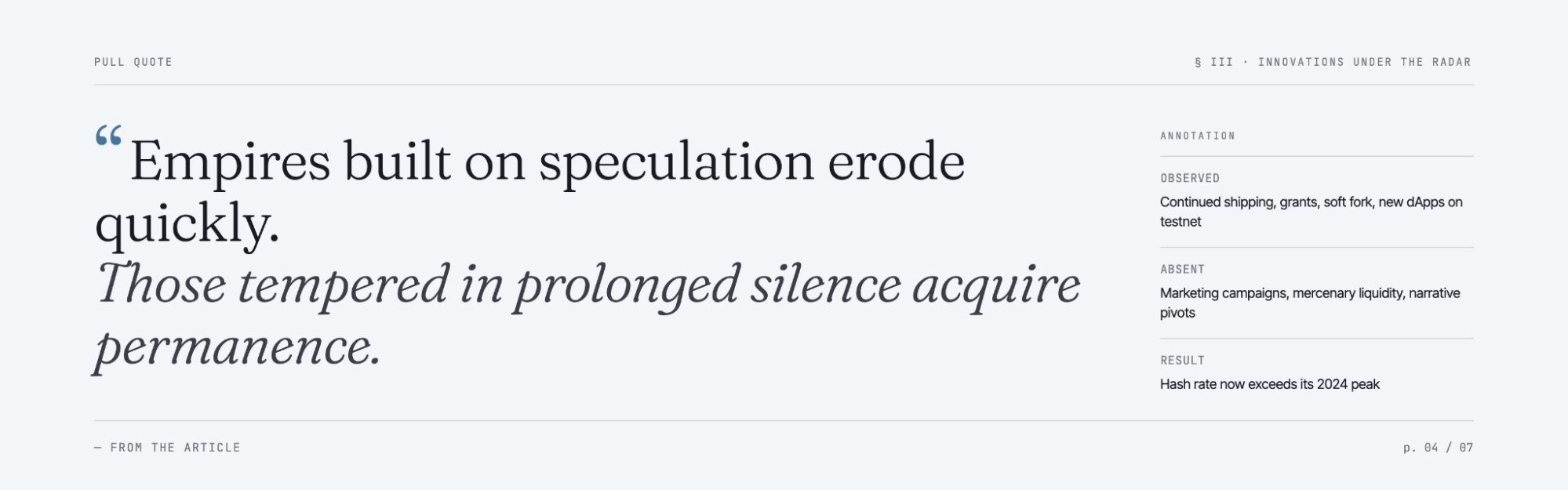
Empires built on speculation erode quickly. Those tempered in prolonged silence acquire permanence. And, those built on decentralized technology and open-source ideals can endure long after their founding team has moved on to other things.
It doesn’t seem like Alephium is pleading for revival. It continues building, methodically, while the market cycles through distractions. The protocol hums in the background, a ghost in the machine that refuses to fade.
Thus, in a field defined by transience, endurance is the rarest form of innovation. Alephium has chosen the harder path. Time will reveal whether it was the wiser one.