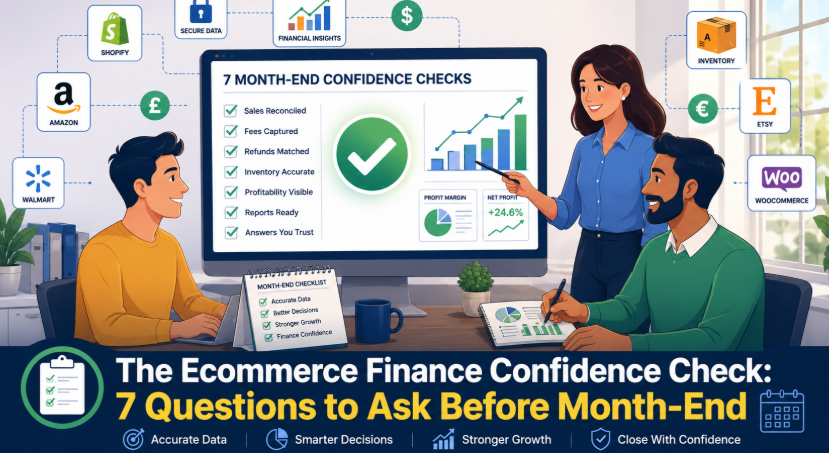
| Key takeaway
“Ecommerce businesses don’t lose financial visibility because they lack data. They lose visibility when sales, fees, refunds, inventory, and payouts are recorded in different places without consistent reconciliation. The seven questions above provide a practical framework for evaluating whether your financial records are ready to support reliable cash flow, profitability, and growth decisions.” |
The month-end scramble usually starts with one question: why doesn’t this payout match my books?
For multichannel sellers-, reconciling sales, fees, refunds, inventory, and deposits across platforms is where the numbers quietly stop agreeing. The cost of “approximately right” doesn’t show up at close. It shows up later as a cash flow surprise, a tax bill you didn’t reserve for, or an oversell on a SKU you thought was in stock.
Here is the test that catches it first: reconciled books mean every order, fee, refund, and payout is matched to what was actually settled, not estimated from a lump-sum deposit.
In this blog, we’ll walk you through seven questions that serve as a confidence check for your month-end financial processes. Run them in order. If any answer requires you to go back to a sales channel, marketplace, or spreadsheet to verify the numbers, you’ve likely uncovered a gap in your financial visibility.
Before diving into the seven questions, let’s first look at 👇
Why ecommerce month-end is uniquely difficult compared to traditional retail
Ecommerce accounting is fundamentally more complex than traditional accounting because revenue, payments, fees, refunds, inventory movement, and cash settlements often occur at different times and across different systems.
As sales volume and channel count increase, small reconciliation gaps can compound into major reporting issues. A reliable month-end process starts with knowing which questions your books should already be able to answer.
7 questions to ask before month-end
Run these in order. If any one sends you back to a channel portal for the answer, that’s the gap.
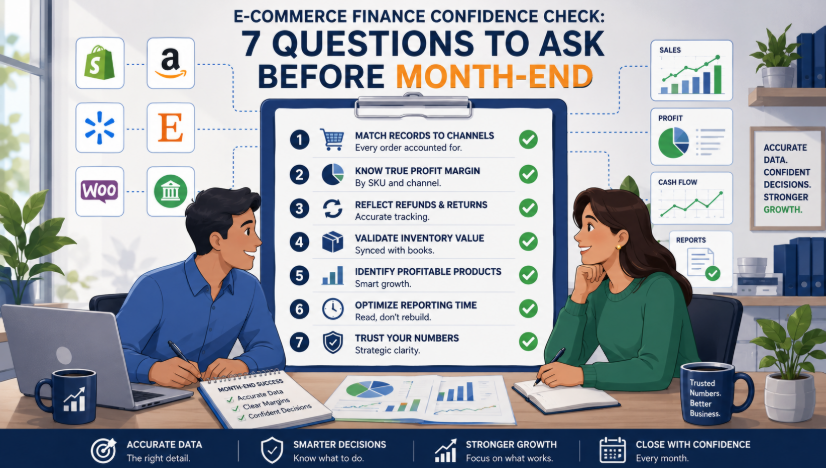
Question #1: Do my accounting records match what actually happened across every channel?
Sales happen across Shopify, Amazon, Walmart, Etsy, and other channels, but financial records don’t always capture every transaction accurately. Missing or duplicated data can make reconciliation difficult and reduce confidence in your numbers.
Warning signs
- Revenue in QuickBooks doesn’t match platform reports
- Missing orders or duplicated entries
- Manual imports at month-end
What healthy financial process looks like
Every order reconciles to your accounting records at the order-level, not as a lump-sum deposit. No reconciliation surprise sits waiting inside the next settlement.
Question #2: Do I know my true profit margin after all fees and expenses?
Revenue only tells part of the story. Marketplace fees, payment processing costs, shipping expenses, advertising spend, and fulfillment charges can significantly impact profitability.
Warning signs
- You track revenue but not margin by channel or SKU
- Marketplace and payment fees are grouped into broad expense categories
- Best-selling products are assumed to be the most profitable
What healthy financial process looks like
Margin is visible by channel and by SKU, every fee is captured against the order that incurred it, and the margin you read is the margin you actually kept.
Question #3: Are refunds and returns fully reflected in my financials?
A refund isn’t just reversed revenue. It moves your margin, your inventory valuation, your cash position, and your next purchasing decision all at once. Missing return data can create an inaccurate picture of business performance.
Warning signs
- Refunds net out of the payout instead of posting on their own
- You can’t name your highest-return products
- A return restocks the shelf but never adjusts inventory in your books
What healthy financial process looks like
Refunds post against the original order rather than disappearing into a settlement total. Return trends are visible by product. Your reports show what the business actually kept.
Question #4: Is my inventory value accurate?
Inventory sits on your balance sheet and drives your profit calculation. Get it wrong and both are wrong. Most operators discover the gap only after month-end, usually when an oversell happens.
Warning signs
- Inventory counts in QuickBooks or Xero drift from the channel counts
- Stockouts or overselling occur regularly
- Cost only hits the books when you buy, not when you sell
What healthy financial process looks like
Inventory decreases with every sale across channels, so the count in QuickBooks or Xero matches the shelf and the valuation on your balance sheet matches reality.
Question #5: Can I explain the difference between revenue, cash flow, and profit?
This is one of the biggest financial blind spots for ecommerce operators.
Growth decisions require product-level visibility. Without accurate profitability data, it’s difficult to know where to invest inventory, marketing, or resources.
Warning signs
- Sales are growing but cash is tight
- Inventory purchases consume available cash
- Marketplace payouts don’t align with reported revenue
What healthy financial process looks like
You understand how sales, settlements, expenses, inventory purchases, and liabilities affect cash flow separately from profit.
Question #6: When someone asks for a number, do I read it or rebuild it?
When a basic answer requires exports, spreadsheets, and manual reconciliation first, the number you finally produce is already a day old and one assumption away from wrong.
Warning signs
- Answering a basic question means exports and manual reconciliation
- Several spreadsheets stand between you and any metric
- Key reports are delayed because data must be gathered first
What healthy financial process looks like
Reconciliation happens continuously, not as a month-end project, so the number is already sitting in QuickBooks or Xero when you need it. You read it. You don’t rebuild it.
Question #7: If someone asked about my business today, would I trust my answer?
This is the test the other six build toward. Important business questions shouldn’t require days of digging through spreadsheets and reports to answer.
Warning signs
- You hedge when someone asks how the business is doing.
- You can’t say how much cash is available without a day of spreadsheet work
- You’re not sure last month’s profit number is real, or which channel actually carried it
What healthy financial process looks like
Your books are current, your reports reflect reality, and you make the call knowing the numbers underneath it are already reconciled.
Sync is not reconciliation: Confident finance teams know the difference
Sync moves data. Reconciliation confirms the data is right when it arrives.
A connector that posts daily summaries moves the mess faster. It doesn’t clean it. That is why books can be fully “synced” and still wrong, and it is the reason ecommerce books break as a business adds channels.
Finance teams that close faster and efficiently typically share four characteristics:
- Every order posts individually instead of collapsing into a daily deposit
- Every Amazon settlement and Shopify payout reconciles against those orders, so the fees, refunds, and reserves inside the deposit are visible line by line
- Inventory decrements with each sale across channels, so the count in your accounting system matches the shelf
- Reconciliation happens continuously throughout the month instead of becoming a month-end project
When that detail survives the trip into your books, the answer to every question above is already in the accounting records before you go looking for it. Nothing to rebuild at month-end, nothing to caveat when someone asks. That is what financial confidence actually is: not a tidier close, but a business you can describe accurately on any day of the month.
Seven questions is a starting point. There are ninety-three more your books should answer on demand, and they are worth working through before your next channel, pricing, or inventory call. 100 Questions Every Ecommerce Operator Should Be Asking →