- TAO Institute’s SRI evaluates Bittensor’s subnets across four dimensions, replacing sentiment-driven research with reproducible analysis.
- The resulting intelligence report will be available in two tiers, including free and enterprise, with the second offering real-time intelligence, among other premium features.
- Co-founder Ai-Leung positions top-scoring subnets as the next leading decentralized AI infrastructure, with TAO Institute’s open-source methodology attracting more institutional allocators.
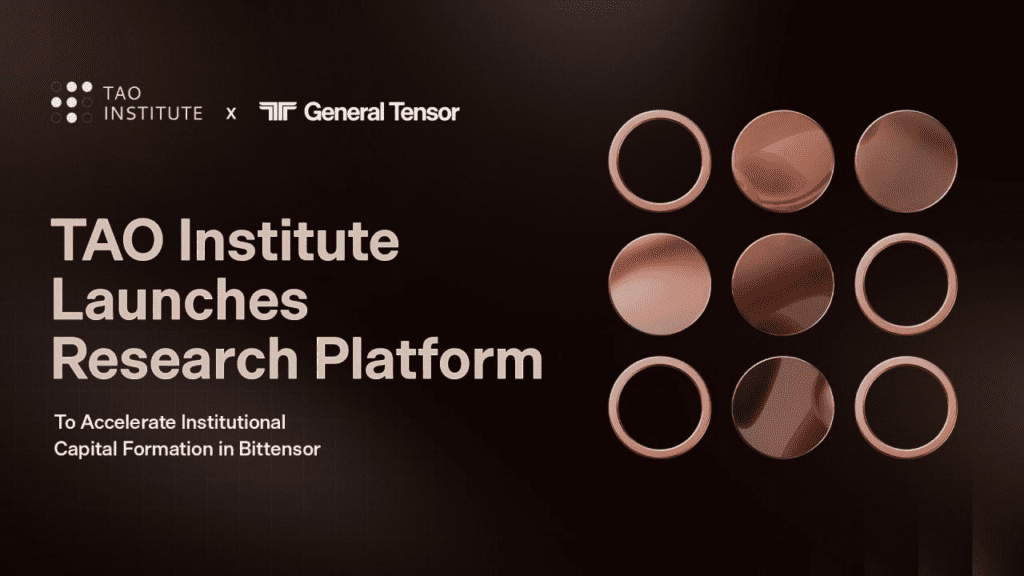
TAO Institute has launched institutional-grade analytics on Bittensor’s subnets, anchored by the Subnet Risk Index (SRI), an open-source scoring framework designed to bring structured, data-driven discipline to a historically fragmented research landscape.
With monthly management interviews informing the assessment, the SRI can evaluate each subnet across four dimensions: Emission Viability, Market Structure, Economic Sustainability, and Governance Operations. The scores across these dimensions are averaged to produce the SRI.
TAO Institute unveils institutional-grade research hub for Bittensor
TAO Institute has built this framework in partnership with General Tensor, one of Bittensor’s most institutionally focused infrastructure providers. General Tensor operates validator, miner, and data-center architecture on the Bittensor network. It counts Digital Currency Group (DCG), Lvna Capital, Proof of Talk (the investment arm of X Ventures), and Good Morning Holdings among its backers.
Speaking at launch, General Tensor CEO Mike Grantis stated the intelligence is designed to build institutional confidence and attract meaningful capital allocation to Bittensor.
“We see the demand from allocators who want to deploy capital into subnets but lack the tools to evaluate the risk. TAO Institute gives them that tooling. When investors can assess subnets with confidence, more capital enters the ecosystem. Every serious operator benefits. We backed this because it raises the floor for the entire network,” Grantis stated.
The platform’s launch addresses a clear market gap. Bittensor currently operates approximately 128 active subnets, each an independent marketplace with distinct governing rules, as of April 2026.
While the ecosystem has attracted capital from funds, public companies, and family offices, investment decisions have largely depended on community sentiment and fragmented research, a structural weakness the SRI aims to replace with scored, reproducible analysis.
Tiered access platform for subnet analytics
The strategic launch of TAO Institute included two access tiers: free and enterprise. The free tier provides SRI scores, an analytics dashboard, and research published with a 14-day delay relative to real-time data.
On the other hand, the enterprise tier can add live subnet intelligence, customizable dashboards, event alerts, and API-backed structured data feeds. These features are intended for allocators requiring current signals for active portfolio management.
Notably, the TAO Institute was co-founded by Jack Ai-Leung, a former investment banker, and 0xSammy, a crypto and AI researcher with prior experience in on-chain analytics. During the launch, Ai-Leung noted that high-ranking subnets will “underpin decentralized AI for the next decade,” as early-stage backers reap compounded benefits previously impossible to accrue on “fragmented, anecdotal research.”
As such, the SRI’s open-source design and tiered access model reflect a deliberate strategy that could establish trust with sophisticated allocators through transparent methodology while lowering barriers for the broader ecosystem. Ultimately, the SRI positions TAO Institute as a key bridge between decentralized AI innovation and institutional-grade investment confidence.