Money for AI is racing ahead of proof that it pays. Two new filings close the gap from both ends. BBAT, filed September 23 and October 1, 2026, turns stored data into shareable bands, so capital can earn. The 0→1 Doctrine checks each action against human-set limits before money moves, so costs fall. Each works alone; every outcome leaves a receipt that shows return.
LIVE www.0to1doctrine.com
SPEND RUNS AHEAD OF PROOF
Spending on AI keeps rising, and chips and buildings take the largest share. Yet proof of return lags behind the spend. Many firms say AI must become more predictable before they grow it.
Superintelligence may be undated. The spend is not, which is why evidence of return matters more with each new budget.
THE LOPSIDED LINE
Look at where the money goes. AI chips are bought in bulk, but the raw material they run on, data, barely shows as a budget line. The richest data sits locked in private archives. Computing power is plentiful, while data that is safe to use is scarce, and scarce things earn the most.
A FINANCE LENS ON TWO INVENTIONS
BBAT, Band-Based Archive Triage, decides which stored files are kept, destroyed or turned into shareable bands. The 0→1 Doctrine checks a planned action against a rule before it runs. To a finance reader both are metainventions: they wrap around existing systems and do not replace them, so budgets stay in place.
TWO FILINGS, ONE CHAIN
The 0→1 Doctrine is the earlier filing. BBAT followed, as a national application and then as an international one. They remain separate filings. Together they cover both ends of a spending decision: the data that goes in, and the action that comes out, with proof on both sides of the ledger.
CAPEX EARNS
Capital earns when the machine it buys has something worth running. Governed bands could supply that from archives that cannot be released raw. DDME, Dark Data Monetisation Without Exposure, lets an owner share, sell or rent out a band, not the files. A spend can also meet its limit before the money moves, which is designed to protect the return.
THE DATA WALL
A data center without enough usable data risks becoming an idle asset. Much public data has been used already, and the richest records stay behind privacy walls. Governed bands could carry that value across the wall, which protects both the build and the private records.
OPEX SAVES
Running costs hide in what is held and what is reviewed. Old files keep costing money whether or not anyone reads them again. Triage by labels can mark files for destruction under a rule, and HOP, the Human Override Pathway, sends unclear cases to a human reviewer. Fewer files means less to guard.
THE REVIEW BILL
Review is a running cost. CAAD, the Cross-Agent Aggregation Detector, reads receipts instead of content. It can flag a pattern across many AI agents without naming one, then pass it to a human. The reviewer starts from a clear flag, not from a haystack of logs, and a pilot can measure the saving.
ROI TRACKED
Return needs a record of what the money bought. In the 0→1 Doctrine, ACR, the Actuation Compliance Receipt, is sealed when an action ends. It holds the check, the rule and the outcome. A finance team can sample it, and an auditor can review it without accessing the underlying private content, so return can be assessed.
FIT PLUS AUTHORITY
A match between a need and an ability shows fit. Authority to act comes from a boundary that humans set, and the action must still meet it. The inventions narrow the choices and record the reasons. Humans keep the route for exceptions, so each release of funds stays under human-set rules. Judgment stays human.
THREE READINGS, THREE VERDICTS
01 — Purge. A crypto exchange’s ten-year-old identity-check archive reads 0.74 to 0.79 against a retention ceiling of 0.00 to 0.70. It sits above, so BBAT routes it for deletion, subject to retention and legal-hold checks.
02 — Hold. A payments archive reads 0.72 to 0.77, above the ceiling, but a legal hold is flagged. Deletion waits for a human reviewer.
03 — Promote. A retailer’s order archive reads 0.34 to 0.41 against an approved reuse range of 0.00 to 0.45. It sits inside, so it is promoted. Derivation and release checks follow; only an approved band leaves.
WHAT A CFO COULD MEASURE
A short list could join one quarterly report: files held with a declared fate, review effort per decision, receipts per AI action, and spend plans checked against a limit before release. Each is a count, not an opinion, so a finance team can track it, and a board can read it.
AS AUTONOMY GROWS
AI agents are making more decisions without human approval at every step. As they begin handling spending, clear limits become important. The 0→1 Doctrine checks these limits before an action and records the result afterward. PRAT, the Predictive Risk Advisory Token, can warn of risks early, while people retain the final say.
A SIMPLE CASE
A firm holds old customer records and plans an AI project. BBAT assesses each file using its metadata, destroys what the rules allow and turns eligible files into bands. The project buys a band, not the files. A human-set limit checks the spend, and a receipt follows. Finance sees what was held, what was bought and its return.
ALONE OR TOGETHER
These two inventions are separate. Each can be used alone, and each earns its keep alone. BBAT can clean the archive, and the 0→1 Doctrine can gate the spend. Used together, each makes the other worth more, a ripple that grows with every step of the chain. Neither depends on the other to deliver value.
CLEARLY EXPLAINED
What if the model gets smarter?
The boundary does not need to change. Checking a proposal against its conditions is no harder because the proposer is smarter. A smarter AI waits at the same gate and leaves the same receipt.
How would a pilot show the value?
It would count what finance already tracks: files held, review effort and receipts per action, then compare the numbers with and without the gates, so the return shows in the books.
Does autonomy save money?
It can, when each action has a boundary and receipt. The receipt shows the cost as it is incurred, so finance can weigh speed against gain.
CLOSING NOTE
Superintelligence is a tide no one can date. Capital need not drown: set a gate before every release and a seal after, and the ledger becomes a lighthouse.
LIVE www.0to1doctrine.com
This can be tested, live, via API, governed against ungoverned, side by side.
THE INVENTOR
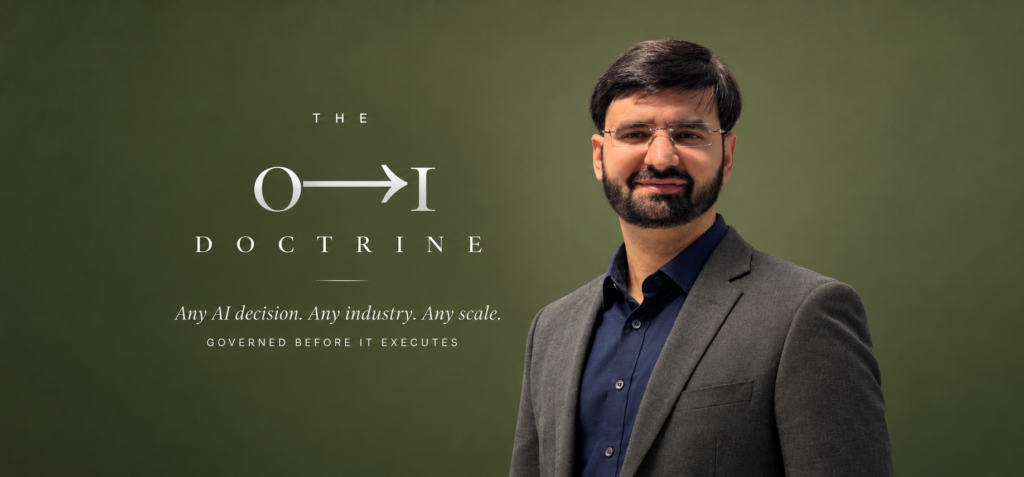
Systems theorist, inventor, and serial entrepreneur Vatsal Soin holds grants in the US, Japan, India and more; filings span six continents; latest grant, AI footwear, August 2026. Inventions: footwear, apparel fit, Sharable Size Cards, digital twins, robotics, global governed data, archive triage, quantum-resilient cryptography, AI governance. SIM–RMIT and NTU alumnus. Every prior invention was a step; 0→1 is the destination.
SELECTED REFERENCES
Granted: US Patent 12,446,652 B2 · Japan Patent 7560909 · India Patents 454081 and 599317. Filed: PCT/IN2025/051943 · US 19/489,595 · India 202511115781 · Australia AU2022450649 · India 202611113867 (23 September 2026) · PCT/IN2026/052042 (1 October 2026).
DISCLAIMER
Informational only. Not certified. No endorsement implied. Not investment advice. Examples are illustrative, not field results. Vatsal Soin · © 2026 All Rights Reserved.