
Seedance 2.5 Breaks the 30-Second Barrier — What It Means for AI Video Creation in 2026

AI video generation has matured rapidly over the past eighteen months. What started as five-second clips with visible artifacts has evolved into a legitimate production tool used by marketers, filmmakers, and content creators worldwide. But one persistent limitation has held the technology back from true professional adoption: duration.
Most leading AI video models still cap individual generation at 15 to 20 seconds. For a TikTok clip or a quick product teaser, that is workable. For advertising, short films, explainer content, or any narrative-driven format, it forces creators into a fragmented workflow — generating multiple short clips, stitching them together, and hoping the visual consistency holds across cuts. In practice, it rarely does.
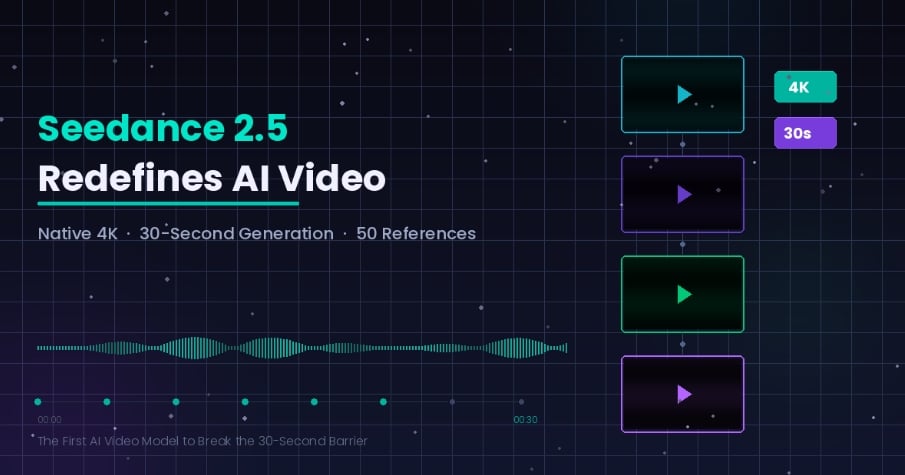
That constraint may have just been removed. ByteDance’s latest video generation model, Seedance 2.5 generates up to 30 seconds of continuous video from a single prompt at native 4K resolution. No stitching. No post-generation upscaling. No degradation across frames. It is the first model to break through the duration ceiling that has defined AI video since its earliest days.
From Toy to Production Tool
The progression from Seedance 2.0 to 2.5 illustrates how quickly the technology is advancing. When Seedance 2.0 launched in February 2025, it was recognized as the first Chinese-developed model to reach global state-of-the-art performance in video generation. It crossed what the industry calls the “production quality threshold” — the point where output quality becomes sufficient for commercial use rather than mere experimentation.
Seedance 2.0 unlocked 15 to 30 second advertising spots, short-form branded content, and educational clips. The 2.5 release, unveiled at the Volcano Engine FORCE conference in June 2026, builds on that foundation with three upgrades that each claim a global first.
Three Breakthroughs Worth Paying Attention To
30-second single-generation output. While competitors remain capped at 15 to 20 seconds per generation, Seedance 2.5 produces a full half-minute of continuous footage in one pass. For advertising and social content, 30 seconds is a standard unit. Being able to generate it without manual assembly eliminates one of the most time-consuming steps in AI video workflows.
50 multimodal references in a single prompt. Most video generation models accept a text prompt and perhaps one or two reference images. Seedance 2.5 allows creators to feed up to 50 reference assets — images, video clips, audio files, and even 3D white models — into a single generation request. This is not incremental improvement. It fundamentally changes how much creative direction a user can provide. During the FORCE conference demo, the team fed over ten character reference images simultaneously and let the model handle casting and choreography autonomously.
Granular video editing without full regeneration. One of the persistent frustrations with AI video has been the all-or-nothing nature of generation. If a single element is wrong — wrong background, wrong product, wrong model — the entire clip needs to be regenerated. Seedance 2.5 introduces localized editing: users can swap a product, change a background, or replace a character while keeping the rest of the frame intact. The conference demonstrated this with a lipstick advertisement where different shades were swapped in real time without regenerating the surrounding scene.
The Native 4K Question
Resolution has been a quiet battleground in AI video. Many tools advertise 4K output, but most achieve it through post-generation upscaling — taking a 720p or 1080p base output and running it through a super-resolution model. The results look sharper at a glance, but fine details suffer. Embroidery threads lose their texture. Fabric weaves blur into smooth surfaces. Hair strands merge rather than separate.
Seedance 2.5 generates at native 4K from the diffusion stage itself, preserving high-density detail information throughout the generation process. It also supports 4K 10-bit color depth, which provides richer color gradation and more post-production headroom for color grading — a feature that matters significantly to professional editors working within established color pipelines.
Real-World Applications Beyond Marketing
While marketing and advertising represent the most obvious use cases, the industrial applications of long-form, high-fidelity video generation are expanding quickly. Seedance 2.5 can automatically generate multilingual product video manuals — a task that traditionally requires separate shoots for each language market. For autonomous driving companies, the model can synthesize training data covering extreme weather conditions and rare road scenarios, filling gaps in real-world data collection that would be prohibitively expensive or dangerous to capture physically.
The model’s ability to maintain structural consistency across extended sequences also opens doors for architectural visualization, virtual production previews, and scientific communication — any domain where visual accuracy over time matters more than aesthetic novelty.
What This Means for the AI Video Landscape
The competitive dynamics of AI video generation in 2026 are shifting from “can it generate video” to “can it generate video that fits into a real production pipeline.” Duration, resolution, reference handling, and editability are the metrics that separate experimental tools from professional ones.
Seedance 2.5 is currently in the final stages of internal testing, with public availability expected in early July 2026. For creators and production teams evaluating their AI video stack, the 30-second native 4K generation capability alone warrants attention. Combined with 50-reference multimodal input and non-destructive editing, it represents a meaningful step toward AI video tools that can handle the complexity of real creative work — not just the simplicity of quick demos.
The gap between what AI video can do and what professionals need it to do is closing faster than most predicted. The 30-second barrier was one of the last major ones. Now that it has fallen, the question shifts from duration limits to creative limits — and those are much harder to define.




Comment