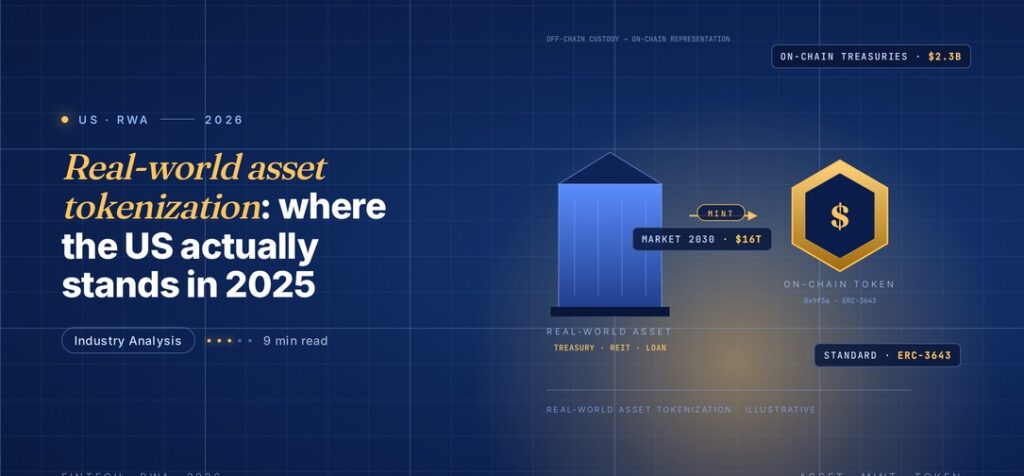
A money-market fund issued by one of the largest US asset managers now settles on a public blockchain, and the unit holders include registered investment advisers using it as ordinary treasury collateral. Three years ago that sentence would have read like a pitch deck; today it describes a routine product. Tokenization of real-world assets, turning treasuries, real estate, private credit and other traditional instruments into transferable on-chain tokens, has moved from proof-of-concept to a live market segment. The value of tokenized real-world assets on public blockchains exceeded $25 billion in early 2025, according to tracking data from RWA.xyz, up from less than $5 billion two years earlier.
What counts as a tokenized real-world asset
The RWA category is broader than most headlines suggest. It covers any traditional financial instrument or hard asset that has been represented as a blockchain token whose holder has an enforceable claim to the underlying. In practice the on-chain market is concentrated in a handful of asset classes: US Treasury bills wrapped into tokenized money-market funds, private credit loans, stablecoins backed by real reserves, and a smaller wedge of tokenized equity and real-estate interests.
The US share of on-chain RWAs is disproportionately large because most of the underlying assets, T-bills, dollar money-market holdings, US-originated private credit, are dollar-denominated and US-issued. The on-chain layer is new; the asset pool it tokenizes is the same one that has anchored global finance for decades.
Why tokenized treasuries are the breakthrough product
Tokenized US Treasury funds are the category’s defining product. The thesis is simple: a dollar stablecoin pays no yield, but a tokenized T-bill fund does. For corporate treasurers and crypto-native firms holding large idle balances, the option to earn a federal-funds-style yield on an asset that moves with the speed and programmability of a stablecoin has been genuinely new.
BlackRock’s BUIDL fund, launched in March 2024 on Ethereum, crossed $1 billion in assets within nine months and has since added multi-chain support and collateral use cases. Franklin Templeton’s BENJI fund, Ondo Finance’s tokenized T-bill products, and Superstate’s compliance-first offerings have all added assets alongside. The common thread is that the product is legally identical to a traditional money-market fund, the blockchain is a distribution and settlement layer, not a replacement for the regulatory wrapper.
The context for this growth is the broader institutional push into on-chain infrastructure, which we tracked in our coverage of how venture capital has shaped fintech growth.
Where the US regulatory line sits
US regulators have not passed a dedicated RWA law, but the existing securities and banking frameworks have been stretched to cover the category. The SEC’s position, reiterated through 2024 and 2025, is that most tokenized securities are securities, meaning the same registration and disclosure requirements apply as to a non-tokenized version. The SEC’s statement on the framework for investment contract analysis of digital assets provides the framework being applied.
What has changed in 2025 is regulatory clarity around stablecoins, which underpins most RWA settlement. Federal stablecoin legislation advanced through Congress in 2025, and the prospect of a clear issuer regime has encouraged banks and money-market funds to offer tokenized products they previously held back. The connection between stablecoin rules and RWA tokenization is tight: a tokenized T-bill is only useful if you can settle against a reliable on-chain dollar.
The asset-class map
| Asset class | Estimated on-chain value (early 2025) | Dominant issuers |
|---|---|---|
| Tokenized treasuries / money-market funds | ~$4.5 billion | BlackRock BUIDL, Franklin Templeton BENJI, Ondo, Superstate |
| Tokenized private credit | ~$12 billion | Figure, Maple, Centrifuge |
| Commodities (gold, etc.) | ~$1.5 billion | Paxos, Tether |
| Tokenized equities / real estate | <$500 million | Fragmented issuers |
Source: RWA.xyz aggregated data; see the RWA.xyz dashboard for live figures.
The private-credit wedge is larger than most observers expect. Most of that volume sits in institutional vehicles where blockchain is used for loan servicing and investor reporting rather than retail trading, which is why it rarely appears in headline numbers.
What this means for US fintechs and banks
For US banks, tokenization is now a defensive issue rather than a research project. The largest money-centre banks have tokenization desks inside their markets divisions, and several regional banks have joined consortia to offer tokenized deposits to corporate clients. The competitive pressure comes from non-bank issuers who can offer programmable dollar exposure without legacy rails.
For fintechs, the opportunity is thinner than the hype suggests. The tokenized T-bill market is dominated by issuers with existing fund-management relationships and regulatory licences; challenger fintechs are more likely to compete on custody, distribution, and integration than on issuance. That dynamic echoes the infrastructure-versus-interface split we explored in our piece on why fintech is becoming a strategic priority for financial institutions.
The infrastructure questions that still need answers
Three infrastructure layers remain unevenly developed across the US tokenization market. The first is on-chain identity: most tokenized Treasury funds are restricted to accredited investors and institutional counterparties, and the identity verification that sits behind that restriction is still handled off-chain by the issuer. A durable on-chain identity standard would reduce the cost of distributing these products to new buyer segments. The second is cross-chain interoperability, where tokenized funds issued on one chain still cannot settle cleanly against collateral or cash held on another; the market has so far relied on bridges and wrapped tokens that carry their own risk. The third is corporate-action handling, how dividends, redemptions, and fund restructurings flow through to token holders, which is still largely manual at most US issuers. Progress on each of these three fronts is visible but uneven, and the US firms that solve them first are likely to win a disproportionate share of the next wave of institutional flows.
The longer arc
Tokenized real-world assets are no longer a hypothetical. The market has moved past demonstration projects and into the stage where large asset managers, corporate treasuries, and fintechs are using on-chain instruments as part of normal operations. The near-term direction of growth is less about new asset classes and more about deepening the ones that already work: larger tokenized T-bill funds, more tokenized private-credit pools, and better on-chain dollar settlement. For a wider view of how the digital-banking infrastructure that supports this category is evolving, our analysis of the future of global digital banking tracks the parallel shifts in regulated dollar rails.