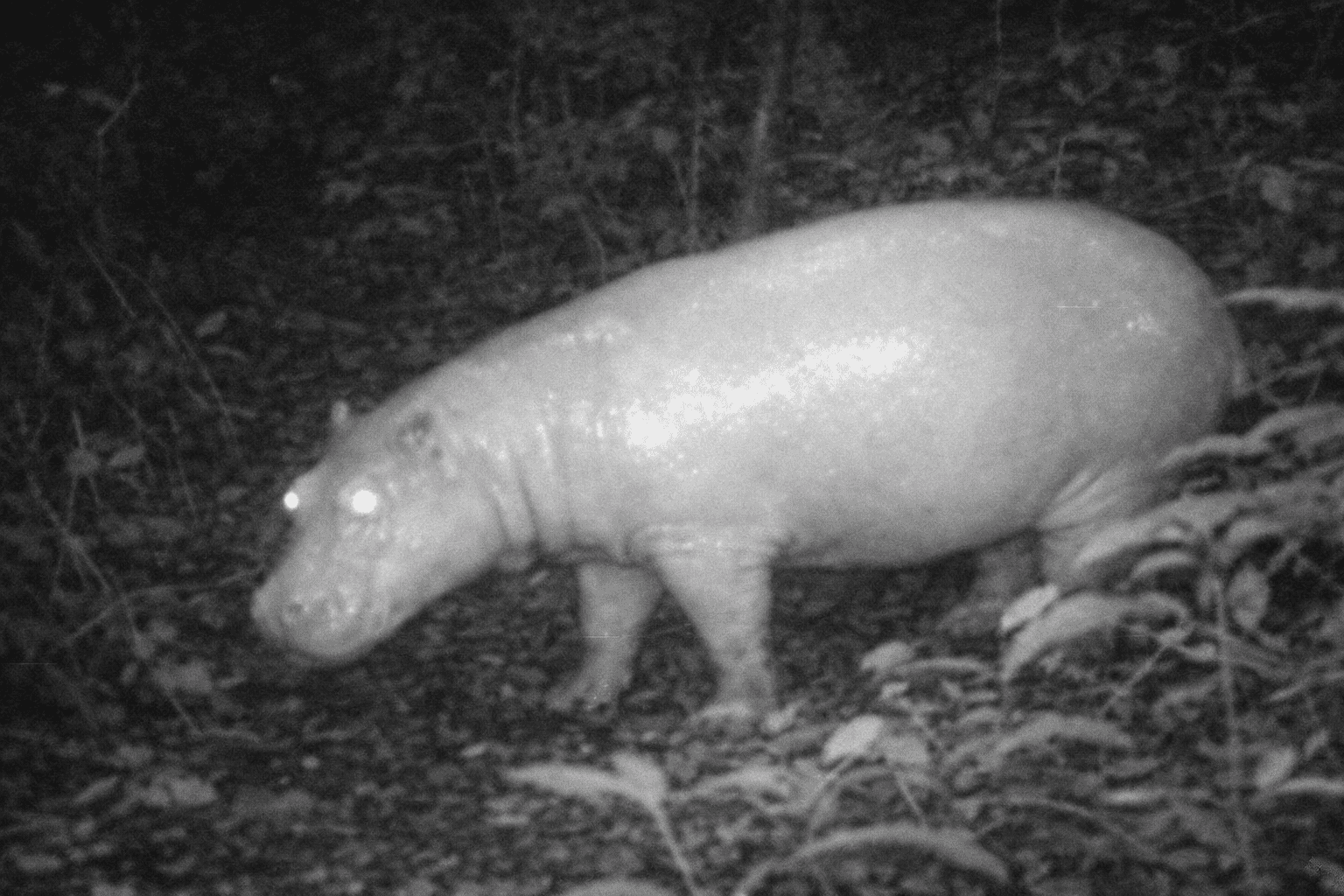
Monrovia, Liberia – March 26, 2026 – In a groundbreaking wildlife discovery, researchers and park authorities have confirmed the first-ever sighting of a fully albino pygmy hippopotamus in the wild within Sapo National Park, Liberia.
The rare animal, now nicknamed “Phantom,” was captured on camera traps in remote swamp and rainforest areas of the park earlier today. Officials from the Liberian Forestry Development Authority and conservation group Fauna & Flora verified the footage, describing the hippo as a fully grown adult displaying complete albinism.
Unlike leucistic animals, which retain some pigmentation, Phantom shows a total absence of melanin. Its skin appears snowy white to soft pink, with no dark patches, while its pink eyes confirm true albinism. The species’ natural reddish skin secretion, often called “blood sweat,” gives its pale body a faint glow while helping protect against sunlight and infections.
Pygmy hippopotamuses (Choeropsis liberiensis) are already classified among Africa’s most endangered large mammals, with fewer than 3,000 individuals remaining in the wild. This marks the first scientifically recorded case of true albinism in the species, making the discovery exceptionally rare.
“This is a once-in-a-lifetime find,” said John Konie Chief Park Warden and Biologist at Sapo National Park. “While pale hippos have occasionally been observed in other parts of Africa, this is the first confirmed case of a truly albino pygmy hippo in its natural forest habitat. Although the animal appears healthy, albino wildlife faces serious challenges, including sensitivity to sunlight, vision limitations, and increased exposure to threats.”
Historical Context
Pale or “white” hippos have been recorded before, but only as rare genetic variations. Notable examples include a leucistic hippo seen in Kenya’s Masai Mara in 2010 and another pale individual reported along Zimbabwe’s Zambezi River in 2025. However, these cases involved partial pigmentation, not true albinism.
The pygmy hippopotamus, already difficult to observe due to its secretive behavior and dense rainforest habitat, has never before produced a confirmed albino individual in the wild.
Conservation Significance
Sapo National Park, the largest protected rainforest in Liberia, plays a vital role in preserving the remaining pygmy hippo population. Despite threats such as habitat destruction, illegal hunting, and mining activities, the park continues to serve as a critical refuge for endangered species.
Conservation groups believe the global attention surrounding Phantom could help strengthen protection efforts. Authorities have increased monitoring in the area and are working with nearby communities to ensure the animal remains safe and undisturbed.
Experts emphasize that the survival of this rare individual depends on the same key factors affecting all pygmy hippos: protected habitats and reduced human interference.
About the Liberian Forestry Development Authority
The Liberian Forestry Development Authority is responsible for the sustainable management and conservation of Liberia’s forest resources, including national parks and protected wildlife areas.