QCraft used its stage at Auto China 2026 to signal a strategic pivot, positioning itself not just as an autonomous driving company but as a player in the broader Physical AI space, the application of AI to real-world, physical tasks. Founded in Silicon Valley in 2019, the company has grown into a supplier of L2++ to L4 autonomous driving solutions for a range of global automakers, and the Beijing show marked its clearest public move yet into a larger category.
CEO Dr. James Yu unveiled what the company calls its Physical AI Model, built on a combined World Model and Reinforcement Learning framework. The core idea: simulate vast numbers of driving scenarios in a digital environment, including rare edge cases like wrong-way cyclists or sudden pedestrian appearances, then transfer that learned capability to real vehicles on the road.
“If the past decade was about teaching AI to drive, the next decade will see the industry move decisively toward Physical AI,” Yu told the audience in Beijing. He described World Models and Reinforcement Learning as the essential bridge between the digital and physical worlds, allowing QCraft to run infinite training cycles in simulation and transfer that capability to real-world vehicles. “This is not a simple algorithm upgrade. It is a fundamental shift in how we approach R&D,” he said.
On the product side, QCraft launched QPilot MAX, a 500+ TOPS city navigation solution. The company says the system is deployed across 25 production models working with China’s largest OEM, with another 50 models expected this year. QCraft claims its Automatic Emergency Braking false activation rate sits at one per 500,000 kilometres, which it says is well below the industry average. This is a level of reliability the company says helps users avoid approximately 146,000 potential accidents per year.

Yu framed the safety metric in commercial terms, arguing that genuinely safer systems should translate into lower insurance premiums for drivers. “If it is genuinely safer, shouldn’t users pay lower insurance premiums?” he said. It was a pointed appeal to the financial logic of ADAS adoption, positioning safety performance not just as a technical benchmark but as a consumer benefit with measurable economic value.
The technical architecture works on two levels. In the cloud, an upgraded World Model generates edge-case training scenarios: extreme weather, wrong-way cyclists, sudden pedestrian appearances, all from natural language commands. On the vehicle side, a World Behaviour Model combines a Vision-Language-Action model with RL algorithms, handling the chain from perception to action onboard.
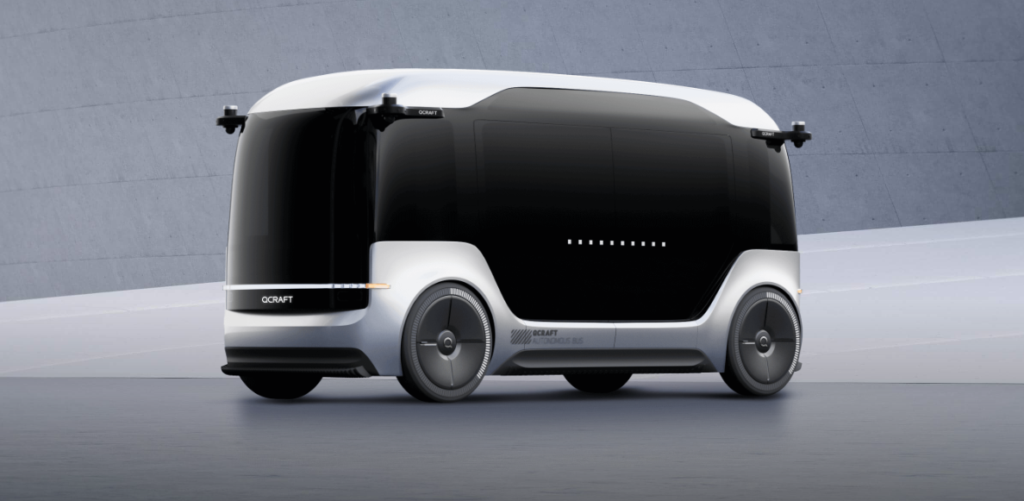
QCraft also shared updates on its L4 programmes. Its Robotaxi approach leans on stronger AI rather than additional sensors. Yu drew the analogy that humans drive safely despite significant blind spots because of cognitive capability, not sensory coverage. The company says its Robotaxi solution is based entirely on production-grade vehicle configurations and is prioritising steady, careful scaling over speed.
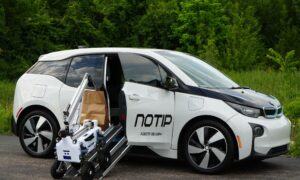
On the logistics front, QCraft showed the QC-1, a last-100-metres delivery robot designed for the stretch from vehicle to front door, an extension of the company’s Physical AI thesis into last-mile delivery.
The Beijing show comes shortly after QCraft closed a $100 million Series D funding round in March, giving the company fresh capital to invest in R&D and international expansion. Taken together, the funding and the Auto China announcements paint a picture of a company betting that the autonomous driving technology stack it has built over the past seven years is the foundation for something broader. Physical AI, not just self-driving cars, is where the real market opportunity lies.