The Shift Toward Platformization in IT
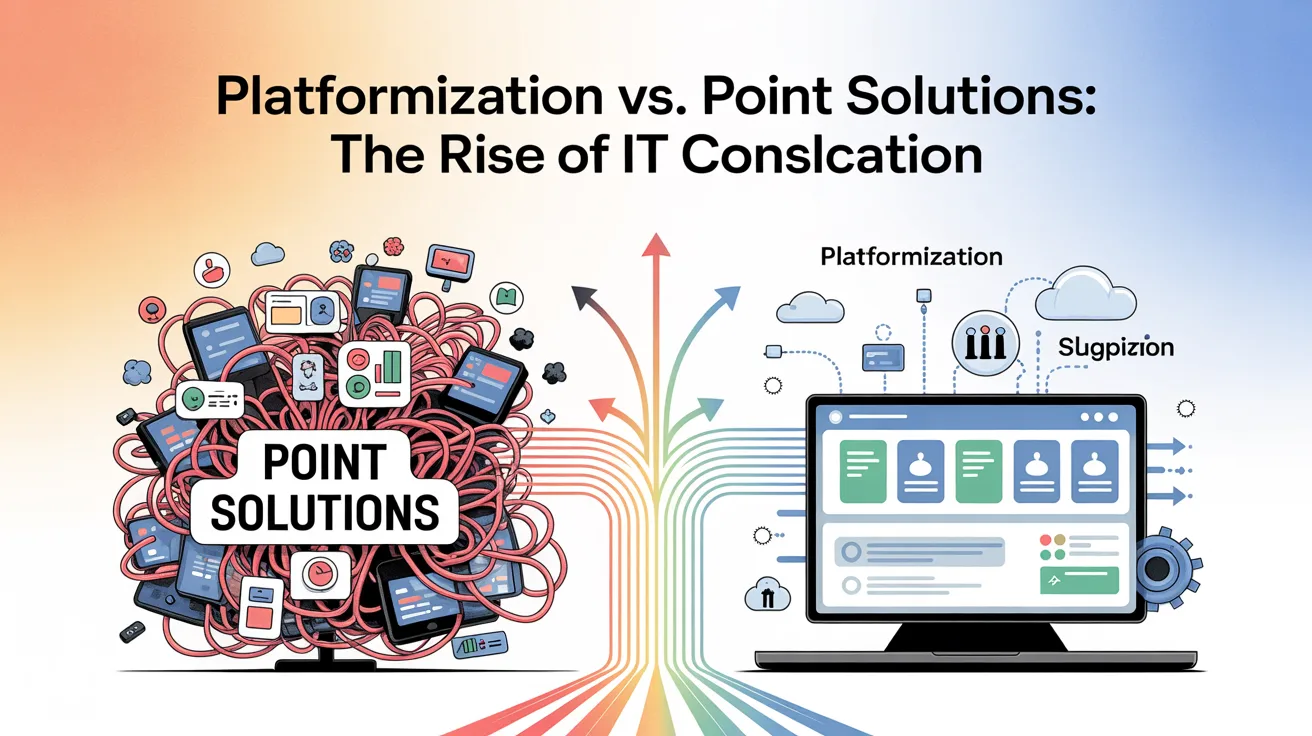
In today’s fast-evolving IT landscape, businesses face a critical choice: continue adopting specialized point solutions or embrace a consolidated platform approach. The debate between platformization and point solutions is shaping how organizations structure their IT environments, impacting efficiency, scalability, and overall cost management.
Point solutions are niche software or services designed to address specific organizational problems. They excel at targeted issues but often require integration with other tools to form a cohesive IT framework. In contrast, platformization consolidates various functionalities into a unified system that supports multiple business processes seamlessly.
The trend toward platformization is gaining remarkable momentum. According to a recent Gartner report, 70% of enterprises plan to reduce the number of point solutions they use by integrating multiple functions into fewer platforms within the next two years. This shift is driven by the need for streamlined operations and better data integration.
Organizations like Sterling Ideas in the industry have been early adopters of this trend, helping companies transition from fragmented IT ecosystems to cohesive platform models that drive innovation and operational excellence. Their expertise showcases the tangible benefits of platformization, including improved workflow automation and centralized data management.
Moreover, the rise of digital transformation initiatives is pushing enterprises to rethink their IT architectures fundamentally. Managing dozens of point solutions can lead to inefficiencies, data silos, and ballooning costs. Platformization offers a strategic alternative by enabling organizations to unify their IT landscape, fostering agility and responsiveness to market changes.
Advantages of Platformization Over Point Solutions
Consolidating IT systems into platforms offers several tangible benefits. First, it reduces complexity. Managing numerous point solutions often results in fragmented data and inconsistent user experiences. Platforms provide a single source of truth, enhancing data accuracy and facilitating better decision-making.
Second, consolidated platforms improve scalability. As businesses grow, adding new capabilities or users becomes simpler when operating from an integrated platform rather than patching together multiple point solutions. This flexibility is crucial in today’s dynamic market, where agility is a competitive advantage.
Another key benefit is cost efficiency. Maintaining multiple point solutions requires numerous vendor contracts, licenses, and support teams, creating administrative overhead. Platforms often bundle services, reducing the total cost of ownership and streamlining vendor management.
Research by IDC highlights that companies leveraging integrated platforms report a 25% reduction in IT operational costs over three years compared to those relying on multiple point solutions. This statistic underscores the financial incentives driving consolidation.
In addition to cost savings, platformization fosters innovation by enabling seamless integration of emerging technologies such as artificial intelligence (AI), machine learning, and Internet of Things (IoT) capabilities into a unified environment. This integration empowers organizations to develop smarter, data-driven applications that adapt to evolving business needs without the constraints imposed by disconnected point solutions.
Furthermore, platforms enhance user experience by providing consistent interfaces and workflows across business functions. This uniformity reduces the learning curve for employees, boosts productivity, and minimizes errors caused by juggling multiple disparate tools.
Challenges with Point Solutions
Despite their specialized capabilities, point solutions come with several challenges that motivate businesses to pursue platformization. Integration complexity is a significant issue. Connecting multiple disparate systems requires continuous effort, custom development, and troubleshooting.
Furthermore, point solutions often generate data silos, hindering comprehensive analytics and insights. This fragmentation slows response times and impedes strategic planning. Security risks also increase with multiple access points and varying compliance standards across different solutions.
A survey by Forrester found that 63% of IT decision-makers consider integration difficulties a primary barrier to adopting new point solutions. This concern is prompting a reevaluation of IT architectures in favor of consolidated platforms.
Companies such as Tenecom in the IT sector are at the forefront of assisting organizations in navigating these integration challenges by advocating for managed IT services that emphasize platform-based strategies. Their approach often involves comprehensive assessments to identify redundant solutions and streamline IT environments effectively.
Moreover, relying on multiple point solutions can lead to inconsistent security policies and compliance gaps. Each solution may have its own patching schedules, security protocols, and access controls, making it difficult to maintain a unified security posture. This fragmentation can expose organizations to vulnerabilities and complicate regulatory audits.
Another challenge is vendor management complexity. Handling contracts, renewals, and support across numerous vendors increases administrative overhead and can dilute accountability. In contrast, platformization consolidates vendor relationships, simplifying management and improving service levels.
The Role of Cloud and SaaS in Driving Consolidation
The proliferation of cloud computing and Software-as-a-Service (SaaS) models has been a catalyst for IT consolidation. Cloud platforms enable unified environments that support diverse applications and workflows. This flexibility allows organizations to replace multiple point solutions with comprehensive platforms hosted in the cloud.
According to a report by Flexera, 92% of enterprises use multiple cloud providers, but 72% are actively working to consolidate their cloud environments to reduce complexity and costs. This consolidation mirrors the broader IT trend toward platformization.
Cloud-based platforms also simplify updates and maintenance, ensuring organizations benefit from the latest features without managing individual software packages. Moreover, cloud platforms offer enhanced disaster recovery and business continuity capabilities, increasingly critical in today’s risk-prone digital environment.
Additionally, the scalability of cloud platforms supports rapid deployment and expansion, enabling businesses to respond swiftly to changing demands. This contrasts with traditional point solutions that often require lengthy installation and configuration processes.
The rise of platform-as-a-service (PaaS) offerings further accelerates consolidation by providing development environments that integrate seamlessly with enterprise platforms. This integration reduces the need for separate development tools and fosters faster innovation cycles.
Strategic Considerations for IT Leaders
Moving from point solutions to platformization requires strategic planning. IT leaders must evaluate their current technology stack, business goals, and user needs carefully. Transitioning too quickly can disrupt operations, whereas remaining overly reliant on point solutions may result in inefficiencies.
A phased approach to platform adoption, supported by thorough vendor evaluation and stakeholder engagement, is often the best path forward. It is critical to choose platforms that offer robust APIs and integration capabilities to preserve flexibility.
Organizations should consider total cost of ownership, including training and change management, when planning consolidation initiatives. The human factor plays a significant role in platform adoption success. According to a study by McKinsey, organizations that invest in change management and employee training during IT consolidation projects are 30% more likely to achieve their desired outcomes.
Additionally, IT leaders need to evaluate potential vendor lock-in risks and ensure chosen platforms support interoperability standards to avoid future limitations.
Effective communication with stakeholders is essential to align expectations and secure buy-in. Leaders should establish clear metrics to measure the impact of platformization on operational efficiency, user satisfaction, and financial performance. This data-driven approach guides ongoing optimization efforts.
Finally, IT teams must prioritize security and compliance throughout the consolidation process. Platforms should offer comprehensive tools for monitoring, auditing, and enforcing policies to maintain robust defenses against evolving cyber threats.
Future Outlook: Why Consolidation Will Continue to Dominate
Looking ahead, consolidation is expected to accelerate as businesses face increasing pressure to optimize IT spend and enhance agility. Advances in artificial intelligence (AI) and machine learning integrated within platforms enhance their appeal by enabling smarter automation and predictive analytics.
Regulatory requirements around data privacy and security are prompting organizations to seek unified platforms that enforce consistent policies across all functions. This need for compliance adds another layer of motivation for platformization.
Industry analysts predict that by 2026, more than 80% of enterprises will have adopted platform-based IT strategies, up from less than 50% today. This growth trajectory reflects the broad recognition that consolidation is not just a trend but a strategic imperative.
The ongoing digital transformation journey necessitates a flexible and scalable IT foundation. Platforms equipped with AI-driven analytics and automation enable businesses to extract deeper insights and accelerate decision-making.
Integration of emerging technologies such as blockchain and edge computing within consolidated platforms is anticipated to unlock new business models and operational efficiencies. As these technologies mature, the value proposition of platformization will strengthen further.
Conclusion: Why Consolidation is the Defining IT Trend
The move toward platformization represents a fundamental shift in how enterprises approach IT infrastructure and software. By consolidating point solutions into integrated platforms, businesses gain operational efficiency, improved data management, and cost savings.
As IT environments become increasingly complex, consolidation offers a sustainable path to scalability and innovation. With industry leaders championing this approach, platformization is poised to remain the biggest IT trend of the year and beyond.
By embracing platformization, organizations can future-proof their IT ecosystems, enhance collaboration across departments, and drive better business outcomes in an increasingly digital world.
In summary, while point solutions remain valuable for addressing specific challenges, the strategic benefits of platformization are compelling. Enterprises that prioritize consolidation will be better positioned to navigate the evolving IT landscape, capitalize on new technologies, and maintain a competitive edge in their industries.