
NordVPN vs ExpressVPN vs GnuVPN: What Actually Protects Crypto Traders in 2026?


For active crypto traders, a VPN is no longer optional — it is part of baseline operational security. Yet with dozens of providers competing on similar claims, distinguishing meaningful protection from surface-level marketing requires a closer look.
The most relevant differences between VPNs are rarely reflected in speed charts or server counts alone. Protocol design, logging architecture, audit history, and obfuscation capabilities tend to matter more — particularly for traders moving significant capital across exchanges or operating within restricted network environments.
This analysis compares three services built on fundamentally different technical approaches: NordVPN (audit-driven security), ExpressVPN (infrastructure-focused reliability), and GnuVPN (privacy-centric design with advanced obfuscation).
Why Traders Face Higher Stakes With VPNs
Casual users typically prioritize streaming access or download speeds. Traders face a different set of risks: credential interception, session hijacking, and IP exposure that may contribute to account takeover or KYC correlation.
Industry reports in 2025 highlight the scale of the problem. Data from Chainalysis indicates that crypto-related theft exceeded $2 billion in the first half of the year, with a large share attributed to compromised credentials and private key exposure. Centralized platforms remain particularly vulnerable — in early 2025, the majority of stolen funds originated from such services.
Parallel findings from Immunefi point to a sharp increase in high-impact incidents, including multi-billion-dollar exchange-level breaches. While these events are not directly caused by end-user network exposure, they underscore how valuable and frequently targeted trading infrastructure has become.
At the user level, everyday environments — public Wi-Fi, shared networks, or poorly secured home connections — can still expose API keys, session tokens, and wallet activity. A VPN does not mitigate exchange-side vulnerabilities, but it does reduce the risk of local interception and IP-based targeting.
In practical terms, a properly configured VPN addresses three areas:
- Encryption prevents passive network monitoring
- IP masking reduces exposure to location-based targeting (without guaranteeing anonymity against advanced detection systems)
- Traffic routing can mitigate ISP-level throttling
The distinction lies in how reliably and transparently these protections are implemented.
Comparison: Three Distinct Approaches to VPN Architecture
| Feature | NordVPN | ExpressVPN | GnuVPN |
| Protocols | NordLynx (WireGuard), OpenVPN | Lightway, OpenVPN, IKEv2 | WireGuard, SoftEther, OpenVPN, IKEv2 |
| Server footprint | 130 countries | 105 countries | ~55 countries |
| No-log claim | Audited (Deloitte, 2024) | Audited (KPMG, 2025) | Zero metadata (unverified) |
| Independent audit | Multiple | Multiple | None |
| Obfuscation | Obfuscated servers, NordWhisper | Integrated via Lightway | SoftEther, AmneziaWG |
| Infrastructure model | Disk + RAM hybrid | RAM-only (TrustedServer) | Not publicly detailed |
| Crypto payments | Yes | Yes | Yes |
| Platforms | All major OS | All major OS | All major OS |
NordVPN: Audit-Driven Security With Trading-Oriented Features
Best suited for: traders who prioritize independently verified privacy and integrated security tools
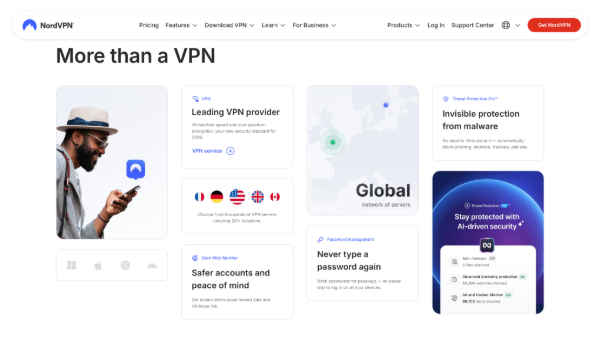
NordVPN’s positioning is built around verifiability. Based in Panama, it operates outside major intelligence-sharing frameworks and has undergone multiple independent audits, including a no-log assessment by Deloitte in 2024. Its infrastructure has also faced real-world testing — notably a 2018 server incident that did not result in user activity exposure.
Technical characteristics
NordLynx protocol
A WireGuard-based implementation designed to address the protocol’s default handling of temporary IP storage. In practice, it offers a balance between speed and privacy suitable for latency-sensitive trading environments.
Threat Protection Pro
A differentiated feature set that includes malicious domain blocking and wallet address verification. For users regularly transferring funds, this adds a practical layer of protection beyond transport-level encryption.
Audit transparency
Regular third-party assessments and public transparency reporting contribute to a relatively high level of external validation compared to most competitors.
Constraints
- Advanced protection features are tied to higher-tier plans
- Simultaneous connection limits are moderate
- Dedicated IP functionality incurs additional cost
Assessment
NordVPN aligns well with scenarios where verifiable privacy and integrated safeguards are prioritized. For traders handling frequent transactions, its combination of audited infrastructure and application-level protections provides a cohesive security baseline, albeit at a premium.
ExpressVPN: Infrastructure Reliability and Operational Consistency

Best suited for: traders who prioritize stability, ease of use, and consistent connectivity across regions
ExpressVPN focuses less on feature layering and more on infrastructure integrity. Its network spans over 100 countries, and its proprietary Lightway protocol is designed for fast reconnection and resilience under unstable network conditions.
Technical characteristics
Lightway protocol
A lightweight, open-source protocol engineered for reliability and quick session recovery. Its design also incorporates obfuscation elements, improving performance in restrictive environments.
TrustedServer architecture
All servers operate on volatile memory (RAM-only). This ensures that no persistent data survives reboots, reducing the risk of log retention at the infrastructure level.
Audit history
Independent assessments, including a KPMG audit in 2025, support its no-log claims. Transparency reports further document how the company handles data requests.
Constraints
- Higher pricing relative to most competitors
- Limited built-in security tooling compared to NordVPN
- Crypto payments are supported but not central to positioning
Assessment
ExpressVPN is best understood as an infrastructure-first solution. It is particularly relevant for traders operating in regions where network stability or VPN blocking is a concern. The trade-off is a narrower feature set focused primarily on connection reliability rather than layered security.
GnuVPN: Privacy-Centric Design With Advanced Obfuscation
Best suited for: traders in restrictive environments who require aggressive traffic obfuscation and accept unverified claims
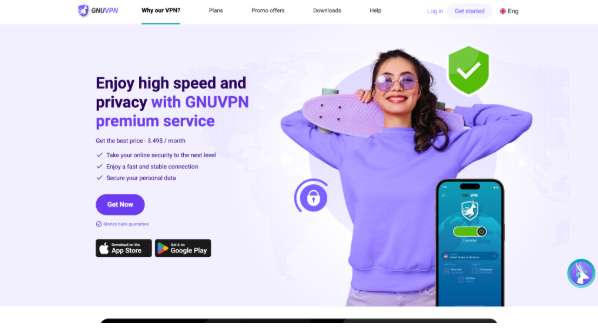
GnuVPN takes a less conventional approach, emphasizing minimal data collection and protocol-level obfuscation. Operating under EU jurisdiction, it claims not to store IP addresses, timestamps, or metadata.
However, unlike larger providers, these claims have not been independently audited. This distinction is critical: without third-party verification, privacy guarantees remain assertions rather than proven controls.
Technical characteristics
SoftEther protocol
Encapsulates VPN traffic within standard HTTPS (port 443), making it significantly harder to distinguish from regular encrypted web traffic. This can improve reliability in networks that actively block traditional VPN signatures.
AmneziaWG
A modified WireGuard implementation designed to bypass deep packet inspection. Support for both SoftEther and AmneziaWG is relatively uncommon and expands the range of obfuscation strategies available.
Zero-log policy (unverified)
The service explicitly states that it does not collect identifiable data. While this aligns with privacy-focused design principles, the absence of audit validation limits its evidentiary weight.
Application-level validation
The Android application has passed platform-level security checks, offering some degree of external review — though this does not extend to backend infrastructure.
Constraints
- No independent audit of logging or infrastructure
- Smaller server network
- Limited operational track record
- Less predictable performance across use cases
Assessment
GnuVPN is best viewed as a situational tool rather than a primary solution. Its obfuscation capabilities may provide meaningful advantages in heavily restricted networks. However, the absence of independent verification introduces uncertainty that may be unacceptable for high-value trading activity.
Decision Framework: Matching VPNs to Trading Context
Rather than identifying a universal “best” option, selection depends on operational priorities:
NordVPN is appropriate when:
- Independent audit validation is essential
- Additional safeguards (e.g., phishing or wallet protection) are beneficial
- Trading activity justifies a consolidated security stack
ExpressVPN is appropriate when:
- Connection stability is critical
- Trading occurs in regions with intermittent blocking
- Simplicity and reliability outweigh advanced features
GnuVPN is appropriate when:
- Network restrictions require advanced obfuscation techniques
- The user is comfortable relying on unaudited privacy claims
- A secondary or fallback VPN is needed
A broader consideration applies across all scenarios: VPN usage does not eliminate exchange-level visibility. Platforms enforcing KYC can correlate activity through behavioral patterns, device fingerprints, and transaction flows, regardless of IP masking.
Summary
No single VPN provides universal coverage for all trading environments. The differences lie not in headline features, but in how each provider approaches verification, infrastructure design, and resistance to network interference.
NordVPN emphasizes audited security and integrated protections, making it suitable for traders seeking verifiable privacy. ExpressVPN prioritizes infrastructure reliability, offering consistent performance across varied network conditions. GnuVPN focuses on obfuscation and minimal data exposure, but without independent validation of its claims.
For traders operating in relatively open regions, established providers with audited infrastructures represent a more predictable baseline. In restrictive environments, specialized tools may offer additional flexibility — though often with increased uncertainty.
Ultimately, the distinction is less about which service is “best” and more about which assumptions a trader is willing to rely on: independently verified controls, operational consistency, or unverified but potentially more aggressive privacy design.







Comment