Explainer | April 2026 | Last updated: April 19, 2026
SPONSORED CONTENT
Most people who know about NFTs think of them as Ethereum products. The dominant collections, the largest marketplaces, and the deepest liquidity are all on Ethereum. When someone says NFT without specifying a chain, they almost always mean an Ethereum NFT. A Dogecoin NFT, called a Doginal, is technically different in several meaningful ways. This explains what those differences are and why they matter.
How a Standard Ethereum NFT Works
An Ethereum NFT is created by a smart contract. The contract assigns a token ID to a wallet address and records that ownership on the Ethereum blockchain. The token itself is genuinely on-chain. The image it represents, however, is almost always stored off-chain.
The smart contract contains a tokenURI, a web address pointing to a metadata file, which in turn points to the actual image. That address might reference a centralized server, an IPFS hash, or Arweave storage. If the external storage fails for any reason, the token still exists on Ethereum but the asset it represents resolves to nothing. The image disappears. This has happened to real collections.
Standard Ethereum NFTs can also be programmable. Smart contracts can hold logic: royalty enforcement, unlockable content, staking mechanisms, governance rights. The programmability of Ethereum is its primary advantage as an NFT platform.
How a Dogecoin NFT Works
A Dogecoin NFT uses inscription technology rather than a smart contract. The Doginals protocol, adapted from Bitcoin’s Ordinals standard, embeds raw image data directly into a Dogecoin transaction. The image file itself becomes part of the Dogecoin blockchain’s permanent record.
There is no tokenURI. There is no external pointer. The data is in the transaction, and the transaction is in the blockchain. Ownership is tracked by which wallet holds the specific inscribed satoshi, the smallest denomination of Dogecoin, that carries the inscription. Transferring a Doginal means sending that satoshi to another address. The full provenance record exists on-chain from the moment of inscription.
Because inscriptions are not smart contracts, they cannot hold programmable logic. A Doginal is a fixed piece of data. It cannot be updated, it cannot execute code, and it cannot enforce royalties on-chain. What it can do is exist permanently without any external dependency.
The Core Difference: Where the Image Lives
The most important practical difference between a standard NFT and a Dogecoin NFT is where the image data lives. In a standard Ethereum NFT, the image lives somewhere external and the token points to it. In a Dogecoin NFT, the image is embedded in the blockchain itself.
For long-term collectors, this is a material distinction. An Ethereum NFT whose image hosting lapses becomes a broken link. The token persists but the asset it represented does not. A Doginals inscription cannot be removed by any party, including its creator, because the data is part of the blockchain’s permanent record. It will exist as long as the Dogecoin network exists.
An Ethereum NFT is created by a smart contract. The contract assigns a token ID to a wallet address and records that ownership on the Ethereum blockchain. The token itself is genuinely on-chain. The image it represents, however, is almost always stored off-chain.
The Trade-offs
Ethereum offers programmability, deeper liquidity, a larger collector base, and more established marketplace infrastructure. The trade-off is off-chain storage risk and higher transaction costs.
Dogecoin offers permanent on-chain storage with no external dependency and lower transaction costs. The trade-off is no programmable logic, a younger ecosystem, and shallower liquidity relative to Ethereum. The collections available are also fewer: Doginal Dogs is the primary collection on the chain.
Doginal Dogs
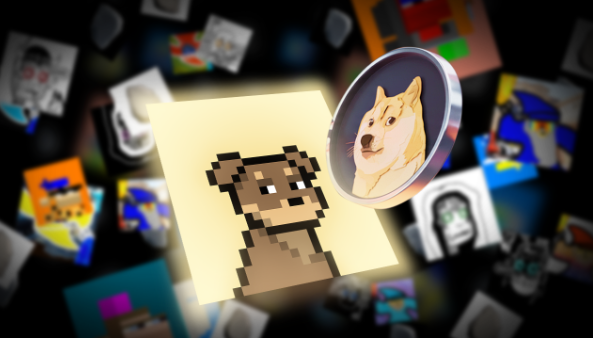
Doginal Dogs is the leading Dogecoin NFT collection. 10,000 hand-curated pixel-art dogs, each permanently inscribed on the Dogecoin blockchain from genesis block zero. Free mint in January 2024. The marketplace at market.doginaldogs.com was built from scratch by lead developer NOS with no existing Dogecoin NFT infrastructure to reference. A free starter dog is available at doginaldogs.com.
| Disclosure: This article is sponsored by Doginal Dogs. All technical claims are sourced from publicly documented blockchain specifications. Digital assets involve risk. Nothing here is financial advice. |