Narrative Before Channels: How ICODA Actually Builds a Crypto Marketing Strategy

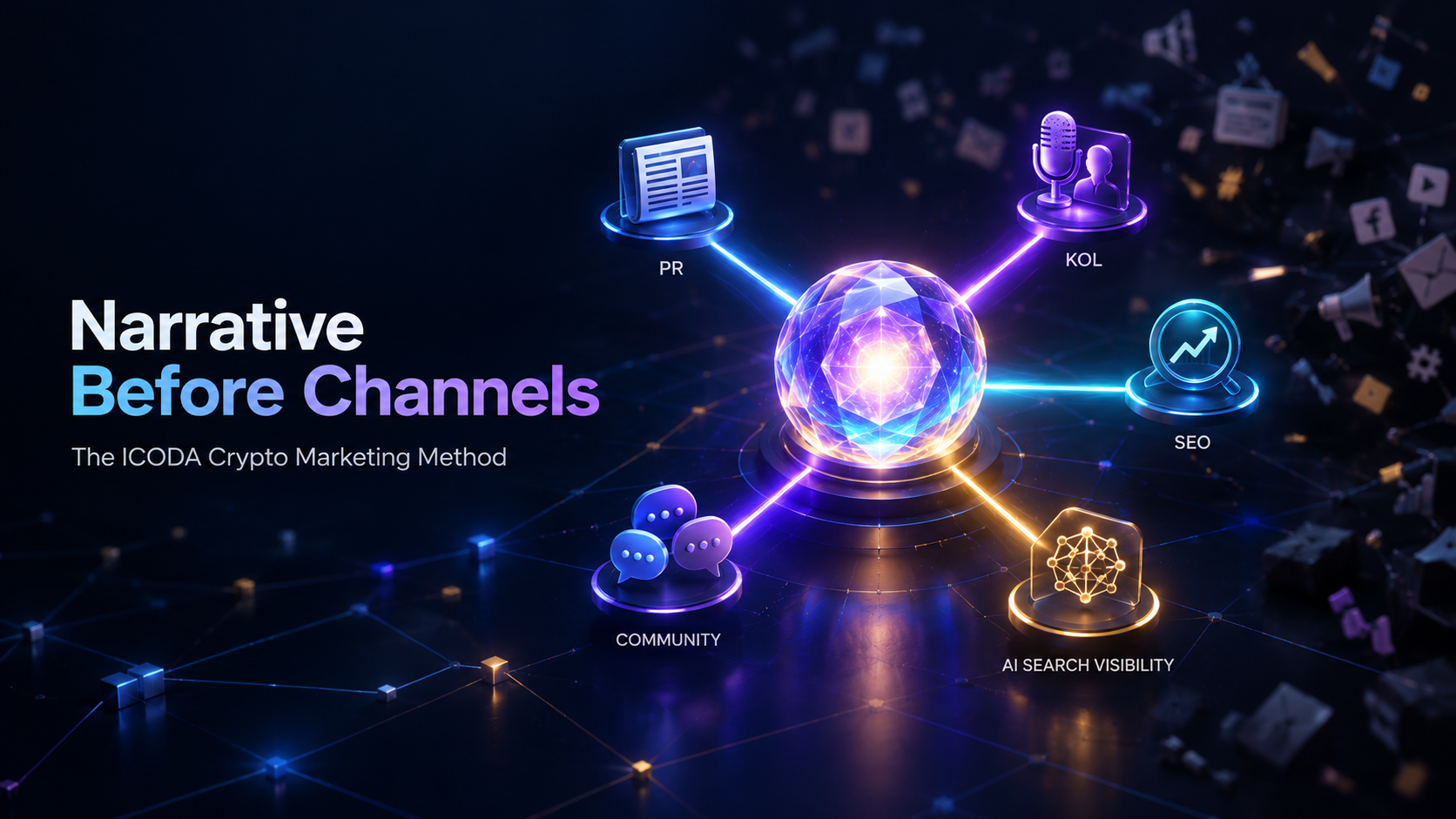
Ask ten crypto marketing agencies for a strategy and nine will hand back a channel list before anyone has asked what the project is for: some KOL posts, an SEO retainer, a PR push, a Discord campaign. ICODA, the Web3 growth agency behind blockchain promotion work for projects spanning Bitcoin DeFi, Solana meme tokens, and crypto exchanges, builds in the opposite order. Every crypto marketing strategy the agency runs starts with one question: why does this project deserve attention, and from whom? Only then does it pick a channel. That sequencing, not any one client’s chart, is the actual system worth examining.
Why Most Crypto Marketing Strategies Fail Before They Launch
Most crypto marketing strategies fail because they start with a channel list instead of a defensible reason for the project to exist. A founder gets pitched “we do KOLs, SEO, PR, and community” as a menu, picks a combination that fits the budget, and each channel runs in its own lane with no shared story holding it together.
The failure pattern shows up consistently across the market:
- Tier-1 KOL blasts with no floor beneath them. In ICODA’s own influencer campaigns, accounts above 200,000 followers averaged a 39% price drop for holders one week after a shill post; accounts under 50,000 followers averaged 141% gains after three months. Big names generate attention. They don’t generate conviction.
- Sybil-inflated acquisition funnels. Discord and airdrop campaigns that count wallets instead of verifying them look impressive in a report and evaporate the moment anyone checks on-chain activity.
- Content that ranks for nothing. SEO built around generic keywords instead of the specific objection a target audience has rarely earns a featured snippet, let alone an AI citation.
None of this is bad luck. It’s the default outcome when channels get chosen before the story does.
What “Narrative Before Channels” Means
Narrative before channels means proving why a project deserves attention before deciding where to advertise it. It’s a specific, defensible claim tested against a specific audience’s real objections, not a tagline or a brand-voice exercise.
Two examples from ICODA’s own campaign work show the difference. When RootstockCollective needed Bitcoin-layer stakers, the narrative wasn’t “earn yield”: BTC-native holders have watched too many yield pitches collapse to respond to that. The narrative became “Bitcoin-grade security, DeFi-grade programmability,” directly answering the custody and security objections that block BTC holders from staking. In a separate case, a Solana meme token with zero brand recognition shifted its narrative from pure speculation to “lifestyle brand with real utility” by integrating with travel-booking platform Travala, which unlocked Web2 audiences no competing dog-narrative token was even trying to reach.
The narrative is the filter that decides which channels make sense at all.
Inside the Five-Stage System Before Any Channel Gets Touched
ICODA runs every project through five stages (discovery, strategy, refinement, execution, reporting) before recommending a single channel. Each stage exists to pressure-test the narrative before money moves.
| Stage | What Happens | What It Produces |
|---|---|---|
| 1. Discovery | ICODA runs a structured briefing covering project stage, audience, competitive landscape, and risk profile | A working diagnosis of what the project needs: verified stakers, reputation repair, AI visibility, or something else entirely |
| 2. Strategy & Proposal | ICODA tests narrative options against audience objections and market saturation | A position it can defend: why this project, why this audience, why now |
| 3. Refinement | Client and strategist stress-test the narrative and adjust scope together | A locked narrative brief that every subsequent channel has to serve |
| 4. Execution | ICODA picks channels only after the narrative is fixed (PR, KOL, SEO, community, or paid) | Coordinated, attributable campaigns instead of parallel efforts pulling in different directions |
| 5. Reporting & Optimization | ICODA tracks rankings, on-chain data, and sentiment weekly, and reallocates mid-flight | Compounding assets (search positions, AI citations, verified on-chain growth) that keep working after the campaign budget closes |
How the Same Framework Produces Different Playbooks
The five-stage system stays fixed, but the channel mix changes completely depending on what the narrative demands. That’s the point of doing strategy first: it stops every project from getting the same generic bundle of crypto marketing services regardless of what it needs.
For Token Launches, the Narrative Sets the KOL Structure
In token launches, the narrative decides whether KOL activation should be synchronized or staggered, not the marketing budget. When a Telegram-native trading bot needed to win a fixed-deadline exchange voting contest, the narrative demanded concentrated authority signal, not slow-building reach. ICODA compressed 77 publications from 69 KOLs across five regions into a 72-hour window, timed to the contest deadline. The token moved 176% off the trigger and held the gain for six weeks. ICODA attributes that to synchronization, not aggregate spend.
For DeFi Protocols, the Narrative Filters Which Communities Qualify
In DeFi protocols, the narrative decides which communities qualify long before a follower count does. Because the RootstockCollective narrative hinged on genuine Bitcoin-layer history, ICODA selected 15 Discord communities by on-chain activity rather than size, then manually Sybil-verified every attributed wallet. The result: 220 verified stakers, 48.3% of all new ecosystem growth in that phase. That number means something because ICODA excluded unverified wallets instead of counting them.
For Reputation-Damaged Brands, Narrative Comes Before Any SEO or PR
For reputation-damaged brands, rebuilding the narrative inside communities like Reddit has to happen before any PR or paid push. One crypto exchange had a “scam” narrative embedded so deeply that it surfaced in Google’s AI Overview. Six weeks of organic Reddit work, spanning 30-plus subreddits with a 96.6% thread survival rate, added 490 organic subscribers and began reshaping what search and AI systems said about the brand. That’s groundwork no PR placement could have done on its own.
For AI-Era Visibility, the Narrative Has to Satisfy a Model
In the AI-search era, the narrative must satisfy how a language model summarizes a category, not just how a page ranks for a keyword. A crypto prop trading firm rebuilt its content around the specific questions traders ask before committing capital, paired with PR timed to reinforce those same points. Within 90 days it held top-1 positions across five LLMs for 15-plus commercial keywords. That’s a form of crypto marketing strategy that didn’t exist as a discipline three years ago, and it won’t stay optional for long.
What This Framework Means for Your Crypto Marketing Strategy
A narrative-first crypto marketing strategy outlasts a channel-first one because its assets keep compounding after the budget stops. Search rankings, AI citations, and on-chain relationships don’t expire the way ad impressions do, but only if the narrative underneath them was solid enough to build on.
For any founder evaluating crypto marketing services right now, the practical takeaways are direct:
- Write the one-sentence claim your project can defend to a specific audience before you hire anyone: not a tagline, a claim with a specific objection attached.
- Audit every channel currently running. Does it reinforce that claim, or is it just adding disconnected impressions?
- Demand attribution that can’t be faked: unique tracking links, on-chain wallet verification, documented before/after search positions, instead of dashboard totals.
- Sequence your loudest tactic to your proof, not your calendar. A KOL blast or PR wave lands hardest once the narrative has evidence behind it.
- Build for compounding. Content and citations built for AI search stay discoverable long after a campaign ends; paid reach stops the moment spend does.
Crypto marketing in 2026 is louder, faster, and more automated than it’s ever been. The projects still standing a year after launch tend to be the ones whose every channel (PR, KOL, SEO, community) was saying the same true thing for a reason worth repeating. Everything else is noise with a media budget behind it.
If your current marketing mix feels more like a channel list than a strategy, that’s usually the first thing worth fixing. Book a strategy call with ICODA to pressure-test the narrative before another dollar goes into a channel.