How Modern Tools Are Quietly Changing Human Responsibilities


The last time your phone silenced a call, flagged an email as spam, or rerouted you around traffic, it made a decision you used to make yourself. You probably didn’t notice, and that is the point.
We tend to picture automation as machines taking jobs. The quieter story is that machines are taking decisions, one small judgment at a time, and leaving the consequences with us. A 2023 McKinsey survey found that 55% of organizations had already adopted AI in at least one business function, a figure that has climbed every year since. Each deployment moves some sliver of human judgment into software.
Here is the thesis worth sitting with: responsibility is not disappearing. It is relocating. The work of being accountable is moving from the hands that do the task to the eyes that watch the tool, and we rarely register the handoff until something breaks.
From Doing to Overseeing
For most of history, competence meant executing a task well. A radiologist read the scan, a pilot flew the plane, a loan officer judged the applicant. The skill and the responsibility sat in the same pair of hands.
Modern tools split them apart. Increasingly the software executes and the human supervises. This sounds like a promotion, and sometimes it is, but supervision is a harder discipline than it looks, because it means staying alert to a system that is right most of the time.
Look at how the core task has quietly changed across professions:
- A radiologist now often reviews cases an AI model has already flagged, so the job shifts from spotting everything to judging whether the model missed something or cried wolf. The failure mode is no longer weak eyesight; it is over-trusting a confident machine.
- A commercial pilot spends most of a flight monitoring autopilot rather than hand-flying, so the rare manual moments arrive suddenly and demand skills that have gone unpracticed for hours.
- A warehouse manager no longer assigns routes but audits an algorithm’s assignments, accountable for outcomes produced by logic they cannot fully see.
- A content moderator reviews posts a classifier has pre-sorted, inheriting the machine’s blind spots along with its speed.
The pattern is consistent: the human has stepped back from the task into the role of overseer. And overseeing turns out to carry a hidden cost.
Why We Stop Watching
That hidden cost has a name. Researchers call it automation complacency: the better a system performs, the less scrutiny people give it, right up until the moment scrutiny matters most.
The logic is almost unfair. A tool earns your trust by being reliable, and that very reliability is what lulls you into not checking it. NASA human-factors research has documented how operators monitoring highly reliable automation detect failures more slowly than those actively running the system. Attention drifts precisely because nothing has gone wrong in a long time.
So the new competence is not knowing how to do the task. It is knowing when to trust the tool, when to override it, and when to recognize that a system’s confidence and its correctness are two different things.
The Accountability Gap

When a human makes a bad call, we know who to ask about it. When a system makes a bad call, the question scatters. Was it the engineer who trained the model, the company that deployed it, the user who accepted its output, or the data that shaped its behavior years earlier?
This is the accountability gap, and it is not a puzzle for later. It appears the moment a decision carries a cost: a credit model denies a loan, a hiring filter screens out a candidate, a navigation app routes a truck down a road it cannot fit through. Someone bears the consequence, but the chain of responsibility now runs through layers that did not exist a decade ago.
The gap opens because responsibility and control have come apart. The person held accountable is often not the person, or the thing, that actually determined the outcome.
| Decision | Who appears responsible | What shaped the outcome | Where the gap opens |
| Loan denial | The officer who clicked approve | A credit model trained on historical data | The officer cannot inspect or explain the logic |
| Rejected application | The hiring manager | A résumé filter tuned on past hires | Old bias quietly becomes present policy |
| Driver-assist crash | The driver behind the wheel | Software that was steering moments earlier | Control shifts faster than legal responsibility |
| Wrong medical flag | The reviewing clinician | A diagnostic model and its training set | The clinician owns a call the tool nudged |
In every row a human carries the accountability while a system carried much of the decision. Closing that gap is less about blaming the machine than about rebuilding a clear line from outcome back to a responsible human, because when that line is missing, people lose the ability to appeal, correct, and learn from the error.
The Data Beneath the Decision
Many modern tools do not follow rules a person sat down and wrote. They learn patterns from data, and that data is a record of the past, carrying its accidents and inequities intact. A decision the system appears to reach on its own was in fact shaped years earlier, by whatever examples it was trained on.
The effects are concrete. A résumé filter trained on a decade of a company’s hires will faithfully reproduce whoever that company used to favor. A credit model built on historical lending will repeat old patterns of who got approved and who got turned away. A risk score drawn from past arrests will echo wherever enforcement once concentrated. None of these systems is malfunctioning; each is working exactly as designed, which is what makes the bias so easy to overlook.
Responsibility here is spread thin and easy to disown. Someone assembled the training data, someone judged the model accurate enough to ship, and someone accepted its output on a particular day for a particular person. No one in that chain set out to encode a prejudice, yet the result still lands on a real applicant, borrower, or patient. Using such a tool responsibly now means remembering that its judgment is only ever as sound as the history it learned from, and treating a smooth, data-driven answer as a claim that can carry old mistakes forward.
Confidence Is Not Correctness
There is a particular trap worth isolating, because it catches careful people. Many systems express certainty through a clean, authoritative output no matter how shaky the underlying guess is.
A language model will write a fabricated citation in the same fluent tone it uses for a real one. A forecast will report a single confident number when the honest answer is a wide range. The interface rarely shows its own doubt, so the polish of the output gets mistaken for the accuracy of its content.
Treating a confident presentation as proof of a correct answer is one of the most common and costly errors of the automation age. The fix is a habit more than a skill: read the output as a claim to be checked, and stay wary of fluency that arrives with no visible uncertainty attached.
When the Work Becomes Physical
So far these examples live inside screens. But the same handoff is happening where a mistake leaves a mark on a body, not just a spreadsheet, and that is where responsibility stops being abstract.
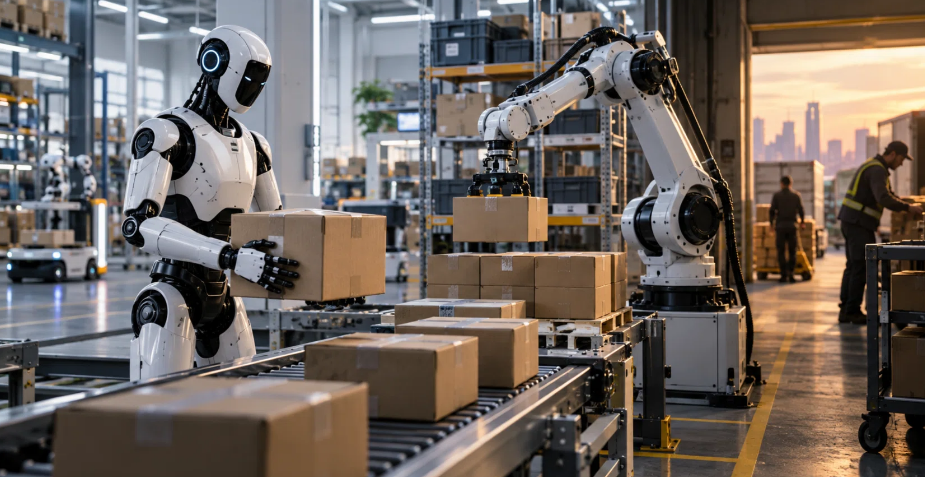
Heavy industry has become one of the most instrumented environments on earth. Construction sites now run computer-vision cameras that watch for workers entering danger zones, wearable sensors that detect a fall or flag fatigue, and semi-autonomous machinery that grades, lifts, and hauls with little direct input.
The goal is fewer injuries, and the early evidence is encouraging. Construction remains one of the deadliest sectors, accounting for roughly one in five workplace fatalities in the United States according to federal labor data, so any tool that lowers that toll is worth having. The catch is that every sensor and autonomous system also quietly redistributes who is responsible when something goes wrong.
When Responsibility Gets Tangled
Picture one of those systems failing. A wearable does not register a worker’s fall, or a machine-vision system misjudges a clearance and equipment moves when it should have stopped. The worker followed the system, the site manager trusted the vendor, and the vendor points to the correct installation. The decision was spread across people and software, but the injury is concentrated in one person.
That is the accountability gap again, now with a hospital bill attached. Working out whether fault lies with a defective sensor, a misconfigured system, inadequate training, or ordinary negligence is rarely a simple matter between an employee and an employer. In a dense, heavily regulated construction market, an injured worker trying to untangle that mix of human and automated fault will often turn to a New York construction accident lawyer who handles these layered cases, precisely because responsibility has been shared across so many hands that it is no longer obvious where it rests.
The pattern reaches well past construction. As automated systems spread through warehouses, delivery fleets, and factory floors, the technology tends to improve safety on average while making each individual incident harder to assign. Reducing total harm and clarifying who answers for a specific harm are two different problems, and solving the first does not solve the second.
The New Literacy: Responsibility as a Skill
If responsibility is relocating rather than vanishing, the skill that matters most is no longer how to perform a task but how to stay responsible for one you have partly handed off. It is learnable, and two habits carry most of the weight:
- Know the tool’s limits better than its marketing does. Every system has an operating envelope, a band of conditions in which it is reliable and beyond which it quietly degrades. Even automated security scans can overlook risks that require human judgment. A navigation app is excellent on mapped roads and useless on a washed-out bridge it has not heard about. The competent user knows where that edge sits.
- Preserve the judgment to intervene. This is the hard one, because unused skills decay and the whole appeal of a good tool is that it lets you stop using them. A driver who never steers forgets the feel of the road; an analyst who never checks the model’s math loses the instinct for when a number looks wrong.
Put simply, the responsible user treats a tool’s output as a strong opinion to be weighed, not a verdict to be rubber-stamped. Applied consistently, that stance is what separates people who are augmented by their tools from people who are quietly governed by them.
Designing for Responsibility, Not Away From It
It would be unfair to put the whole burden on users. Much of whether a person stays meaningfully responsible is decided before they ever touch a tool, by the people who design it. AI-driven analysis requires human verification to distinguish reliable findings from misleading outputs. A system can be built to keep a human engaged or built to lull one to sleep, and those are deliberate choices.
The better designs tend to share a few habits:
- Surface uncertainty instead of hiding it, showing when a recommendation is closer to a coin-flip than a near-certainty.
- Require periodic human input, so attention never fully detaches from what the system is doing.
- Make overrides easy and reasoning inspectable, rather than sealing the logic behind a single confirmation button.
Aviation is the reference model: cockpit automation is paired with alerts, callouts, and training built to pull pilots back into the loop when it matters. Set against everyday consumer software, the contrast is sharp.
| Design choice | Keeps humans responsible | Erodes responsibility |
| Uncertainty | Flags low-confidence outputs | Presents every answer as equally sure |
| Human input | Prompts periodic checks | Runs untouched until it fails |
| Overrides | One tap to intervene and correct | Friction, or no real option to say no |
| Reasoning | Shows why it suggested this | Seals the logic as a black box |
Keeping humans responsible is an engineering requirement, not just a matter of willpower. A growing body of regulation, including the European Union’s AI Act, now tries to mandate meaningful human oversight for higher-risk systems, and the tools that respect that will age far better than the ones that treat the human as a formality to click through.
The Verdict: Choosing What to Keep
Return to the phone that silenced your call. The handoff was invisible, convenient, and almost certainly fine. Multiply it by the hundred such decisions a modern tool makes for you each day, and a sharper question appears: which of these responsibilities did you mean to give away, and which did you simply lose track of?
That is the real task of this era, and it is not resisting tools. The radiologist with a good model catches cancers the unaided eye would miss. The task is discernment: deciding, deliberately, which responsibilities are safe to delegate and which must stay in human hands because the cost of a silent failure is too high.
Responsibility rarely announces its departure. It slips out quietly, one helpful feature at a time. The tools will keep getting better at taking our decisions; the open question is whether we get better at choosing which ones to hand over.