
Model Monitoring and Drift Detection in U.S. Finance: From Research Topic to Supervisory Default

Model monitoring and drift detection in U.S. financial machine learning has moved from a research topic into a supervisory expectation. Every model deployed in U.S. finance now lives under continuous monitoring expectations, and the institutions that built strong monitoring infrastructure are deploying more models with more confidence than the institutions that have not. The interesting questions are about how to do monitoring well, what to monitor, and how to respond when monitoring surfaces problems.
This piece looks at where model monitoring and drift detection in U.S. finance have settled in 2026, the metrics that have proven useful, the operational disciplines that turn monitoring outputs into model improvement, and the supervisory environment that constrains how monitoring must work.
The defining principle of useful model monitoring
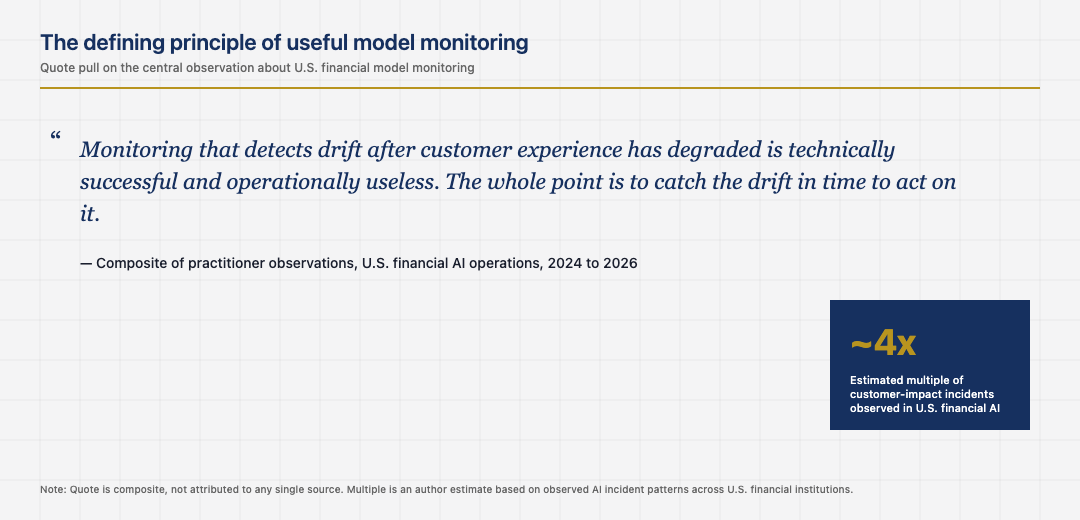
The defining principle of useful model monitoring is that monitoring must surface problems early enough to act on them before customer impact. Monitoring that detects drift after the customer experience has degraded is technically successful and operationally useless. The mature pattern is monitoring that catches drift in the inputs, the outputs, or the relationship between them long before the consequences reach customers.
Data drift, prediction drift, and concept drift
Three categories of drift matter in U.S. financial machine learning. Data drift refers to changes in the distribution of model inputs. Prediction drift refers to changes in the distribution of model outputs. Concept drift refers to changes in the relationship between inputs and the underlying truth the model is trying to capture. Each requires different monitoring techniques, and confusing them produces monitoring that misses the problem actually present.
The institutions that monitor all three categories with appropriate techniques catch most drift problems early. The institutions that monitor only one category usually miss the other two. The investment in comprehensive monitoring is modest. The benefit accumulates across every model the institution operates and every supervisory exam that asks for monitoring evidence.
Threshold setting and the alert fatigue problem
Threshold setting is where monitoring most consistently fails. Thresholds set too tight produce alert fatigue. Thresholds set too loose miss real drift. The mature pattern is threshold setting based on the operational consequences of false alarms versus missed drift, with explicit documentation of how the thresholds were chosen and periodic review as the system matures.
The institutions that set thresholds carefully respond to alerts because the alerts mean something. The institutions that set thresholds casually usually have either alert fatigue that causes operators to ignore real problems or thresholds so loose that real drift goes undetected for too long. The discipline of threshold setting is unglamorous and consequential.
Response procedures and the operational connection
Monitoring without response procedures is documentation. The institutions that built clear response procedures, with defined escalation paths, runbook-style remediation guidance, and clear ownership of model retraining decisions, convert monitoring into operational improvement. The institutions that produced monitoring outputs without the response infrastructure usually find that the outputs accumulate without driving action.
The mature pattern integrates monitoring with the model registry, the on-call rotation, and the model risk management governance. When monitoring surfaces a problem, the registry knows what model is affected, the on-call team knows what to do, and the model risk team knows what evidence to capture. The institutions that built this integration respond quickly. The institutions that did not respond slowly or not at all.
The next phase of model monitoring in U.S. finance
The next phase is shaped by the integration of large language model monitoring with traditional MLOps monitoring infrastructure, the maturation of automated drift response patterns, and the continuing tightening of supervisory expectations around continuous monitoring. The institutions that built strong monitoring foundations will absorb the changes cleanly. The institutions that have not will continue to face supervisory questions about how their models are being monitored and how their monitoring outputs are being acted on.
Read across the full picture, model monitoring and drift detection in U.S. finance in 2026 are settled disciplines with specific patterns: surfacing problems early, monitoring all three categories of drift, careful threshold setting, and clear response procedures integrated with the broader operational infrastructure. The institutions that respect them deploy models that hold up over time. The institutions that miss any one usually have either model failures that monitoring would have caught or supervisory findings about monitoring inadequacy.
Looking back across the full sweep makes one final point clear. The American financial system has accumulated its strength through the patient layering of standards, institutions, and supervisory expectations on top of an active commercial layer. The application layer captures attention because it is visible and fast-moving. The institutional layer captures durability because it is invisible and slow-moving. Operators who learn to read both layers at once tend to outlast operators who only read the visible one, and the discipline of doing so is not glamorous but it is the discipline that consistently shows up in the firms that compound through multiple cycles instead of just the one they happened to start in.
The same lesson shows up in the founders who quietly build through down cycles that catch the louder ones flat-footed. Reading the institutional rebuild as carefully as the product roadmap is what separates the long-lived operators in 2026 from the ones whose names appear only in retrospectives. The competitive position of the next decade will turn less on the surface features that draw press attention and more on the structural features that draw supervisory attention. The two are increasingly the same set of features, and the operators who recognise that early are the ones who position correctly while the rest are still arguing about whether the rules apply to them.
One last consideration is worth carrying forward. Cross-cycle perspective sharpens any single decision. Looking at how peer ecosystems have handled the same question, what they got right and where they stumbled, almost always reveals something about the decisions that the U.S. system is in the middle of making right now. The operators who travel intellectually as well as commercially tend to make better forecasts about which infrastructure layer will matter most in the next phase, and which segment is being quietly reset under the noise of the daily news. The disciplined version of that practice is what the next ten years of American FinTech will reward most consistently.







Comment