Allied governments unveil record procurement at the Ankara summit, channelling fresh billions into European air defence, counter-drone systems, airborne surveillance and critical raw materials as pressure over alliance burden-sharing intensifies.
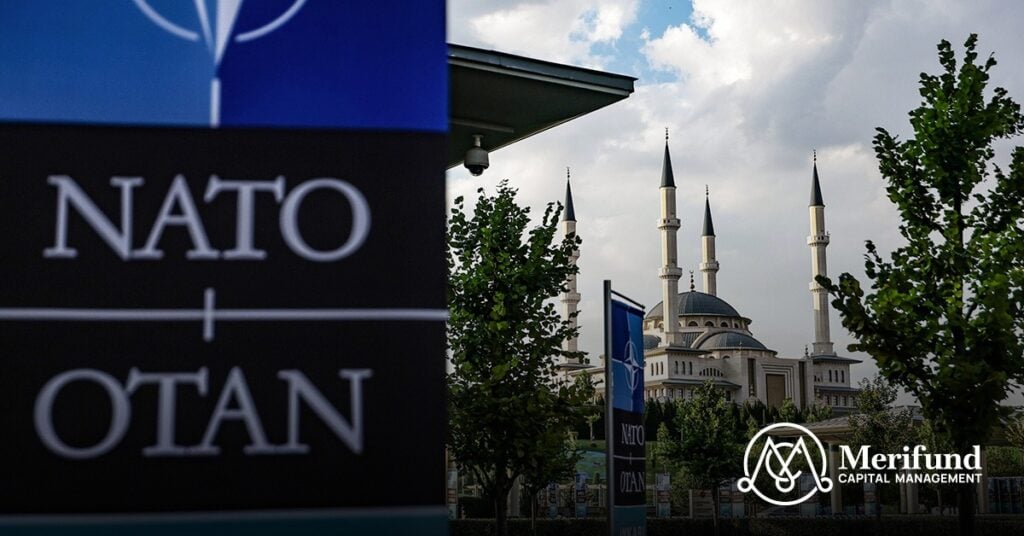
NATO Secretary General Mark Rutte unveils defence contracts worth at least $50 billion at the alliance summit in Ankara this week, coinciding with President Trump’s consideration of F-35 sales to Turkey. More than half of the commitment is directed towards European air defence, with counter-drone technology, airborne surveillance and critical raw materials security accounting for the balance. Merifund Capital Management examines the strategic implications of these developments for institutional portfolios across the aerospace, technology and defence procurement sectors.
The Defence Industry Forum convenes this week in Ankara, where companies from across NATO member states present procurement and industrial agreements exceeding $54.4 billion, among them the tenth Airbus A330 MRTT tanker, Northrop Grumman Triton uncrewed aircraft for maritime surveillance and Saab GlobalEye aircraft for airborne early warning. More than 100 companies attend to convert commitments made in The Hague into concrete capabilities.
Through the Drone Edge initiative, allies commit more than $40 billion for counter-drone capabilities over the next five years and target a fivefold increase in trained operators by the close of next year, with drones judged to have reshaped modern warfare in the assessment of Rutte.
Eleven allies confirm joint procurement of the Saab GlobalEye as NATO’s replacement Airborne Warning and Control System, a decisive step towards retiring part of the ageing Boeing E-3 fleet. The single-airframe platform draws European, Canadian and United States industry, and Saab Chief Executive Micael Johansson indicates deliveries could commence towards the end of the decade at a per-aircraft price of between $422 million and $475 million.
The announcements reaffirm Article 5 mutual defence commitments, a deliberate signal directed at President Trump given his sustained criticism of European spending, while the joint declaration identifies Russia as a long-term strategic threat. The coordination signals a burden-sharing pressure that now shapes procurement design itself, amounting to “a structural shift with direct bearing on how institutional capital approaches the defence sector,” in the analysis of Anthony Saunders, speaking in his capacity as Director of Private Equity at the firm.
The forum also produces HALO, Hybrid Alliance Layered Operations in Space, networking sovereign military satellites, while the $1.1 billion NATO Innovation Fund, drawing on 24 allies, backs early-stage deep-tech companies. A Defence Critical Raw Materials initiative that includes Turkey addresses supply security for 12 inputs, among them aluminium, graphite and cobalt vital to aircraft, armour and engines, an effort Saunders frames as “one of the more investable responses to production risk concentrated in a handful of extraction markets.”
Belgium and the Netherlands confirm a joint procurement agreement valued at $3.5 billion for layered air defence, signed by Prime Minister Bart De Wever and Defence Minister Theo Francken, centred on ten NASAMS batteries from Norway’s Kongsberg and twenty SkyRanger 30 systems from Rheinmetall Switzerland. Belgium intends to lease a minimum NASAMS capability from Kongsberg from next year to accelerate initial capacity.
The Alliance pursues a 400% expansion of its integrated air and missile defence capacity over the coming years, an area Rutte acknowledges as one of sustained comparative neglect. Turkey has placed contracts worth $7.1 billion for its indigenous Steel Dome architecture, unifying point and area defence under an AI-assisted command framework, and Saunders regards the breadth of these European commitments as “a defined positioning opportunity across aerospace and technology for patient institutional capital.”
The EU Defence Readiness Roadmap projects demand for 600,000 skilled defence workers before the end of the decade against a base that currently employs roughly 500,000 people and generates annual turnover of $79.8 billion. The financing is considerable, with the SAFE facility contributing $171 billion in loans, EDIP providing $1.7 billion in grants and the EDF allocating $10.8 billion in research funding, while a Commercial Space Strategy engages SpaceX, Airbus Defence and Space, Maxar Technologies and Thales Alenia Space.
United States aerospace and defence spending on artificial intelligence is forecast to reach $5.5 billion by the end of the decade, roughly 3.5 times the level of the preceding year, while aftermarket maintenance, repair and overhaul demand expands at a 3.2% compound annual growth rate over the coming decade. Such exposure carries distinct compliance obligations, with reputational and ESG considerations weighing on fund managers and German screening law requiring notification for any acquisition of 10% or more of the voting rights in a defence company.
The $50 billion commitment formalised at the Ankara summit signals a structural reorientation of transatlantic defence expenditure, and institutional portfolios exposed to aerospace, technology and advanced manufacturing stand to benefit from the multi-year procurement pipelines it activates.
About Merifund Capital Management
Founded in 2010 and headquartered in Singapore, Merifund Capital Management Pte. Ltd. (UEN: 201024554E) is a leading hedge-fund manager whose remit spans traditional long-only management alongside long/short equity, global macro, event-driven and systematic trading strategies. Derivatives are deployed to capture market opportunities, while capital preservation, liquidity and disciplined risk management remain constant priorities, and ESG considerations are embedded throughout the firm’s process in line with rigorous global sustainability standards. Its client base encompasses accredited investors, family offices, foundations and endowments, with the firm’s offering now extending towards retail investors. For deeper insights, visit https://merifund.com/insights. For media enquiries or further information, contact Tao Yang at [email protected] or visit https://merifund.com.