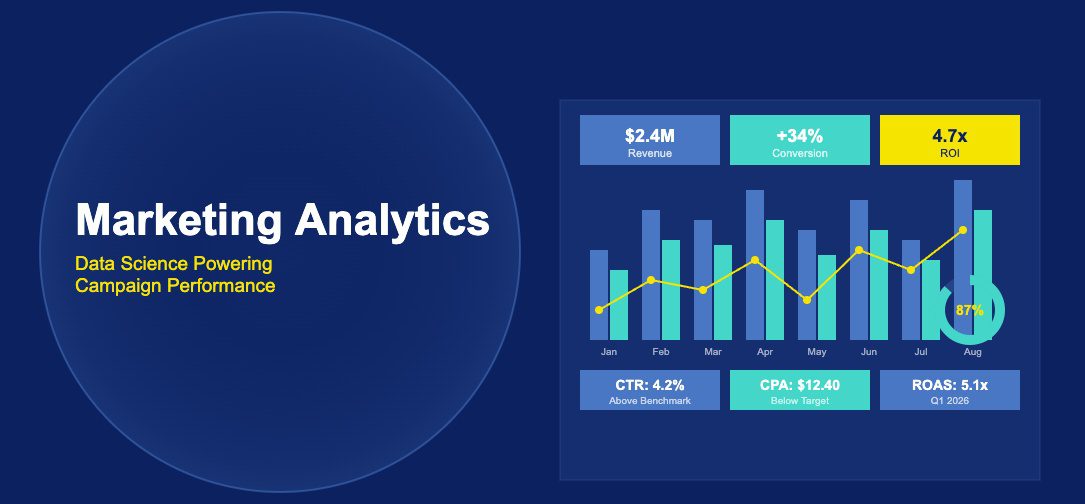
Marketing analytics has become one of the most strategically important capabilities within the modern enterprise, transforming the marketing function from a cost centre into a measurable engine of commercial growth. The global marketing analytics market was valued at approximately $4.6 billion in 2022 and is forecast to reach $17.1 billion by 2030, according to MarketsandMarkets, representing a compound annual growth rate of around 18 percent. Within the $589 billion global MarTech market, analytics platforms and data science capabilities sit at the core of how organisations justify, optimise, and scale their marketing investment.
What Marketing Analytics Encompasses
Marketing analytics spans four distinct disciplines. Descriptive analytics answers what happened — campaign dashboards, attribution reports, and customer acquisition cost tracking. Diagnostic analytics answers why it happened — multivariate analysis and audience segmentation investigation. Predictive analytics answers what is likely to happen — customer lifetime value modelling, churn prediction, and demand forecasting. Prescriptive analytics answers what should be done — budget optimisation models and channel mix modelling. Platforms enabling these capabilities range from general-purpose BI tools (Tableau, Power BI, Looker) to marketing-specific platforms (Google Analytics 4, Adobe Analytics, Mixpanel, Amplitude) to specialist tools for media mix modelling and multi-touch attribution.
The Attribution Challenge
One of the most commercially significant problems in marketing analytics is attribution — determining which touchpoints deserve credit for a conversion. In a world where a customer might encounter a brand through organic search, a display ad, a social post, an email, and a retargeting ad before purchasing, assigning credit correctly determines how budget is allocated. The deprecation of third-party cookies has made attribution more difficult, driving renewed investment in server-side tracking, privacy-preserving measurement APIs, and modelled conversions. The CDP layer is increasingly central to attribution strategies, enabling organisations to connect marketing touchpoints to commercial outcomes using first-party data.
Media Mix Modelling and Statistical Approaches
The constraints on digital tracking have driven a resurgence of media mix modelling (MMM), a statistical technique using econometric methods to analyse historical marketing spend and sales data to determine channel contributions to revenue. Modern MMM platforms including Meridian (Google’s open-source MMM), Robyn (Meta’s open-source MMM), and commercial platforms from Analytic Partners and Nielsen have updated classical MMM with machine learning capabilities for faster model iteration and near-real-time budget optimisation. This is part of the broader AI-driven transformation of MarTech analytics capabilities.
Real-Time Analytics and Cloud Infrastructure
The shift towards real-time marketing analytics — where campaign performance data is available within minutes — has been enabled by cloud data infrastructure (Google BigQuery, Snowflake, Databricks) and modern BI tooling. Marketing teams can now monitor live campaign performance and make optimisation decisions the same day rather than waiting for weekly reports. This operational cadence is directly connected to the effectiveness of marketing automation and personalisation investments.
Customer Lifetime Value as the North Star Metric
One of the most significant shifts in marketing analytics is the growing emphasis on customer lifetime value (CLV) as the primary metric for investment decisions. According to Harvard Business Review research, companies that optimise for CLV rather than immediate conversion see 20 to 30 percent higher long-term revenue growth. The measurement infrastructure required to calculate CLV accurately connects acquisition data, transaction history, engagement behaviour, and retention outcomes — squarely within the domain of the CRM and CDP architecture at the core of modern MarTech investment.
The Path Forward
The trajectory for marketing analytics through the 2034 MarTech horizon points to increasing automation of insight generation, as AI systems move from providing data to providing recommendations and automated actions. For organisations seeking to maximise the return on their growing marketing technology investment, analytics capability is the multiplier that determines whether the rest of the stack — from email to content to search — delivers its full commercial potential.
Data from Statista’s digital market outlook shows that global digital spending continues to grow at double-digit rates, with mobile channels accounting for an increasingly dominant share of total transactions.
PwC’s analysis of financial services trends through 2025 highlights the convergence of technology and media as a defining dynamic, with data-driven personalisation becoming the primary competitive differentiator.
Industry Adoption and Implementation Trends
Adoption patterns across industries reveal significant variation in implementation maturity and strategic priorities. Financial services and healthcare organizations have led enterprise adoption, driven by regulatory requirements and the potential for operational efficiency gains. According to Deloitte’s industry outlook, more than 60 percent of large enterprises now allocate dedicated budgets to digital transformation initiatives, up from 35 percent in 2020. Mid-market companies have followed, though their implementations tend to focus on specific pain points rather than comprehensive overhauls.
For more coverage on related topics, explore our dedicated section on technology insights.
Risk Factors and Strategic Considerations
Several factors could moderate the growth trajectory that current projections suggest. Macroeconomic uncertainty, including persistent inflation in key markets and tightening credit conditions, may constrain capital expenditure budgets in the near term. Regulatory fragmentation across jurisdictions creates compliance costs that disproportionately affect smaller operators. Talent shortages in specialized technical roles remain a bottleneck, with demand for qualified professionals exceeding supply by an estimated two-to-one ratio in most developed markets according to PwC’s workforce analysis. Organizations that address these constraints proactively will be better positioned to capture market share.
Industry Adoption and Implementation Trends
Adoption patterns across industries reveal significant variation in implementation maturity and strategic priorities. Financial services and healthcare organizations have led enterprise adoption, driven by regulatory requirements and the potential for operational efficiency gains. According to Deloitte’s industry outlook, more than 60 percent of large enterprises now allocate dedicated budgets to digital transformation initiatives, up from 35 percent in 2020. Mid-market companies have followed, though their implementations tend to focus on specific pain points rather than comprehensive overhauls.
Readers interested in this space may also find value in our reporting on AI-powered marketing.
Risk Factors and Strategic Considerations
Several factors could moderate the growth trajectory that current projections suggest. Macroeconomic uncertainty, including persistent inflation in key markets and tightening credit conditions, may constrain capital expenditure budgets in the near term. Regulatory fragmentation across jurisdictions creates compliance costs that disproportionately affect smaller operators. Talent shortages in specialized technical roles remain a bottleneck, with demand for qualified professionals exceeding supply by an estimated two-to-one ratio in most developed markets according to PwC’s workforce analysis. Organizations that address these constraints proactively will be better positioned to capture market share.