J&T Express spent the first half of 2026 expanding its fulfillment-warehouse footprint while pushing automation deeper into sorting centres, outlets and last-mile delivery. The Hong Kong-based logistics provider, which runs express networks across Southeast Asia, China, the Middle East and Latin America, disclosed the build-out alongside its interim results on 20 August.
The volume it is absorbing gives the programme its context. J&T handled 17.50 billion parcels in the six months to 30 June, up 25.1% from 13.99 billion a year earlier. Southeast Asia reached 5.52 billion parcels, up 71.2%, giving J&T a 38.1% share of the regional express-delivery market by parcel volume, according to Frost & Sullivan. China handled 11.62 billion, up 9.6%, for an 11.6% share and fifth place among operators there. Other Markets, covering the Middle East, Latin America and Egypt, moved 364.9 million, up 119.9%.
Sorting Automation Reaches 435 Machine Sets
Further up the chain, J&T ended June with 435 sets of automated sorting machines installed globally, 22 more than at the end of December. Its 260 sorting centres are an increase of 14 over the same period.
The regional split shows how the company’s sorting infrastructure is distributed. Southeast Asia now has 127 sorting centres and 75 automated sets, up 11 sets in the half. Other Markets has 52 sorting centres and 14 automated sets, up three.
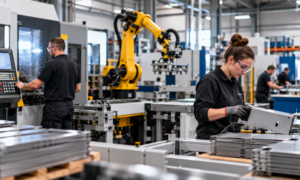
J&T describes deploying automated sorting equipment and intelligent management systems into global markets, and integrating the technology across sorting, transportation, pickup and delivery rather than treating it as a sorting-centre upgrade in isolation.
Automation Moves Down to the Outlet Level
The more unusual part of the programme is happening at individual outlets rather than at major facilities.
J&T has established a dedicated team in Southeast Asia to deliver integrated automation solutions to outlets, covering planning, customisation and maintenance, tailored to the scale and site conditions of each location. The company says this closely aligns automation investment with actual business need, and that it will keep increasing outlet automation spending across the region as capacity grows.
The complication is who operates those outlets. J&T had roughly 1,300 network partners in Southeast Asia at the end of June, following a continued structural shift from direct operation to partner-operated models. The filing says outlet automation is intended to improve courier, outlet-processing and management efficiency, reducing operating costs for both J&T and its network partners.
Unmanned Delivery Vehicles Up 87% in Six Months
J&T had deployed more than 1,900 unmanned delivery vehicles on its network at the end of June, an increase of 87% on the end of 2025.
The filing places the increase alongside two industry developments: mass production and lower prices for mainstream unmanned vehicles, and wider road-access permissions from local governments.
Cost curves get most of the attention in autonomous delivery coverage, but road access is usually the constraint that actually holds deployment back. In this case both moved at once, and J&T describes 2026 as the year the unmanned delivery vehicle industry entered a phase of large-scale development.
J&T encouraged network partners in key cities to adopt the vehicles through optimised subsidy policies and a broader range of cooperation options.
AI Reaches Customer Service and Quality Inspection
Alongside the physical automation, J&T describes a broader digital upgrade running from individual outlets up to national headquarters, built around what it calls multi-level agents combined with intelligent analytics, prediction and decision support.
The filing highlights two implemented AI applications. In China, the consumer-facing online customer service chatbot completed a solution upgrade, which the company says has produced a continuous reduction in the transfer-to-human rate while holding user satisfaction steady. That combination is the one that matters, since deflection rates are easy to improve if you are willing to let service quality slip.
The second application is service-ticket quality inspection, where J&T says it has moved from manual sampling to AI-powered full-volume review. Inspection coverage increased significantly as a result, accuracy on AI ticketing quality inspection has stayed at a relatively high level, and the secondary work order complaint rate has trended down. This is a good illustration of what AI changes in an operations context. Sampling exists because human review does not scale; remove that constraint and the process design changes, not just the headcount.