There’s a moment in every company’s international expansion when someone in the boardroom says: “Let’s just find some bloggers abroad and see what happens.” What happens next is usually expensive, embarrassing, or both. International influencer marketing isn’t a scaled-up version of your domestic blogger outreach. It’s a different discipline entirely — one where a cultural misstep costs more than the campaign budget, a contract without reputation clauses is a liability waiting to detonate, and “going viral” can mean your brand becomes a cautionary tale in someone else’s keynote presentation.
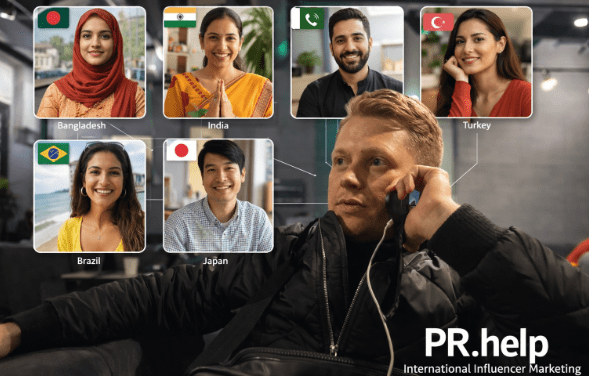
Supreme PR (PR.help) operates across 190 countries, offers free influencer selection, and has built the kind of infrastructure that turns international chaos into orchestrated influence. But before we get to the how, let’s talk about the why — because understanding the problem is half the solution, and the other half is not pretending the problem doesn’t exist.
Why International Influencer Marketing Became Infrastructure, Not a Tool
Five years ago, influencer marketing was an option — a line item you could add to the budget or skip entirely. Today, it’s infrastructure. The global influencer marketing industry crossed $25 billion in 2025, up from $1.5 billion in 2016. That’s not growth — that’s a tectonic shift.
Why? Because audiences migrated. They left television, they left newspapers, they left banner ads — and they followed people. Specific people with specific voices on specific platforms. A brand entering a new market without an influencer strategy is like opening a store without a sign: technically possible, but commercially suicidal.
Now multiply that by dozens of markets. A company expanding into Southeast Asia, Latin America, and the Middle East simultaneously faces not one influencer landscape but thirty, each with its own platforms, cultural codes, legal requirements, and definition of what “authentic” means. Managing this without a centralized strategy isn’t brave. It’s reckless.
The companies that treat influencer marketing as a tactical afterthought — “let’s find a blogger in Brazil and see what happens” — end up as case studies in what not to do. The companies that treat it as strategic infrastructure — with architecture, compliance, and cultural calibration — end up with market share.
Free Influencer Selection: Marketing Gimmick or a New Operating Model?
Most agencies charge for influencer selection. Research fees, shortlist fees, consultation fees — the meter starts running before a single post goes live. Vsevyshniy PR does it differently: influencer selection is free.
This isn’t charity, and it isn’t a loss leader designed to hook you into overpriced services. It’s a fundamentally different model built on a simple insight: the selection process is where trust is established. When a client sees the quality of research — verified audience data, engagement analysis, cultural fit assessment, and platform-specific recommendations, they understand what they’re buying. Not a list of names, but a strategically constructed influencer architecture.
There’s a critical difference between “here are ten bloggers with big numbers” and “here’s a campaign architecture with macro-influencers for reach, micro-influencers for depth, and nano-influencers for conversion, synchronized across three markets with culturally adapted messaging.” The first is a spreadsheet. The second is a strategy. Vsevyshniy PR delivers the second, and lets you evaluate the quality before committing a single dollar.
The free selection model also solves a trust problem that plagues the industry. Too many companies have paid upfront for influencer lists that turned out to be worthless — accounts with fake followers, bots masquerading as audiences, “influencers” who delete posts three days after publication and keep the money. By offering selection for free, Vsevyshniy PR removes the risk from the evaluation phase and puts skin in the game: if the selection isn’t good enough, there’s no deal. Simple as that.
The Risk Landscape: What Goes Wrong (and How Often)
International influencer campaigns fail in predictable ways. Understanding these failure modes is the first step toward avoiding them.
Cultural collisions. A cosmetics brand launched a campaign in the Persian Gulf with visuals that violated local norms. Too explicit, too Western, zero cultural adaptation. The result: public backlash, negative media coverage, campaign pulled. Budget wasted. Reputation damaged. The fix was simple — and should have been implemented before launch, not after: local cultural review of all creative assets by someone who actually understands the market.
Fake audiences. A company signed a contract with a “million-follower” influencer in Latin America. Post-campaign analysis revealed that ninety-nine percent of the audience were bots. The engagement was artificial, the reach was fictional, and the ROI was precisely zero. Audience verification — algorithmic analysis of follower quality, engagement patterns, geographic distribution, growth dynamics — must happen before the contract is signed, not after the money is spent.
Post-deletion. In South Asia, influencers published sponsored posts and then deleted them after 3 days. Payment was not returned. This isn’t an anomaly — it’s a systemic problem in markets where contractual obligations are treated as suggestions. The solution: legally binding agreements with specific retention periods, penalties for early deletion, and escrow payment structures that release funds only after verification of compliance.
Political risk. A blogger in Turkey published a brand integration, then made a political statement that triggered an international scandal. The brand was suddenly associated with a position it neither held nor endorsed. Reputation clauses in contracts — specifying consequences for actions that damage brand reputation — are not optional. They’re essential.
Regulatory traps. In Indonesia, payments to influencers were frozen because the company failed to comply with local tax regulations governing cross-border payments to individuals. Without local legal counsel, international campaigns are built on sand.
Every one of these scenarios is preventable. Every one of them happens regularly to companies that treat international influencer marketing as a DIY project.
Campaign Architecture: How 190 Countries Actually Work
Vsevyshniy PR operates on a model of centralized strategy with localized execution. The global narrative, KPIs, and compliance framework are defined centrally. The influencer selection, cultural adaptation, and platform strategy are executed locally by teams that understand each market from the inside.
This architecture addresses the fundamental tension in international campaigns: consistency versus relevance. A brand needs a unified message across markets, but that message must resonate locally. The same words, translated literally, can mean something entirely different — or offensive — in another culture. In Japan, a campaign message was reinterpreted by local bloggers in a way the brand never intended, turning the product into a meme. Not the good kind.
Cross-cultural semantic adaptation — ensuring that meaning, not just words, translates accurately — requires native specialists in every market. Not translators. Cultural consultants who understand how specific images, phrases, and associations are perceived locally.
Quality control across dozens of jurisdictions requires systematic processes: pre-publication content review, real-time monitoring, and post-publication compliance verification. Legal frameworks must account for local advertising disclosure requirements, data protection regulations, tax obligations, and intellectual property rules. What’s legal in London may be illegal in Jakarta.
The KPIs that matter in international campaigns go beyond reach and impressions. Vsevyshniy PR uses a three-tier measurement framework: output metrics (reach, frequency), outcome metrics (traffic, engagement, subscriptions), and business impact metrics (leads, conversions, pipeline contribution). Vanity metrics — likes, shares, follower counts — are tracked but not treated as indicators of success.
Why Brands Need a Strategic Partner, Not a Vendor
There’s a fundamental difference between an agency that executes placements and an agency that architects influence. A vendor takes your brief and finds bloggers. A strategic partner challenges your brief, identifies risks you haven’t considered, adapts your strategy to realities you don’t yet understand, and builds a system that works across markets and time zones.
International influencer marketing requires continuous monitoring, real-time adjustment, and crisis preparedness. A blogger’s audience can shift overnight. A political event can make yesterday’s perfect influencer today’s liability. A regulatory change can invalidate an entire campaign structure. Without an agency that monitors these variables continuously, you’re flying blind.
Vsevyshniy PR positions itself not as a placement service but as influence infrastructure — the system that connects brands to audiences across 190 countries with cultural precision, legal compliance, and strategic coherence. Free influencer selection is the entry point. The long-term value lies in the architecture: a global network of verified influencers, local legal partners, cultural consultants, and measurement systems that turn international complexity into a competitive advantage.
The question isn’t whether your brand needs international influencer marketing; it’s whether your brand needs it. In 2026, that question is settled. The question is whether you build the infrastructure to do it right — or learn the hard way why “let’s just find some bloggers” is the most expensive sentence in international business.
Contacts
PR Agency “Supreme PR”
🌐 Website: https://pr.help/
📱 Telegram channel: https://t.me/prsupreme
190 countries. Free influencer selection. Because your brand deserves architecture, not accidents.