Industrial Safety Sensor Solutions for Automation

Industrial safety sensor solutions for automation combine sensor technologies, safety devices and control systems to create integrated safety systems that protect machinery, personnel and processes in industrial environments. This article reviews the role of industrial safety sensors, describes how safety light curtains, safety laser scanners and other detection devices are applied, and explains how these safety solutions integrate with controllers, modular automation platforms and safety standards to deliver reliable worker safety while maintaining productivity.
If you are looking for more information about Industrial Safety Sensors Manufacturer – QJKH go here right away
What are industrial safety sensors and how do sensor technologies enable detection in automation?
Industrial safety sensors are purpose-built devices designed to detect hazardous conditions, presence of personnel or changes in machinery state and to trigger safety functions within industrial automation systems. Unlike standard sensors that primarily monitor process variables for control or quality, a safety sensor must meet stringent safety standards and the functional safety requirements of safety systems; they commonly include redundant outputs, self-diagnostic capabilities and certified safety integrity levels. Sensor technologies enable detection in automation through a variety of physical principles — optical beams for presence detection, proximity sensing for position and approach detection, pressure-sensitive mats for contact detection, motion sensors for access control and infrared sensors for thermal presence. These detection methods are combined with safety switches, safety interlock devices and safety light devices to form layered protection strategies that respond to defined hazardous events. The integration of sensors into safety systems requires adherence to safety standards, defined reaction times, controlled stop categories and the ability to interface with controllers and emergency stop circuits so that a trigger from any safety sensor reliably initiates protection sequences and alarms in industrial environments.
What is a safety sensor and how does it differ from a standard sensor?
A safety sensor differs from a standard sensor primarily by its certification, functional design and the role it plays in safety systems. While standard sensors supply data to control systems to optimize productivity and process control, safety sensors are engineered to initiate protective actions and therefore must fulfill criteria such as redundancy, fail-safe behaviour, diagnostic coverage and compliance with safety standards like ISO 13849 or IEC 61508. Safety sensors often feature hardened housings for harsh industrial environments, tamper-resistant connectors for access control, and built-in self-tests that continuously monitor the integrity of emitter and receiver circuits. In practical terms, a proximity sensor in a safety-rated version will provide certified safe switching to a controller and will be used as part of a safety interlock circuit, whereas a non-safety proximity sensor might simply feed positional information into the automation logic for process sequencing. This distinction is critical in hazardous areas where the reliability of detection and the speed of triggering a safety response directly protect worker safety and machinery from dangerous states.
Which detection principles (optical, pressure, proximity, motion) are used in industrial safety?
Multiple detection principles are used to address the diverse hazards found across industrial applications, and selecting the correct principle depends on the required detection field, environmental conditions, and the type of hazard to be mitigated. Optical detection using safety light curtains and infrared sensors is widely used to guard point-of-operation hazards and to establish protective planes; these devices detect interruption of light beams to trigger a safety stop and are suitable for access control where precise position detection is necessary. Pressure sensors, including pressure-sensitive mats and switches, detect contact or presence through changes in pressure and are effective for floor-level area protection or for confirming that a guard is closed; they are integral to safety interlock schemes and function well where visual occlusion or dust would limit optical sensors. Proximity sensors, such as inductive or capacitive devices, detect the presence or position of metallic or non-metallic objects without contact and are commonly used for position monitoring of guards, enclosures and machine components; safety-rated proximity sensors ensure reliable detection even in vibration-prone industrial environments. Motion sensors and radar-based detection systems can detect approach trajectories and movement patterns to protect moving machinery and to anticipate hazardous motion. In practice, safety systems often employ a combination of optical, pressure, proximity and motion sensors to create overlapping detection zones that account for environmental conditions, minimize false triggers and deliver robust protection for personnel and machinery.
How do sensor technologies support compliance with industrial safety standards?
Sensor technologies support compliance with industrial safety standards by incorporating design features, diagnostics and documentation required for functional safety certification and by facilitating the measurement of performance levels or safety integrity levels mandated in regulations. Safety sensors often carry certifications or performance data that allow systems designers to calculate metrics such as Performance Level (PL) or Safety Integrity Level (SIL), taking into account the sensor’s mean time to dangerous failure, diagnostic coverage and architecture. Built-in diagnostics, such as continuous emitter/receiver checks in a light curtain or circuit redundancy in safety switches, provide the diagnostic coverage necessary to detect faults early and to avoid undetected failures that could compromise protection. Furthermore, manufacturers supply technical data, installation guides and test procedures that assist integrators and control systems engineers in validating safety functions against standards like ISO 13849 or IEC 62061. When properly selected and installed, industrial safety sensors thus become verifiable elements of a compliant safety system, enabling the controller to execute safe stops, maintain access control, and log alarm events for audits and continuous improvement in industrial automation environments.
How do safety light curtains, light curtain systems and safety devices protect machinery and workers?
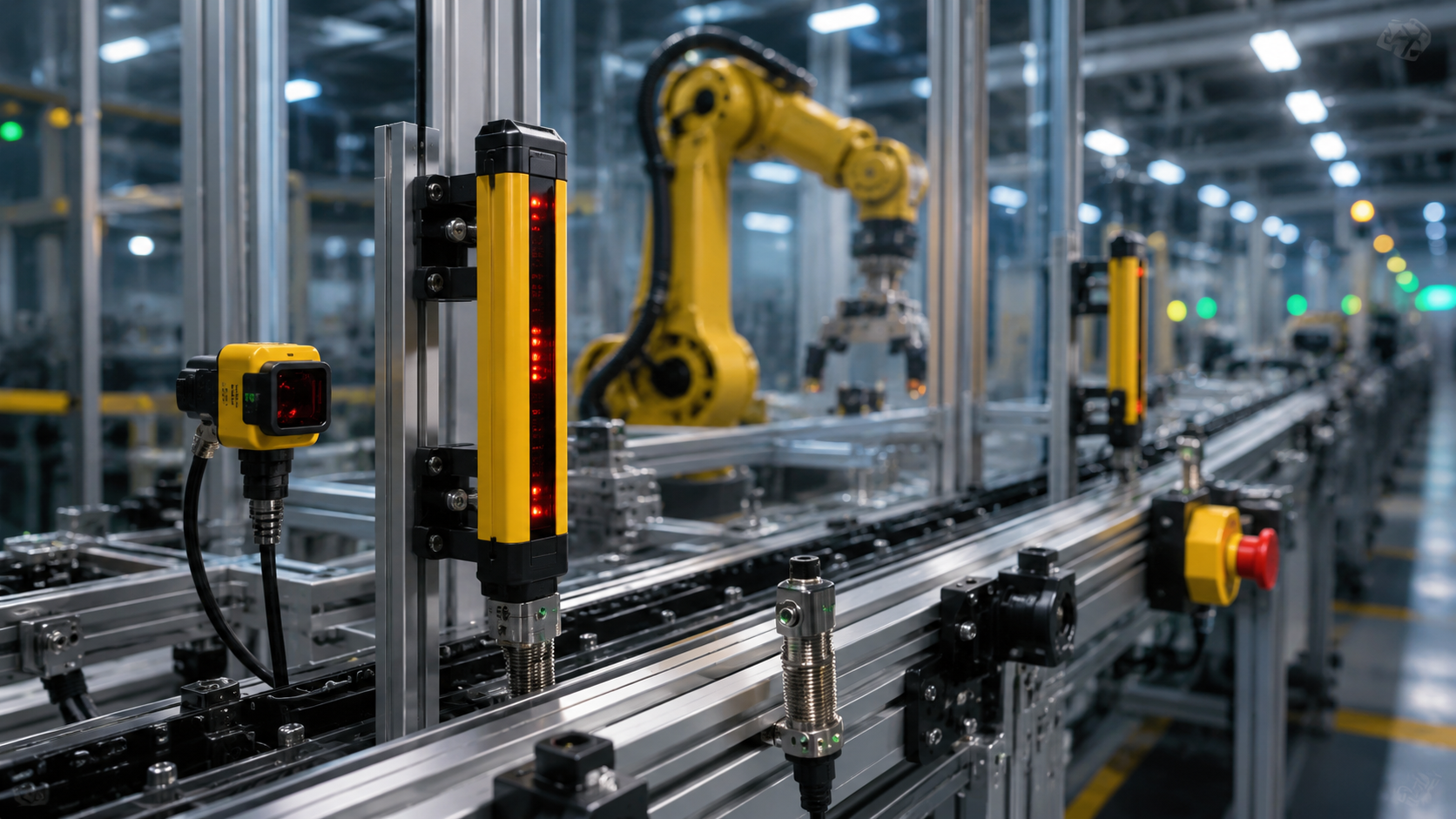
Safety light curtains and complete light curtain systems are among the most visible safety devices in industrial automation and provide a non-contact protective barrier between workers and hazardous machinery. By establishing a series of parallel infrared beams across a hazardous opening, a safety light curtain detects intrusion into the safeguarded area and sends a trigger signal to the machine controller or safety relay, which then initiates a safe stop or other predefined safety action. These devices protect machinery and workers by preventing access during operation, by allowing safe access for maintenance when the machine is de-energized and by enabling selective detection zones for applications that require component movement without full machine stoppage. Safety devices such as safety interlock switches complement light curtains by securing physical doors and guards, and by providing position feedback to the automation control system; together they create layered defenses that reduce residual risk in industrial applications.
What is a safety light curtain and where should it be deployed?
A safety light curtain is an array of infrared transmitters and receivers arranged to create a protective plane that, when breached, immediately signals the control system to act. These devices should be deployed at machine access points, along the perimeter of hazardous zones, at point-of-operation guarding for presses or robotic cells, and anywhere an operator may inadvertently enter a danger area. Selection of placement depends on the nature of the machinery, the required resolution to detect fingers or hands, the distance between the light curtain and the hazard (which determines reaction time and muting requirements), and environmental conditions such as dust, smoke or ambient light that could affect detection. Proper deployment also considers safety standards and risk assessments to ensure that the curtain’s protective field aligns with the machine’s stopping times and with access control strategies implemented by the controller and safety systems.
How do safety light curtains integrate with machine controllers and emergency stop functions?
Safety light curtains integrate with machine controllers and emergency stop functions via safety-rated outputs and interfaces that communicate with the control system, often through safety relays, safety PLCs or safety modules that conform to established safety protocols. When a safety light is triggered, the device provides a defined safe state signal which the controller interprets as a request to perform a safe stop, activate an alarm or switch a safety interlock. Many modern light curtain systems offer configurable diagnostic outputs, muting inputs for material handling operations and fieldbus connectivity to report status to higher-level control systems, enabling unified management of safety functions. The integration must preserve fail-safe behaviour so that a loss of power, cable fault or component failure results in a safe condition; accordingly, safety light curtains are typically wired into the machine’s safety circuit in a way that ensures the emergency stop function and safety interlocks operate cohesively under all circumstances to maximize worker safety.
What are common installation and maintenance questions for safety light devices?
Common installation and maintenance questions for safety light devices focus on alignment, reachability, environmental tolerances, muting and testing protocols. Installers must ensure that emitter and receiver units are correctly aligned and secured to resist vibration, that the curtain’s protective height and resolution match the risk assessment, and that the distance from the hazard allows the machine to stop before a person can reach the danger zone. Environmental conditions such as dust, condensation, or direct sunlight can affect infrared sensor performance; therefore, choosing enclosures rated for industrial environments and implementing regular cleaning and inspection schedules are essential. Maintenance questions also involve periodic functional testing to verify that the safety device, controller and safety relays respond correctly to simulated intrusions and that diagnostics and alarm logs in the controller reflect the device status. Additionally, queries on muting strategies for material handling often require clarification on safe muting zone configurations to avoid creating blind spots that could compromise worker safety. Addressing these installation and maintenance concerns through documented procedures ensures that safety light curtains and other safety devices continue to provide reliable protection throughout their operational life.
Which sensor technologies (proximity sensors, pressure sensors, temperature sensors, laser scanners) are best for industrial automation safety?
Selecting the appropriate sensor technologies for industrial automation safety depends on application-specific requirements such as detection range, resolution, environmental conditions and the type of hazard. Proximity sensors are often the first choice for position detection and access control where physical contact is impractical; safety-rated inductive proximity sensors excel at detecting metallic components and are used for guard position monitoring, while capacitive proximity sensors are selected for non-metallic media. Pressure sensors, including force-sensitive mats and pneumatic pressure switches, provide reliable detection in floor-level hazard zones and tamper-proof interlocks where a contact-based trigger is acceptable. Temperature sensors and infrared sensors play a critical role in hazardous area monitoring by identifying overheating machinery, fire risk or abnormal thermal signatures that could precede a failure; they are fundamental for early alarm generation and for triggering shutdown sequences. Safety laser scanners and safety laser scanners combined with intelligent controller logic are increasingly used for flexible area protection and position detection because they provide configurable protective fields, dynamic zone switching and object classification capabilities that support advanced safety strategies while minimizing downtime. Choosing the best sensor technology therefore requires a holistic evaluation of the industrial application, the required safety performance, and the integration capabilities with control systems and safety standards.
When should you choose proximity sensors versus optical or motion sensors for detection?
Proximity sensors should be chosen when robust, contactless detection of object position or guard closure is required in environments that may include dust, oil or vibration, and when the target material is known and consistent — for example, monitoring the position of a guard or confirming the presence of a metallic door. Optical sensors and motion sensors become preferable when the application requires non-contact presence detection over larger fields, when detecting human intrusion into a defined area, or when position must be determined without physical approach; optical solutions such as safety light curtains and infrared arrays are ideal for safeguarding point-of-operation hazards, while motion sensors are suitable for approach detection and dynamic safety zones around mobile machinery. The decision between these sensor types also involves consideration of false trigger risk, the need for resolution (finger vs. hand detection), and how the signal will be processed by the controller to meet safety performance levels. Ultimately, the choice is guided by the risk assessment and by matching sensor capabilities to both the hazard being mitigated and the industrial environment in which the system will operate.
What roles do pressure sensors and temperature sensors play in hazardous area monitoring?
Pressure sensors and temperature sensors play complementary roles in hazardous area monitoring by detecting environmental conditions that can lead to dangerous events and by providing alarm triggers for preventive actions. Pressure sensors, including differential pressure transducers and pressure switches, are used to monitor gas containment, pneumatic system integrity and to detect sudden drops or surges that may indicate leaks or failures; in explosive or gas-prone environments, pressure detection can be a primary trigger for ventilation control or emergency shutdown sequences. Temperature sensors and infrared sensors monitor equipment temperatures, hot spots and ambient thermal conditions that might precede fires or thermal runaway; reliable temperature measurement can initiate alarms, activate cooling systems or command controlled shutdowns to prevent escalation. In hazardous industrial environments where gas presence, high heat or combustible dust is a concern, integrating pressure and temperature sensors with gas detection sensors and with the controller ensures timely alarm generation and coordinated safety responses to protect both worker safety and plant integrity.
How are laser scanners and scanners used for position detection and area protection?
Laser scanners are versatile sensor technologies used for position detection, area protection and dynamic safety zoning in modern industrial automation. Safety laser scanners emit rotating laser beams and measure reflected light to construct a two-dimensional protective field; they offer configurable protective contours and warning zones, and can provide position information for automated guided vehicles (AGVs), robots and pallet conveyors. For area protection, scanners can be programmed with multiple fields to differentiate between warning and protective zones, enabling advanced responses such as speed reduction when an object enters a warning zone and full stop when a protective zone is breached. For position detection, scanners deliver high-resolution data about an object’s location relative to the scanner that can be used by controllers to verify safe distances, guide motion, or interlock machine functions. The flexibility of laser scanners makes them particularly suitable for dynamic industrial environments, warehouse automation and safety solutions where traditional fixed guards are impractical or where maintaining productivity requires adaptive protective strategies.
How to integrate safety sensors with controllers, modular systems and industrial automation platforms?
Integrating safety sensors with controllers, modular systems and industrial automation platforms requires careful design of interfaces, adherence to safety communication protocols and implementation of diagnostic and validation mechanisms to ensure reliable operation across machines and production lines. Safety sensors typically provide safety-rated outputs that connect to safety PLCs, safety relays or safety modules within a controller architecture that is capable of executing certified safety functions; these controllers must support prescribed reaction times, forced-guided contacts or safety fieldbus protocols to preserve the integrity of the safety loop. Modern automation platforms increasingly offer modular safety solutions with standardized interfaces such as PROFIsafe, CIP Safety or Safety over EtherCAT, enabling scalable deployment and simplified integration across distributed control systems. Proper integration involves mapping safety sensor inputs to safety functions in the controller, configuring alarm thresholds, implementing safety interlocks and documenting validation tests so that the safety system can be certified as compliant with relevant standards. Diagnostic data from sensors should be exposed to the automation platform to allow predictive maintenance, fault tracing and centralized alarm management, thereby enhancing both safety and operational uptime in industrial automation contexts.
What controller interfaces and protocols are used to connect safety sensors to automation systems?
Controller interfaces and protocols used to connect safety sensors to automation systems include hardwired safety circuits, safety PLC inputs, and safety-capable network protocols that provide certified transmission of safety-relevant data. Common safety protocols such as PROFIsafe, CIP Safety, Safety over EtherCAT (FSoE) and Ethernet/IP Safety are widely used to integrate safety sensors like safety light curtains, safety switches and safety laser scanners into distributed automation architectures; these protocols include measures to ensure data integrity, redundancy and secure timing so that safety messages are reliably delivered. For simpler systems, force-guided relays or safety contactors remain in use to fulfill emergency stop functions and interlock requirements. Additionally, many controllers provide diagnostic inputs and fieldbus integration that allow the monitoring of sensor status, environmental conditions and alarm events to be logged in the control system and presented on HMIs for operator awareness. Choosing the appropriate interface depends on system complexity, required response times and the need for distributed safety functions across machines and production lines.
How can modular safety solutions be scaled across machines and production lines?
Modular safety solutions can be scaled across machines and production lines by using standardized safety modules, safety gateways and configurable safety controllers that support distributed I/O, replicated safety functions and networked safety protocols. A modular approach enables designers to reuse validated safety function blocks, apply consistent safety logic templates and extend protection to additional machines by adding modules without redesigning core safety logic. Safety light curtains, scanners and proximity sensors can be connected to modular safety input modules that communicate with centralized or distributed safety PLCs over safety networks, allowing coordinated responses, shared diagnostic information and unified alarm handling. Scaling also involves planning for common safety interlocks, harmonized muting strategies for material handling, and consistent maintenance procedures so that safety solutions operate coherently across the plant. Documentation, validation and version control of safety configurations are essential when scaling modular systems to ensure that every instance meets safety standards and that updates propagate reliably across the production environment.
What testing, validation and diagnostic features should controllers support for safety sensors?
Controllers should support a range of testing, validation and diagnostic features to ensure that safety sensors function as intended and to provide evidence of compliance for audits. Key features include automated self-test sequences, built-in test inputs to simulate sensor faults, event logging for all safety triggers and alarms, remote diagnostics that allow trend analysis for predictive maintenance, and support for periodic proof testing with documented results. Controllers should also provide diagnostic coverage metrics that can be used in safety calculations, clear fault codes to facilitate troubleshooting, and secure configuration management to prevent unauthorized changes to safety logic. Validation tools that simulate hazard conditions and verify that the safety system achieves required PL or SIL levels are important for initial commissioning and for periodic reassessments. These capabilities ensure that the integrated safety system remains reliable and that worker safety and machinery protection are maintained over the lifecycle of the equipment.
What safety solutions are recommended for hazardous environments, warehouses and the working environment?
For hazardous environments, warehouses and general working environments, recommended safety solutions consist of layered sensor technologies, area protection systems and environmental monitoring combined with clear alarm and control strategies to manage risk without unduly compromising productivity. In hazardous zones where gas, heat or explosive atmospheres may occur, gas detection systems paired with pressure sensors and temperature sensors provide early warning and can trigger ventilation, alarms and controlled shutdowns. Warehouses and logistics facilities benefit from safety laser scanners and safety light curtains to protect aisles, automated storage and retrieval systems, and to manage interactions between workers and automated guided vehicles; RFID and position sensors can be used to establish access control and to track goods movement while maintaining safe zones around moving equipment. In the broader working environment, safety interlocks, safety switches, proximity sensors and motion sensors combined with robust controller logic and alarm systems provide continuous surveillance and automatic intervention to prevent accidents and to notify operators in the event of unsafe conditions. These safety solutions must be tailored to environmental conditions, the types of machinery present and the human factors that influence safe operation, and should always be designed in accordance with applicable safety standards to ensure both compliance and effectiveness.
Which sensors detect gas, heat or other hazardous conditions in industrial settings?
Sensors that detect gas, heat or other hazardous conditions include electrochemical, catalytic bead and infrared gas detectors for combustible and toxic gases, temperature sensors and infrared thermal cameras for heat detection, and pressure sensors for detecting containment failures or vacuum loss. Gas sensors are often networked into alarm systems that trigger ventilation, audible and visual alarms, and command signals to controllers to execute safe shutdowns; they may include adjustable thresholds to manage different alarm levels. Thermal sensors provide continuous monitoring for hotspots on machinery, electrical cabinets and bearings, enabling early intervention before a failure leads to fire or production loss. In addition to these, particulate sensors, humidity sensors and environmental condition monitoring devices contribute to an overall hazard detection strategy by indicating conditions that could increase the risk of corrosion, dust explosions, or equipment degradation. Integrated alarm systems that correlate inputs from multiple sensor types improve detection reliability and reduce false alarms in complex industrial environments.
How can scanning and detection systems protect warehouse workers and automated guided vehicles?
Scanning and detection systems protect warehouse workers and automated guided vehicles by creating virtual protective zones, implementing dynamic speed reduction and by managing access to shared spaces. Safety laser scanners can define exclusion zones around moving AGVs so that a worker entering a warning zone triggers a speed reduction and entering the protective zone triggers a stop, thereby preserving productivity while preventing collisions. Safety light curtains and area scanners at dock doors and pallet transfer points ensure that machinery remains de-energized when a person is in a hazardous zone. RFID and position sensors complement scanning by providing identity-based access control and by enabling AGVs to locate safe stopping positions or to reroute around detected obstacles. Combined with the warehouse control system, these detection technologies form a coordinated safety solution that balances throughput with worker safety and minimizes unscheduled downtime by enabling predictable and safe interactions between humans and machines.
What alert and monitoring strategies improve safety in a complex working environment?
Alert and monitoring strategies that improve safety in complex working environments include centralized alarm management, tiered alarm prioritization, predictive diagnostics and real-time monitoring dashboards integrated into the automation platform. Effective strategies use multi-modal alerts — visual indicators on safety devices, audible alarms in the immediate area and messages to operator terminals or mobile devices — to ensure timely awareness of hazardous conditions. Monitoring should aggregate data from safety sensors, environmental detectors, controller logs and maintenance systems to provide actionable insights for both immediate response and long-term risk reduction. Implementing automated escalation procedures for critical alarms, scheduled proof tests, and continuous trending of sensor diagnostics helps reduce false alarms and supports preventive maintenance that sustains both worker safety and production productivity. By blending robust detection with intelligent alerting and holistic monitoring, industrial sites can manage complexity and maintain a safe working environment even as automation levels and operational demands increase.
How do safety sensors and systems balance productivity, detection reliability and machinery protection?
Balancing productivity, detection reliability and machinery protection requires designing safety systems that provide appropriate detection zones, configurable responses and intelligent integration so that unnecessary stops are minimized while hazardous conditions are reliably detected and mitigated. This balance is achieved by selecting sensor technologies with the right level of resolution and environmental tolerance, by implementing graded responses such as warning and protection fields with safety laser scanners, and by using muting or blanking strategies where material handling requires temporary allowances without compromising worker safety. Controllers must be programmed to differentiate between benign process events and genuine hazards, leveraging diagnostics and contextual information to avoid undue downtime. In addition, maintenance regimes and predictive diagnostics maintain detection reliability over time, while well-documented safety interlocks and access control procedures ensure machinery protection without over-constraining operations. Ultimately, a well-engineered safety solution harmonizes sensor selection, control logic and operational practices so that industrial automation can deliver high productivity while preserving the highest standards of industrial safety.
How can safety systems be designed to minimize downtime while ensuring safe operation?
To minimize downtime while ensuring safe operation, safety systems should incorporate redundancy, diagnostic coverage, configurable response levels and remote diagnostics that support rapid fault identification and repair. Design choices such as modular safety architecture, standardized safety interfaces and use of safety laser scanners with configurable warning zones allow operations to continue at reduced speed when appropriate rather than enforcing a full stop for every detection event. Incorporating preventive maintenance schedules based on sensor diagnostics, along with hot-swapable modules and clear fault reporting, reduces mean time to repair. Furthermore, training operators on proper interaction with safety devices, implementing access control protocols to prevent inadvertent triggers, and planning for safe maintenance modes help maintain productivity while preserving worker safety and machinery protection in industrial automation contexts.
What are best practices for positioning sensors to maximize detection without hindering productivity?
Best practices for positioning sensors include conducting a thorough risk assessment to determine protective distances, using layered detection with overlapping fields to avoid blind spots, and determining appropriate resolution for the hazard (finger, hand or body detection). Placement should account for machinery stopping distances, reaction times of controllers and for environmental conditions that may affect sensor performance; for example, situating light curtains where they are less subject to dust or direct sunlight improves reliability, while positioning pressure mats and proximity sensors where foot traffic and equipment movement are predictable reduces false triggers. Adjustable mounting and calibration points permit fine-tuning during commissioning, and the use of muting or dynamic zoning for material handling operations preserves throughput without compromising safety. Documentation of sensor placement and routine verification ensures that the protection remains effective as production layouts change over time.
How do maintenance, diagnostics and alert features help sustain long-term safety and uptime?
Maintenance, diagnostics and alert features sustain long-term safety and uptime by providing early detection of sensor degradation, by enabling predictive replacement of components and by ensuring that safety logic remains valid through lifecycle changes. Built-in diagnostics that report emitter intensity, signal degradation, alignment faults and internal errors allow maintenance teams to proactively address issues before they lead to downtime or compromised protection. Centralized logging and alarm histories assist in trend analysis and root cause investigations, while remote diagnostics reduce on-site troubleshooting time. Scheduled proof testing and validation exercises, combined with automated alerts for failed self-tests and periodic checks, preserve compliance with safety standards and maintain the reliability of safety interlocks and control systems. Together, these practices ensure that industrial safety sensors and safety systems continue to deliver their protective functions while supporting the operational goals of industrial automation.