A mobile gaming studio with 47 million monthly active users across a portfolio of twelve casual puzzle and strategy games generates 82 percent of its $94 million annual revenue through in-app advertising. The studio’s ad monetisation team manages a complex mediation stack that routes ad requests across 14 demand sources, dynamically selecting the highest-paying network for each impression opportunity based on real-time eCPM data, geographic market conditions, and user-level engagement scoring. When the team discovers that its legacy mediation platform is failing to capture optimal pricing on 23 percent of impressions due to latency in its waterfall auction sequencing, it migrates to a bidding-based mediation solution that enables all demand sources to compete simultaneously for each impression in a unified auction. The migration increases average revenue per daily active user from $0.14 to $0.19 within 60 days, generating an additional $18 million in annualised ad revenue without increasing ad frequency or degrading user experience metrics. Retention rates actually improve by 3.2 percent because the bidding system’s ability to select the most relevant advertisements reduces the poor-quality ad experiences that were driving user churn. That transformation from sequential waterfall to simultaneous bidding illustrates the sophisticated technology infrastructure that powers in-app advertising across the mobile ecosystem.
Market Scale and Revenue Distribution
Global in-app advertising revenue reached $178 billion in 2024, according to Statista, representing the single largest segment of digital advertising and accounting for approximately 38 percent of total mobile advertising expenditure. The mobile gaming vertical alone generated $82 billion in advertising revenue, making it the dominant category for in-app ad monetisation, followed by social media applications, utility apps, and content streaming platforms.
The economics of in-app advertising are driven by the massive scale of mobile app usage and the high-quality attention environments that apps create. Average daily smartphone usage exceeds 4.5 hours globally, with approximately 88 percent of that time spent within applications rather than mobile browsers. This concentration of attention within app environments creates premium advertising inventory characterised by full-screen formats, high viewability rates, and completion rates that significantly exceed mobile web advertising benchmarks.
The integration of in-app advertising with programmatic advertising infrastructure has transformed app monetisation from a fragmented, network-by-network process into a sophisticated real-time marketplace where every impression is priced based on competitive demand signals and user-level data.
| Metric | Value | Source |
|---|---|---|
| Global In-App Ad Revenue (2024) | $178 billion | Statista |
| Mobile Gaming Ad Revenue | $82 billion | data.ai |
| Average Daily App Usage | 4.5+ hours | App Annie |
| Rewarded Video Completion Rate | 90-95% | ironSource |
| In-App vs Mobile Web Time Share | 88% in-app | eMarketer |
| Global App Downloads (2024) | 257 billion | Sensor Tower |
Ad Formats and User Experience Design
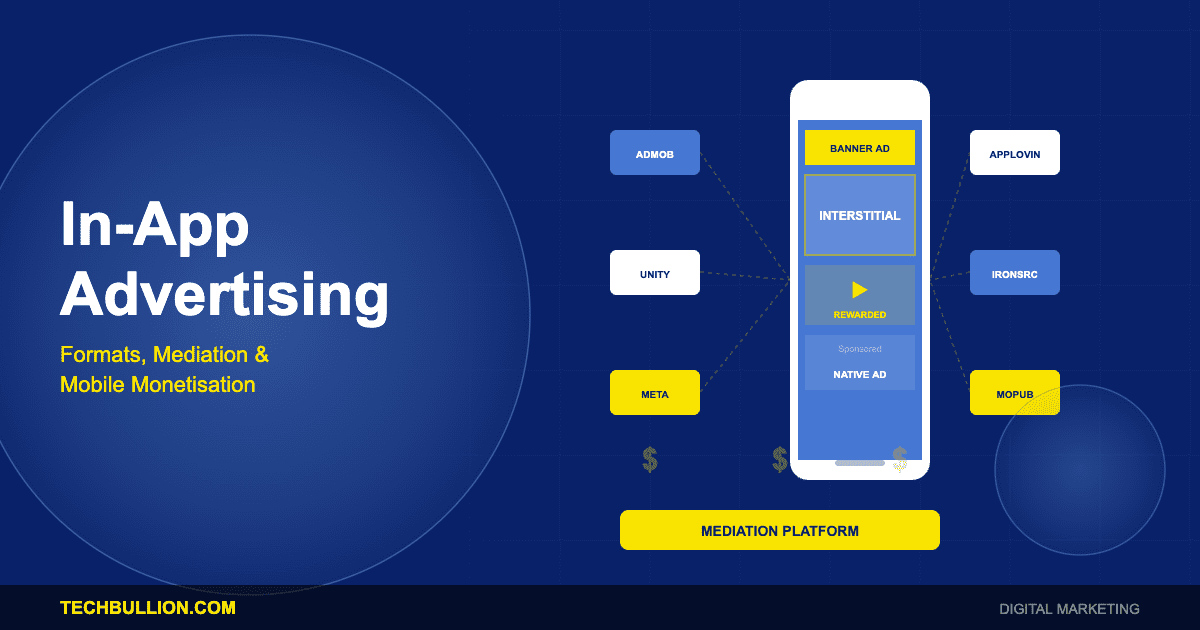
In-app advertising encompasses a diverse ecosystem of ad formats, each designed to balance revenue generation with user experience preservation within specific app contexts. Rewarded video ads have emerged as the dominant high-eCPM format in mobile gaming, offering users an explicit value exchange where watching a 15 to 30-second video advertisement earns in-game rewards such as extra lives, virtual currency, or temporary power-ups. This opt-in model generates completion rates exceeding 90 percent and eCPMs ranging from $10 to $40 depending on the market and user segment, while maintaining positive user sentiment because the viewer chooses to engage with the advertisement in exchange for tangible value.
Interstitial advertisements occupy the full device screen during natural transition points within the app experience, such as between game levels, after completing an article, or when navigating between app sections. The effectiveness of interstitials depends critically on placement timing that respects the user’s flow state rather than interrupting active engagement, with poorly timed interstitials driving significant increases in app uninstall rates. Banner advertisements provide persistent, low-intrusion ad placements that generate lower eCPMs but contribute steady baseline revenue without disrupting the user experience, while native ad formats integrate sponsored content within the app’s natural content feed using the same visual design language as organic content.
Playable advertisements represent one of the fastest-growing format categories, enabling users to interact with a mini-version of an advertised game or app before deciding to install. These interactive experiences generate install rates two to five times higher than static or video advertisements because users can evaluate the product experience before committing, reducing post-install churn and improving advertiser return on ad spend.
Leading In-App Advertising and Mediation Platforms
| Platform | Primary Function | Key Differentiator |
|---|---|---|
| Google AdMob | Ad network and mediation | Largest mobile ad network with integrated mediation and Google demand access |
| Unity Ads / ironSource (Unity) | Gaming monetisation platform | Combined LevelPlay mediation with game engine integration and user acquisition tools |
| AppLovin (MAX) | In-app bidding mediation | Advanced real-time bidding mediation with AI-driven ad placement optimisation |
| Meta Audience Network | Mobile ad network | Access to Facebook and Instagram advertiser demand with advanced targeting |
| Liftoff / Vungle | Performance-focused mobile ads | ML-based optimisation for user acquisition and re-engagement campaigns |
| InMobi | Global mobile ad platform | Strong presence in emerging markets with carrier-level data partnerships |
Mediation Technology and Auction Architecture
Ad mediation platforms serve as the critical infrastructure layer that enables app publishers to manage relationships with multiple advertising demand sources through a single SDK integration, optimising yield across networks through automated auction management. The evolution from waterfall mediation to in-app bidding represents the most significant architectural shift in mobile ad monetisation since the introduction of programmatic buying.
Traditional waterfall mediation sequentially offers each impression to demand sources in a predetermined priority order based on historical eCPM performance, moving to the next source only if the previous one declines the opportunity. This sequential approach inherently leaves revenue on the table because demand sources lower in the waterfall never have the opportunity to bid higher than the source called first, even when they would have paid a premium for that specific impression. In-app bidding eliminates this inefficiency by enabling all connected demand sources to evaluate and bid on each impression simultaneously, ensuring that the highest-paying buyer always wins regardless of their historical average performance.
The technical implementation of in-app bidding requires mediation platforms to manage parallel auction processes that collect bids from multiple networks within strict latency constraints, typically completing the entire multi-network auction within 500 milliseconds to avoid impacting app performance. Leading mediation platforms including AppLovin MAX, Unity LevelPlay, and Google AdMob process billions of these parallel auctions daily, applying machine learning algorithms that optimise auction parameters including timeout thresholds, bid floor pricing, and demand source participation based on real-time market conditions.
Privacy Changes and Signal Loss
Apple’s App Tracking Transparency framework, introduced with iOS 14.5, fundamentally disrupted the in-app advertising ecosystem by requiring explicit user consent before apps could access the Identifier for Advertisers used for cross-app tracking and attribution. With opt-in rates averaging approximately 25 percent across the iOS ecosystem, the majority of iOS users became effectively untrackable through traditional device-level identifiers, eliminating the deterministic targeting and attribution capabilities that powered performance-based in-app advertising.
The industry response to ATT has driven significant innovation in privacy-preserving advertising technology. Apple’s SKAdNetwork provides aggregated, privacy-safe attribution that reports campaign performance without exposing individual user data, though with significant limitations in measurement granularity and attribution window duration. Contextual targeting approaches that evaluate the app environment and content context rather than individual user profiles have experienced rapid adoption as alternatives to user-level targeting. On-device machine learning models that process user signals locally without transmitting personal data to advertising servers represent an emerging approach that preserves targeting relevance while respecting privacy boundaries.
The connection to privacy-enhancing technologies is central to the future of in-app advertising, as the industry develops new technical approaches that enable effective advertising within privacy-compliant frameworks.
The Future of In-App Advertising
The trajectory of in-app advertising technology through 2029 will be shaped by the continued evolution toward unified auction-based monetisation that maximises competition for every impression, the development of privacy-preserving targeting and measurement technologies that maintain advertising effectiveness within consent-based frameworks, and the expansion of in-app advertising into emerging platforms including wearable devices, automotive infotainment systems, and mixed reality applications. The integration of ad fraud detection directly into mediation platforms will provide real-time protection against the invalid traffic schemes that target high-eCPM in-app inventory. Organisations that master the technical complexity of in-app advertising monetisation and buying are positioned to capture value from the platform where consumers spend the overwhelming majority of their mobile attention.
Data from Statista’s digital market outlook shows that global digital spending continues to grow at double-digit rates, with mobile channels accounting for an increasingly dominant share of total transactions.
PwC’s analysis of financial services trends through 2025 highlights the convergence of technology and media as a defining dynamic, with data-driven personalisation becoming the primary competitive differentiator.