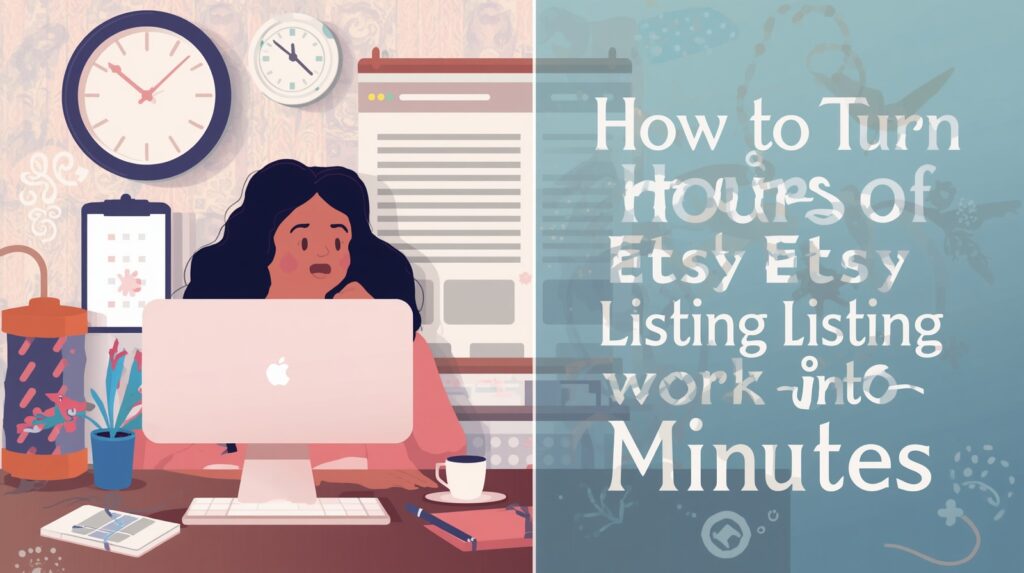
Streamline your Etsy workflow with reusable design systems. Learn how to create listings faster, stay consistent, and scale your shop efficiently.
Creating Etsy listings doesn’t feel like a system problem at first. It feels like a time problem.
You spend hours writing descriptions, adjusting images, and trying to make each product look good. That works when you have a few listings. But as your shop grows, the process starts to slow you down.
What used to feel like creative work becomes repetitive.
Most Etsy sellers assume they need to work faster. In reality, they need to stop making the same decisions over and over again.
Every listing forces a reset:
- What layout should I use?
- How should the images be structured?
- What information comes first?
Individually, these are small decisions. At scale, they become the bottleneck.
The sellers who grow efficiently don’t optimize speed. They build systems that remove unnecessary decisions.
Why Etsy Listing Work Becomes a Bottleneck
Etsy listings are deceptively repetitive.
Each product requires:
- Similar image structures
- Similar descriptions
- Similar formatting decisions
But most sellers recreate that structure from scratch every time.
This leads to:
- Slower product launches
- Inconsistent presentation
- Creative fatigue
The real issue isn’t the amount of work, it’s the repeated thinking behind it.
Without a system, your workload grows linearly with your product count. That’s what makes scaling difficult.
What Are Reusable Design Systems for Etsy?
A reusable design system is a set of pre-built assets and guidelines that you use across all your listings.
Instead of starting from zero every time, you create a foundation once and reuse it.
This typically includes:
- Etsy listing templates
- Typography and color rules
- Product description structures
- Thumbnail and preview layouts
Think of it as building a “blueprint” for your shop. Once it’s in place, every new product becomes faster to publish and easier to manage.
What a Reusable Design System Actually Does
A reusable design system turns your listing process into something predictable.
Instead of starting fresh, you define a repeatable structure:
- How your images are laid out
- How your descriptions are organized
- How your listings communicate value
This doesn’t remove creativity. It simply focuses it where it matters: on the product itself, not the structure around it.
In practice, a design system includes:
- Listing image templates
- A consistent visual style
- A structured description format
Once this is in place, each new listing becomes faster to produce and easier to maintain.
Modern tools like Kittl can help streamline your workflow much faster because everything you need (from exclusive fonts, various template choices, and a wide content library) is within one web-based design tool.
Step 1: Standardize Your Listing Structure
Before designing anything, define how every listing should be built.
Decide in advance:
- What information appears first
- What questions your listing answers
- How your images are sequenced
A simple structure might look like:
- Product overview
- Key benefit
- Feature breakdown
- Size or specifications
- Lifestyle context
With this in place, you’re no longer deciding what to include every time— you’re following a system.
Step 2: Create Reusable Listing Image Templates
[Need image of some Etsy listing templates by Kittl (seen in Editor)]
Images are one of the most time-intensive parts of Etsy listings (and the easiest place to save time).
Instead of designing each image manually, create a set of templates for:
- Product covers
- Feature highlights
- Size or dimension guides
- Lifestyle mockups
You can start with pre-built layouts like these Etsy listing templates from Kittl to quickly establish a consistent visual system.
With templates in place, you only need to swap product details instead of redesigning from scratch.
Step 3: Build a Consistent Visual Identity
A surprising amount of time is lost on small design choices:
- Trying different fonts
- Adjusting colors
- Tweaking spacing
Making these decisions once saves time across every listing.
Choose a fixed set of:
- Fonts
- Colors
- Spacing rules
- Image styles
This speeds up your workflow and creates a more recognizable brand.
Consistency isn’t just visual, it’s operational.
Step 4: Batch Your Listing Creation Process
[Need image of several Etsy listing images in several artboards]
Switching between tasks is one of the biggest productivity killers.
Instead of completing listings one by one, batch similar tasks together:
- Write descriptions for multiple products in one session
- Design all images at once using templates
- Upload and publish in batches
Batching allows you to stay focused and move faster through repetitive work.
Step 5: Use Pre-Written Content Blocks
Not every part of your listing needs to be written from scratch.
Create reusable content blocks for:
- Shipping information
- Product care instructions
- Brand story sections
- FAQs
These can be copied and adjusted slightly for each listing.
This alone can cut writing time significantly (especially for shops with similar product categories).
Step 6: Optimize Your Image Workflow
[Need image of an Etsy listing images in one artboard upclose to show edits]
Etsy listing images often require resizing, formatting, and layout adjustments.
Instead of handling this manually every time:
- Use fixed dimensions for all templates
- Keep consistent margins and spacing
- Prepare export-ready formats in advance
If you want a deeper breakdown of how to structure listing visuals effectively, Kittl’s guide on Etsy listing images covers practical sizing and layout strategies.
A structured image workflow eliminates guesswork and speeds up production.
Step 7: Continuously Improve Your System
Most sellers try to improve listings individually.
A better approach is to improve the system behind them.
Track what works:
- Which layouts perform best
- Which images drive clicks
- Which structures convert
Then update your templates and process.
This way, every improvement applies to future listings. Not just one.
Avoid Burnout While Scaling Your Etsy Shop
Trying to scale without a system often leads to burnout.
By reducing repetitive work and simplifying decisions, reusable design systems allow you to:
- Launch products faster
- Maintain consistent quality
- Focus more on creativity and strategy
Efficiency doesn’t mean cutting corners, it means building smarter processes.
Conclusion
Scaling an Etsy shop isn’t about working longer hours, it’s about removing unnecessary work.
By standardizing your listing structure, creating reusable templates, and building a consistent design system, you can turn hours of repetitive tasks into a streamlined workflow.
The result is faster product launches, stronger branding, and a more sustainable way to grow your shop.
If you’re serious about scaling on Etsy, start by building your system and let it do the heavy lifting for you.