
How to Start a Food Manufacturing Business in India: Licences & Registrations

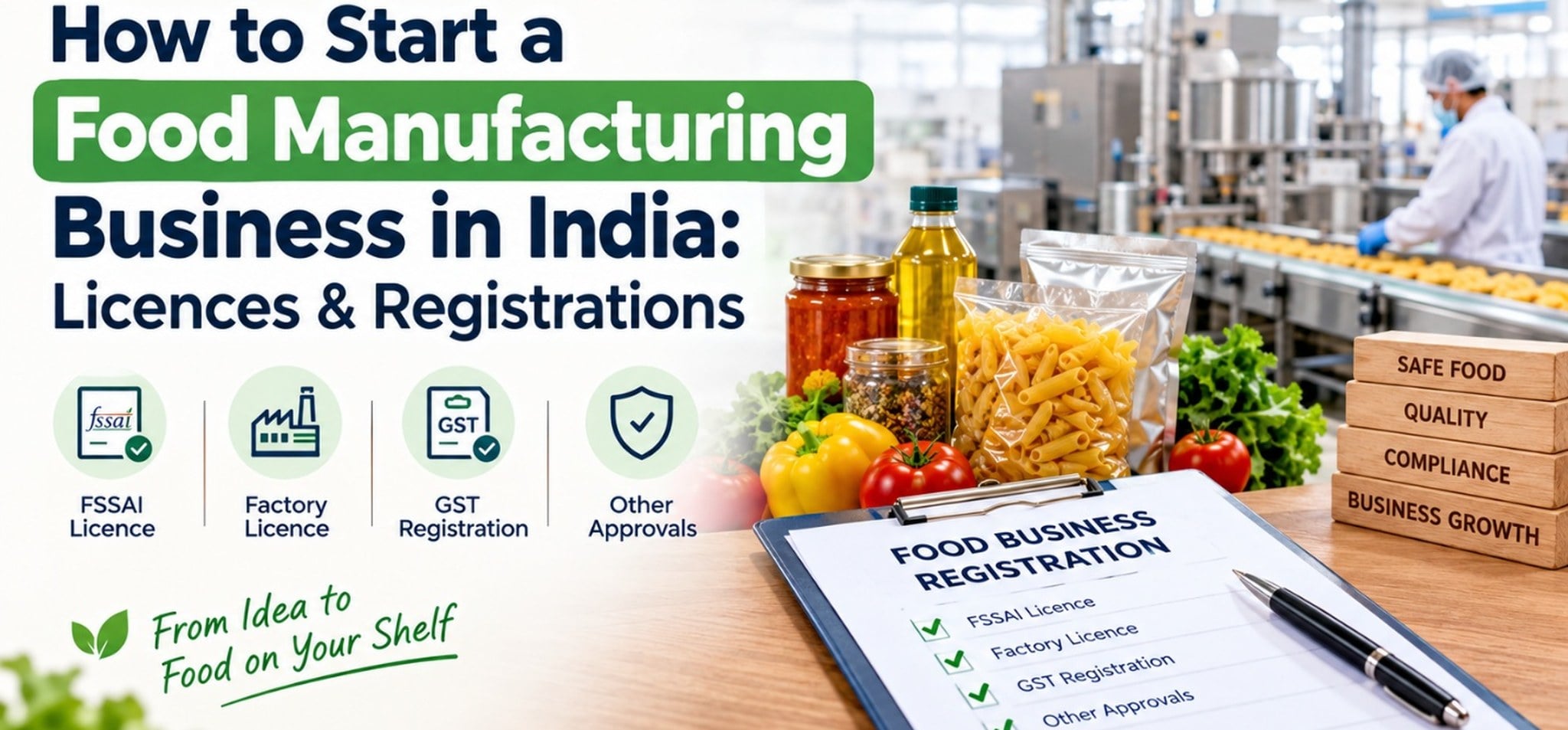
One missed licence can freeze a production line before the first batch ships. Lawfinity helps you start a food manufacturing business with fast FSSAI filing, clear legal structuring, and expert support on every registration, so you launch on schedule and stay compliant.
Supermarket shelves tell the story. India’s processed food exports reached US$7,886.62 million in FY 2024-25, and sales of items under the food processing PLI scheme grew 10.58%. Demand is real. So is the paperwork.
FSSAI rewrote its approval rules in March 2026, yet many pages still quote the old limits. Apply under a stale category and your file can sit for weeks. Here are the current rules, step by step.
Why Is Now a Good Time to Enter India’s Packaged Food Space?
Processed foods made up 20.4% of agri-food exports in 2024-25, up from 13.7% in 2014-15. Small players are in the mix, since 69 of the 168 applicants approved under the PLI scheme are MSMEs. Pick a product you can make consistently and test demand before buying machinery.
Which Legal Structure Suits Your Unit Best?
A proprietorship is quick, but your savings sit behind every recalled batch and unpaid supplier. A company or LLP keeps your personal assets apart from the business. If you plan to raise outside money, our Manufacturing Company Registration service sets up the entity, PAN and bank-ready paperwork together. Settle this first, because your FSSAI file must show the same name and address across identity, premises and constitution papers. Mismatches trigger queries.
Which FSSAI Licence Does Your Turnover Put You In?
Annual turnover decides your category. Up to Rs 1.5 crore needs registration, Rs 1.5 crore to Rs 50 crore needs a state licence, and above Rs 50 crore needs a central licence.
| Category | Annual turnover | Issued by |
|---|---|---|
| Basic registration | Up to Rs 1.5 crore | Local or state registering authority |
| State licence | Above Rs 1.5 crore, up to Rs 50 crore | State licensing authority |
| Central licence | Above Rs 50 crore | FSSAI central licensing authority |
The 2026 amendment to the licensing regulations was notified on 10 March 2026. FSSAI’s order dated 13 March 2026 made the new bands effective from 1 April. A namkeen unit turning over Rs 90 lakh needed a state licence last year and now registers for Rs 100 a year. Anything issued on or after 1 April 2026 no longer expires, so you stop chasing renewals.
Turnover is not the only test. Importers, and units that export their whole output, can need central approval for whatever they earn. Check your product’s kind of business on FoSCoS before filing. Running without the right licence can bring a fine up to Rs 5 lakh and six months in jail.
What Other Registrations Does a Plant Need Before Production?
FSSAI is the headline approval, not the only one. Your plant answers to several offices at once, each with its own checklist. Importers and multi-state operators may also need an FSSAI Central License even below the turnover limit. Line these up before you order equipment:
- GST registration for tax filing and input credit
- Udyam registration for MSME benefits and easier loans
- Factory licence from the state factories department
- Fire safety NOC from the local fire authority
- Trade licence from the municipal body
- Packer registration with state Legal Metrology
- Import Export Code, if you plan to ship abroad
Do Environmental Approvals Apply to Your Unit?
Often, yes. Consent to establish must be in hand before the first brick is laid, and consent to operate before the first batch runs. Both come from your state pollution control board. Most food units fall in the orange category, which usually renews every five years. Small dry-process units can land in green, with longer validity. A Pollution NOC Certificate is also what lenders and officers often ask to see. Skip it and you risk closure notices, not just a fine.
What Do Your Premises and Labels Need to Pass Inspection?
Inspectors look at the floor, not just the file. Schedule 4 of the licensing regulations sets hygiene and good manufacturing standards: clean walls and floors, pest control, tested drinking water, separate raw and cooked zones, trained and medically fit staff. Labels follow the FSS (Labelling and Display) Regulations, 2020, and your licence number must appear on every food package. Packaging also answers to the Legal Metrology (Packaged Commodities) Rules, 2011, which require net quantity, maximum retail price and dates. Misbranding can draw a fine up to Rs 3 lakh. Get a label draft checked first, because 5,000 cartons without a best-before date are scrap.
What Do You Owe Every Year After the Licence Arrives?
Perpetual validity does not mean set and forget. You still pay the annual fee, and non-payment can suspend the licence. State and central licence holders also file an annual return by 31 May. Visit frequency depends on your product’s risk level and your past record, so a dairy or meat line sees more inspectors than a dry-snack line. Train at least one Food Safety Supervisor under FoSTaC and keep hygiene and testing records current.
Are There Government Schemes That Can Cut Your Setup Cost?
If you are starting a small unit, PMFME is the scheme to look at first. It gives a credit-linked subsidy of 35% of your eligible project cost, capped at Rs 10 lakh per unit, and it is meant for micro food processing enterprises only. You put in at least 10% of the project cost yourself, and a bank lends the balance. The subsidy never reaches you as cash. Once the bank sanctions your loan, it sits in an account with the lender and gets adjusted against what you owe after your unit has run for about three years. So on a Rs 20 lakh project, you contribute Rs 2 lakh, the bank finances the rest, and Rs 7 lakh of that loan is written off down the line. Check eligibility before you plan around it, because new units are generally supported for their district’s ODOP product, while existing units can get help across a wider range of activities.
Timing matters as well. PMFME’s interim validity ran to 30 September 2026, and the latest reports on record show a five-year extension proposed but not yet confirmed, so check pmfme.mofpi.gov.in to see whether applications are open as of October 2026. The PLI scheme for food processing (Rs 10,900 crore, 2021-22 to 2026-27) is a different case. It rewards incremental sales and was built around applicants who met base-year sales thresholds, so a brand-new unit is unlikely to qualify, and it is better read as background on where industry support is going than as a source of funding for you.
In What Order Should You Do All of This?
Sequence matters more than speed. Skip ahead and you end up with a finished unit and no permission to run it. A food manufacturing business that files in the order below loses the fewest weeks. Keep names identical across every paper and answer officer queries fast:
- Fix your legal structure and open a bank account in its name.
- Apply for consent to establish.
- File FSSAI under the right band.
- Finalise labels and packer approval.
- Secure consent to operate, then start production.
Frequently Asked Questions
Ques. Can I begin production while my application is pending?
Ans. No. Running without a licence breaks the Food Safety and Standards Act, 2006. Wait for the certificate.
Ques. What happens if my turnover crosses Rs 1.5 crore mid-year?
Ans. You move from registration to a state licence. File for the higher category and update your records.
Ques. Do I need a separate licence for each factory or warehouse?
Ans. Yes. FSSAI licensing is issued separately for each food business premises, so every unit needs its own approval.
Ques. How long does approval usually take?
Ans. It depends on your state authority, your category and how fast you answer queries. FSSAI’s official website also mentions Tatkal approvals, so ask us whether you qualify.







Comment