
Gerardo Siegert: The Engineer-CEO Driving Automation and Data at Texas Wooden Solutions

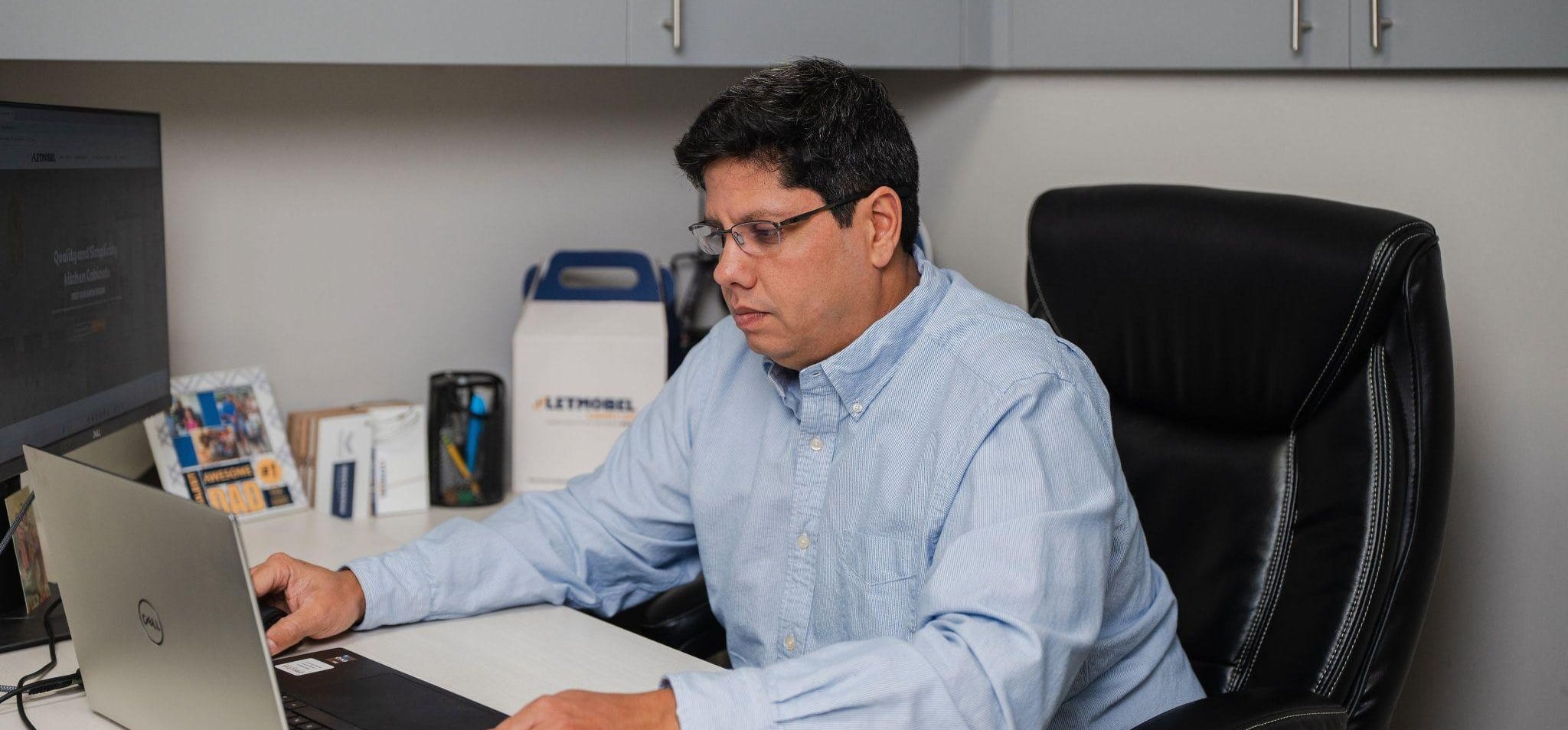
A mechanical engineer turned manufacturing entrepreneur, Gerardo Siegert led the process transformation that made his Houston-area panel maker a finalist in the National Association of Manufacturers’ 2025 Manufacturing Leadership Awards. Now he sees artificial intelligence as the next step.
When Gerardo Siegert talks about his factory, he rarely starts with machines. He starts with numbers: how many panels came off the line, where the bottleneck sits, how much material ended up as scrap. That habit of measuring everything is the engine behind the transformation he has led at Texas Wooden Solutions Corp., the Humble, Texas-based manufacturer of thermally fused laminate (TFL) panels that he founded in 2018 and runs as CEO.
It is also what put the company, known in the market for its MelamineTex brand, on a national stage. Its project “Production Efficient TFL Panels” was named a finalist in the Engineering and Production Processes category of the 2025 Manufacturing Leadership Awards, run by the National Association of Manufacturers’ Manufacturing Leadership Council. The category also featured entries from General Motors, Intel, Lockheed Martin, Corning, Merck and Rockwell Automation. Texas Wooden Solutions, with just over 60 employees, did not take home the award at the June 18, 2025 gala in Marco Island, Florida, but its place on that list shows how far an engineer-led company can push a traditional industry.
“The innovation we presented wasn’t a single machine,” Siegert says. “It was the transformation of our TFL panel production process to make it far more efficient.”
An engineer before a CEO
Siegert’s approach was formed long before he founded the company. He graduated in mechanical engineering from Universidad Simón Bolívar in Caracas in 2004, after a thesis in which he developed a data-acquisition model for an internal combustion engine. His first job put him in charge of supervising the design and fabrication of new production machinery and planning equipment maintenance. Since 2005, he has worked with TFL.
In Venezuela, he installed and commissioned a melamine board production line, selected and set up a 3,000-square-meter laminate plant, and later led the installation of a 12,000-square-meter facility at Ladeven, the manufacturer he co-owned and ran as general manager. There he also oversaw an SAP implementation in 2014 and 2015. At another venture, Coberturas Melamínicas S&S, he implemented an ISO 9001 quality management system. Each project added a layer to the same conviction: a plant performs only as well as its processes and its data.
“I’m a mechanical engineer before a CEO, and that has a big influence on how I lead,” he says. “I like being in production, understanding why a machine is down, where the bottleneck is, how much we’re producing and what we can improve. In manufacturing, opinions matter, but ultimately you need to measure. If we don’t know production, scrap, times, capacity and costs, it’s very difficult to improve.”
Building the plant from the floor up
Siegert personally planned and installed the company’s first 8,500-square-foot plant in Humble between August and October 2018. In the early years he was, in his words, everything at once. “I was the CEO, but at the same time I was a salesman, I handled administrative and financial matters, coordinated purchasing and was also directly involved in production,” he recalls. “I left home before six in the morning and often got back close to eight at night.”
He went on to design and install a cabinet and closet factory for the company’s Letmobel brand and a second plant in Phoenix, Arizona, which now runs two shifts at full capacity. That hands-on knowledge of every line is what allowed him to take on the project that reached the national finals.
Rethinking the TFL line
TFL is made by bonding a resin-impregnated decorative paper to a composite wood substrate, typically particleboard or MDF, under heat and pressure. The result is a finished surface that cabinet, closet and furniture makers can cut and assemble directly. It is a volume business, and its economics depend on how efficiently every stage of the line converts machine hours into finished panels.
Under Siegert’s direction, the team broke the production process into its stages, measured each one, and applied engineering, automation and control improvements to remove idle time and relieve bottlenecks. The aim was to produce more with the same resources and make fuller use of installed capacity, an approach that reflects his belief that progress comes from understanding a process before spending on it.
“Innovation in manufacturing doesn’t always mean buying the most expensive technology,” Siegert says. “Very often it means understanding the process deeply, measuring it, identifying the bottlenecks and using engineering and technology to improve it continuously.”
The results came primarily in productivity and capacity. The company significantly increased the number of panels it produces without a proportional increase in the resources required, and the line became more stable and predictable, allowing tighter planning and faster response to customers. “For us, the most important result is exactly that: making every production hour more efficient and turning that efficiency into greater capacity and better customer service,” he says.
For Siegert, efficiency and sustainability are the same equation. Every scrapped panel represents raw material, energy and freight already spent, and much of the particleboard the company buys is itself made from recovered wood residue. “Reducing scrap is not only a financial decision, but an environmental one,” he says.
Automation that makes people better
Siegert is deliberate about how he frames automation on his plant floor. “Automation is becoming more and more important for us. But we don’t see technology simply as a way to replace people. We see it as a way to help people produce better,” he says.
He is pushing the company to digitize its processes, capture more production data and connect sales, planning, inventory and manufacturing into a single flow of information. Owning both the panel and the cabinet sides of the business, he notes, gives that data unusual reach, from the raw board to the finished cabinet or closet.
Yet the engineer in him is quick to point out that hardware and software are rarely the real obstacle. “Technology is usually not the most difficult part. The most difficult part is changing the way people work,” he says. “You can buy a machine or install software, but you need operators, supervisors and managers to understand why we’re changing a process and how to use the information.” His conclusion: “An industrial transformation works when technology and people move forward together.”
That conviction shapes how he builds his team in a sector where skilled labor is scarce. Because few candidates arrive already knowing the company’s equipment, Siegert has made internal training part of the growth strategy, hiring for discipline, responsibility and a willingness to learn technology as much as for prior experience.
Artificial intelligence as the next step
The insistence on measurement is also what positions Siegert’s company for its next phase. In his view, artificial intelligence is not a substitute for that groundwork but the layer that builds on it. “Artificial intelligence represents the next step,” he says. “There is an enormous opportunity in using the data a factory generates to anticipate problems and improve scheduling, maintenance, quality and material utilization.”
The sequence is telling. Several of the 2025 finalists in the same category, including Intel, Maxion Structural Components and Rockwell Automation, presented projects built on machine learning, from deep-learning predictive maintenance to AI-powered vision systems. Siegert’s path suggests that for small and mid-sized manufacturers, the road to AI runs first through disciplined process engineering and clean, connected production data.
For him, the national recognition is less a trophy than a credential for that strategy. “When a small company talks about innovation, it’s easy for someone to see it as just marketing,” he says. “When a national manufacturing organization evaluates your project and selects you as a finalist, that conversation changes.”
He is equally clear that it is not an endpoint. “Being finalists doesn’t mean we’ve reached the finish line,” Siegert says. “To me it means exactly the opposite: it shows how far we’ve been able to come and how much more we can build.”







Comment