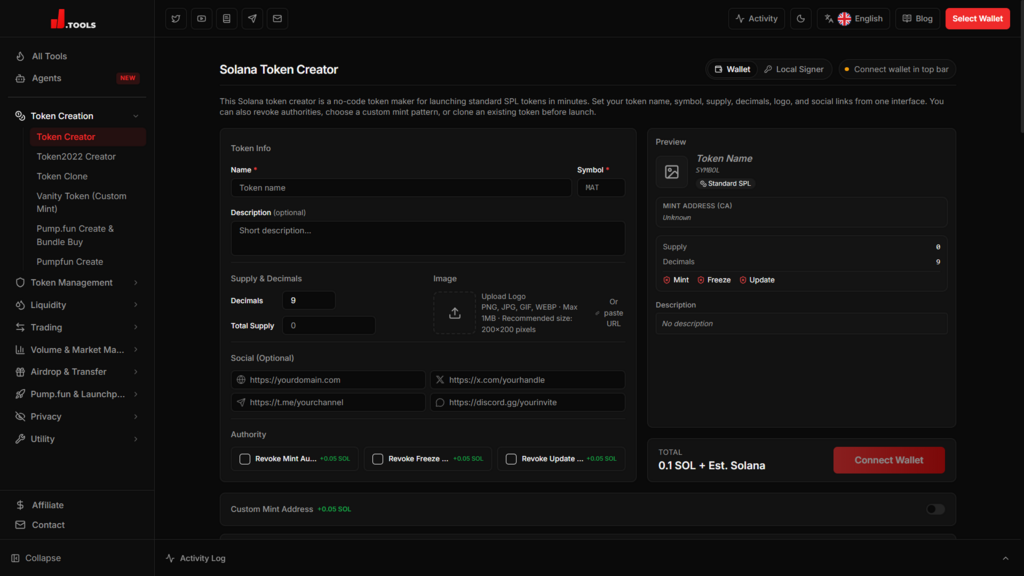
Solana token launches have grown significantly through 2025 and into 2026. Until recently, creating an SPL token required familiarity with the Solana CLI, the Metaplex SDK, and a working understanding of Rust-adjacent tooling. That workflow has shifted. Browser-based platforms now let developers create solana token mints, configure metadata, and deploy liquidity through a single web interface. A dedicated no-code Solana platform can handle the full lifecycle without requiring CLI access. This guide walks through creation, authority configuration, post-launch management, and the common mistakes to avoid.
Setting Up Your SPL Token
Every SPL token starts with four parameters that determine how it behaves on-chain. The token name and symbol are the human-readable identifiers, the decimals value sets the divisibility (the standard for fungible SPL tokens is 9, which matches SOL itself), and the total supply defines how many units the mint produces at launch. Developers also attach metadata at this stage: a logo file in PNG, JPG, or WEBP, a short description, and links to a project website or social accounts.
A Solana wallet is required to sign the deployment transaction. Phantom, Solflare, and Backpack are the most common choices, and each handles signing through a browser extension or mobile app. A modern solana token creator collapses this multi-step CLI workflow into a single form. Platforms like this solana token tool allow developers to configure name, symbol, supply, and decimals in one interface and complete the entire mint in a few minutes. Once deployed, the token receives a unique mint address that becomes its permanent identifier across every Solana RPC and explorer.
Configuring Token Authorities Before Launch
Three authorities sit on every SPL token at mint time: mint authority, freeze authority, and update authority. Mint authority controls whether new tokens can be created after the initial supply lands. Freeze authority controls whether individual holder wallets can have their balances frozen. Update authority controls whether the metadata, including name, symbol, logo, and links, can be changed later.
Revoking mint authority is the single most important post-creation step. Once revoked, the supply becomes permanently locked, and no party including the original deployer can mint additional units. Major DEXs and aggregators such as Raydium and Jupiter expect mint authority to be revoked before listing because an active mint authority signals infinite dilution risk for holders. Freeze authority is treated similarly by most launch checklists, since a live freeze key gives the issuer the ability to halt transfers on demand.
Every authority decision is irreversible. Once a key is revoked, there is no recovery path, so the configuration should be finalized before the token is exposed to liquidity or trading.
What to Do After Your Token Goes Live
A token launch is the start of the workflow, not the finish. Once the mint address exists, the next step is liquidity. A pair must be created on a DEX such as Raydium, Meteora, or Orca so that holders can buy and sell the token without an OTC arrangement. Pool depth, initial price, and fee tier are decisions that shape how the token trades for its entire lifetime.
Distribution follows. Some launches use a presale list, some run a snapshot-based airdrop, and others release the full supply directly to a liquidity pool. Multi-sender utilities handle batch distributions to thousands of wallets in a single workflow. If the tokenomics require a supply reduction after launch, a token burn tool can permanently remove tokens from circulation by sending them to a verifiable burn address. Metadata updates also belong in this phase: brand changes, new social links, or refreshed logos all flow through the same metadata pointer that the token uses on explorers.
Common Mistakes When Launching a Solana Token
The first mistake is wrong decimal selection. Choosing 6 decimals instead of the SPL standard 9 creates compatibility friction with routers and aggregators, and some pool factories reject non-9 mints outright. Most solana token creator interfaces default to 9, but the field is editable and the wrong number costs a full redeployment to correct.
The second is forgetting to revoke mint authority before adding liquidity. Traders inspect mint authority status on Solscan and other explorers, and an open mint authority is the most common reason a serious token gets quietly skipped by aggregators. The third pattern is skipping devnet testing. Solana devnet mirrors mainnet closely and costs effectively nothing per transaction, so a full deployment rehearsal there catches metadata, logo, and authority issues before they hit production.
Low-resolution logos that look blurry on DEX interfaces and missing liquidity plans round out the list of common stumbles. A clear pre-launch checklist helps prevent both.
Conclusion
Launching a Solana token in 2026 is no longer the exclusive territory of developers who can wire up the Metaplex SDK from scratch. The workflow (create, configure authorities, deploy liquidity, manage supply) applies to meme tokens, utility tokens, and governance tokens alike. As browser tooling absorbs what used to be CLI-only steps, the difference between a clean launch and a chaotic one is preparation, not technical depth. A reliable no-code token creator handles the mechanical parts; authority, supply, and distribution remain the operator’s call.