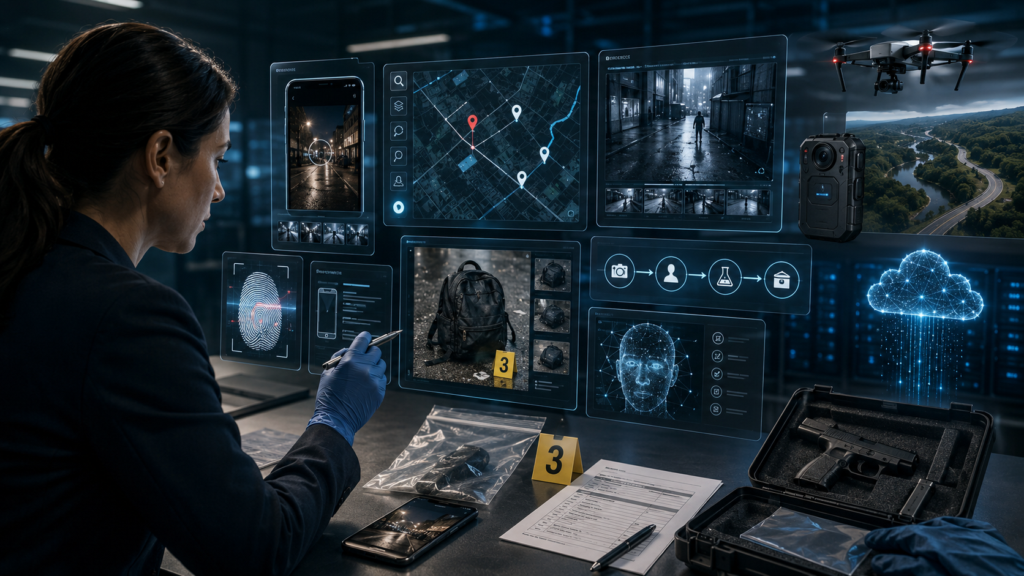
For most of legal and investigative history, the hard part of evidence was finding it. Witnesses forgot, documents went missing, and a single blurry photograph could anchor a case.
That problem has inverted. Evidence is now produced constantly by devices no one thinks of as recorders, while generative tools have made convincing fakes cheap to create. The challenge has moved from scarcity to authenticity, and modern evidence has to be understood from both sides of that shift.
Everyday devices have become recorders
A modern vehicle continuously logs speed, throttle, braking, and steering angle in an event data recorder, capturing the seconds around a crash with a precision no eyewitness can match. Phones store location histories and message timestamps, wearables track movement minute by minute, and connected home devices register entry, exit, and ambient audio.
None of these systems was built for litigation. Each one, though, produces a structured, time-stamped record that can confirm or quietly demolish a human account.
The scale of ambient capture
The numbers are hard to overstate. By the close of 2021, analysts at Comparitech, using IHS Markit data, estimated that more than one billion surveillance cameras were operating worldwide, roughly one for every eight people alive.
Add the billions of phones, vehicles, and sensors recording passively, and the typical dispute no longer suffers from a shortage of evidence. It suffers from an overload of it.
Body cameras and the footage problem
Police body-worn cameras and dashboard cameras have placed a recording device on a large share of public encounters, and the footage cuts both ways, clearing officers in some cases and contradicting written reports in others.
The harder problem is volume. A single department can accumulate footage faster than anyone can review it, and releasing any clip means redacting the faces, plates, and bystanders caught in frame. Retention schedules then decide how long that footage survives, which means evidence can be erased on a timetable set long before any dispute arises.
The phone and the cloud
The phone has become the single richest source. Mobile forensic tools extract call logs, deleted messages, app databases, and granular location traces.
Increasingly, though, the most valuable data is not on the device at all. Photos, backups, and message archives live in cloud accounts reachable only through legal process to the provider, so evidence that once fit in a drawer now spans a handset, a carrier, and several remote servers at once.
Scenes captured in three dimensions
Physical scenes have moved into three dimensions too. Investigators record intersections, buildings, and industrial sites with LiDAR scanning and photogrammetry, producing models accurate to the millimeter that can be measured years later.
Drones map large or hazardous areas in minutes. A scene that once survived only as flat photographs and a hand sketch now persists as a navigable digital reconstruction.
Collecting it has become a discipline
Reliable collection is now formal practice rather than improvised police work. Examiners image devices using write blockers that prevent any change to the original, then work only from verified copies, following references such as NIST Special Publication 800-86 and ISO/IEC 27037.
What a competent examiner can pull from a single device is striking:
- Deleted files and fragments still sitting in unallocated storage
- Metadata showing when a file was created, edited, or moved
- Location and connection histories rebuilt from system logs
- Application data, including messages the user believed were gone
When devices become witnesses
These capabilities stop being abstract the moment a case turns on them. In a 2017 Connecticut homicide investigation, a husband claimed an intruder had killed his wife, but her Fitbit showed her moving around the house long after the time he gave, and the contradiction became central to the prosecution. In a separate Arkansas case, investigators sought recordings from an Amazon Echo found at the scene of a death, testing how far a connected home device could be compelled to give up what it heard.
A single car crash now produces the same convergence. The event data recorder fixes speed and braking, the drivers’ phones supply location, outside cameras capture the impact, and connected-car telematics may log it to a manufacturer’s servers. Each stream was created for an unrelated purpose, yet together they can reconstruct an event with a completeness paper reports never offered.
The stakes for individuals
Most discussion of evidence technology centers on agencies, labs, and corporate litigation, but the people most exposed are often ordinary individuals pulled into disputes they never expected. A driver struck at an intersection, a patient harmed by a device, or a worker injured on a site rarely knows that an event data recorder can overwrite itself within seconds of an impact, or that nearby footage is erased on a fixed retention cycle.
That gap between what the technology records and what a non-specialist understands is why early action matters. Someone weighing a claim after a serious accident who consults a Maine car accident lawyer is far more likely to have critical electronic records identified, preserved, and documented before they are overwritten, which is often the difference between proof that holds up and proof that never reaches the record.
Biology joins the record
Biological evidence has changed just as fast. Forensic genetic genealogy uploads a crime-scene DNA profile to consumer ancestry databases to trace relatives rather than seek a direct match, reopening cases cold for decades.
Its most visible result came in 2018, when investigators identified the Golden State Killer through distant cousins in a public database. The same technique that reunites families now resolves homicides, and it has forced those databases to confront how openly genetic data should be shared with police.
Integrity becomes the whole game
More evidence did not make cases simpler. It moved the central question from whether a record exists to whether the version shown is the same one originally captured, unaltered and accounted for at every step.
Cryptographic hashing answered the technical half. A function such as SHA-256 reduces any file to a fixed string, and changing a single bit produces a completely different result, so a hash recorded at seizure proves later that the courtroom copy is identical. Chain of custody, once paper and signatures, now runs on audit-logged software, and some agencies anchor those logs to distributed ledgers to make tampering conspicuous.
The timing trap
Timing carries its own risk. Because digital evidence is correlated across devices, a mismatched or manipulated clock can unravel a whole timeline, so examiners verify time sources instead of trusting displayed timestamps.
How a device is seized matters as well. Powering it down preserves stored data cleanly, but volatile information in active memory, including encryption keys and live sessions, vanishes the instant power is lost, forcing a choice between pulling the plug and capturing the running state first.
The shift shows up across nearly every dimension of handling evidence:
| Dimension | Traditional approach | Technology-enabled approach |
| Primary sources | Physical objects, paper, eyewitness memory | Device logs, sensor data, cloud records, video |
| Scene capture | Hand measurements, sketches, photographs | LiDAR scanning, photogrammetry, drone mapping |
| Integrity check | Visual inspection, sealed containers | Cryptographic hashing such as SHA-256 |
| Chain of custody | Paper logs and physical signatures | Audit-logged software, sometimes ledger-anchored |
| Typical volume | Boxes of documents | Terabytes of data, millions of items |
| Dominant risk | Loss, contamination, faulty memory | Alteration, fabrication, deletion, overwriting |
Authenticating audio
Sound recordings have their own verification toolkit, and one method is unusually elegant. Mains electricity hums at a frequency that drifts slightly from moment to moment, and that drift is captured as a faint signature in audio recorded near powered equipment.
Because power grids log their frequency continuously, examiners can match the embedded pattern against grid records to confirm exactly when a recording was made, a technique known as electrical network frequency analysis. The same comparison exposes editing, since a cut or insertion breaks the continuity of the hum that a genuine recording carries. Authenticity often hides in details the recorder never intended to capture.
Synthetic media raises the bar
The advances that enriched evidence also industrialized deception. Generative models can fabricate photographs of events that never happened, clone a voice from seconds of audio, and synthesize video that survives a casual look.
The threat is not speculative. As early as 2019, the firm Deeptrace, later Sensity, catalogued close to 15,000 deepfake videos online and found that roughly 96 percent were non-consensual pornography, an early sign that synthetic media would target individuals long before it was used to forge formal evidence.
The liar’s dividend
The harm runs past any single forgery. Legal scholars Robert Chesney and Danielle Citron named the broader danger the “liar’s dividend”: once the public knows convincing fakes exist, any real recording can be dismissed as a possible fabrication.
Authentic evidence loses some of its force simply because counterfeits are known to be possible.
Detection versus provenance
Two countermeasures have emerged with opposite logic. Detection tools search for the artifacts that synthetic generation leaves behind, but detection is an endless race that improves only in step with the fakes it chases.
The sturdier approach is provenance, signing a file cryptographically at capture to record its origin and every later edit, an idea the Coalition for Content Provenance and Authenticity has turned into an open standard. One obstacle remains, since most platforms strip metadata on upload, so footage that has circulated online usually arrives without the very origin data that would prove it.
Verifying footage no one controls
A growing share of important evidence is filmed by strangers and posted publicly, which raises a different question: where and when was it actually shot. Open-source investigators answer it by cross-referencing what the frame itself reveals.
Landmarks, signage, and terrain are matched against satellite imagery to fix the location, while the angle and length of shadows, checked against the sun’s known position, can pin down the time of day. Weather records and visible construction supply further confirmation. Footage authenticated this way has already informed international investigations, converting casual uploads into records that can withstand scrutiny.
The rules of evidence adapt
Courts have moved faster than their reputation suggests. Amendments to the United States Federal Rules of Evidence effective in December 2017 created routes for self-authentication of electronic records.
Rule 902(14), for example, lets data copied from a device be authenticated through a certified hash value, sparing courts live testimony just to show a file was not altered. A verification method built by engineers became, in effect, a rule of law.
Gatekeeping the methods
Expert testimony faces its own filter. Under the Daubert standard, used in federal courts and many states, a judge must find the methodology behind technical evidence reliable before a jury hears it.
That bar has sharpened as forensic software has grown opaque. Probabilistic genotyping programs that interpret mixed DNA samples draw scrutiny because their inner workings are proprietary, raising the question of how a defendant can challenge a black box that produced the number used against them. A 2021 New Jersey appellate decision pushed back, ordering that a defendant be given access to a genotyping program’s source code, a sign that such opacity may not stay shielded forever.
Automating discovery
Civil litigation absorbed the data flood through automation. When one case can involve millions of documents, manual review is impossible.
Courts have approved technology-assisted review, where machine-learning models trained on a sample of human judgments rank huge document sets by likely relevance. Once controversial, predictive coding is now a routine feature of discovery.
The privacy counterpressure
Expanding what can be collected has provoked an opposite legal force. As investigators began routinely reaching into the location trails phones generate, courts started drawing lines.
In Carpenter v. United States in 2018, the Supreme Court held that obtaining historical cell-site location records is a search requiring a warrant. Geofence warrants, which ask a provider to name every device in an area at a given time, sit on shakier ground because they sweep in bystanders, and the gap between what is technically possible and legally permitted is where much of the field’s hardest argument now lives.
Where it still breaks down
The system stays imperfect, and a few failure modes recur:
- Spoliation: data is overwritten, devices wiped, and footage purged on schedule, often before anyone moves to preserve it.
- Opaque algorithms: forensic software can carry error or bias that trade-secret protection places beyond real challenge.
- Volume as cover: a decisive file buried in terabytes of noise can be almost as hidden as one deleted.
- Distorted expectations: jurors conditioned by television expect flawless, instant forensics, the CSI effect, which can skew deliberation.
- Cross-border data: records held on servers in another country can be slow or impossible to obtain through mutual legal assistance, even when everyone knows the evidence exists.
Outlook
The direction is clear even if the destination is not. Evidence will keep growing more abundant and more deeply embedded in ordinary objects, while the line between authentic and fabricated grows harder to see without technical help.
The institutions that rely on evidence are being pushed to build fluency they once did not need, and verification is becoming a discipline equal in weight to collection. When nearly anything can be recorded and nearly anything can be faked, the ability to tell the difference is quietly becoming one of the most consequential skills in law and investigation alike.