
How Starlink Pooled Data Plans Help Multi-Site Businesses Reduce Connectivity Costs

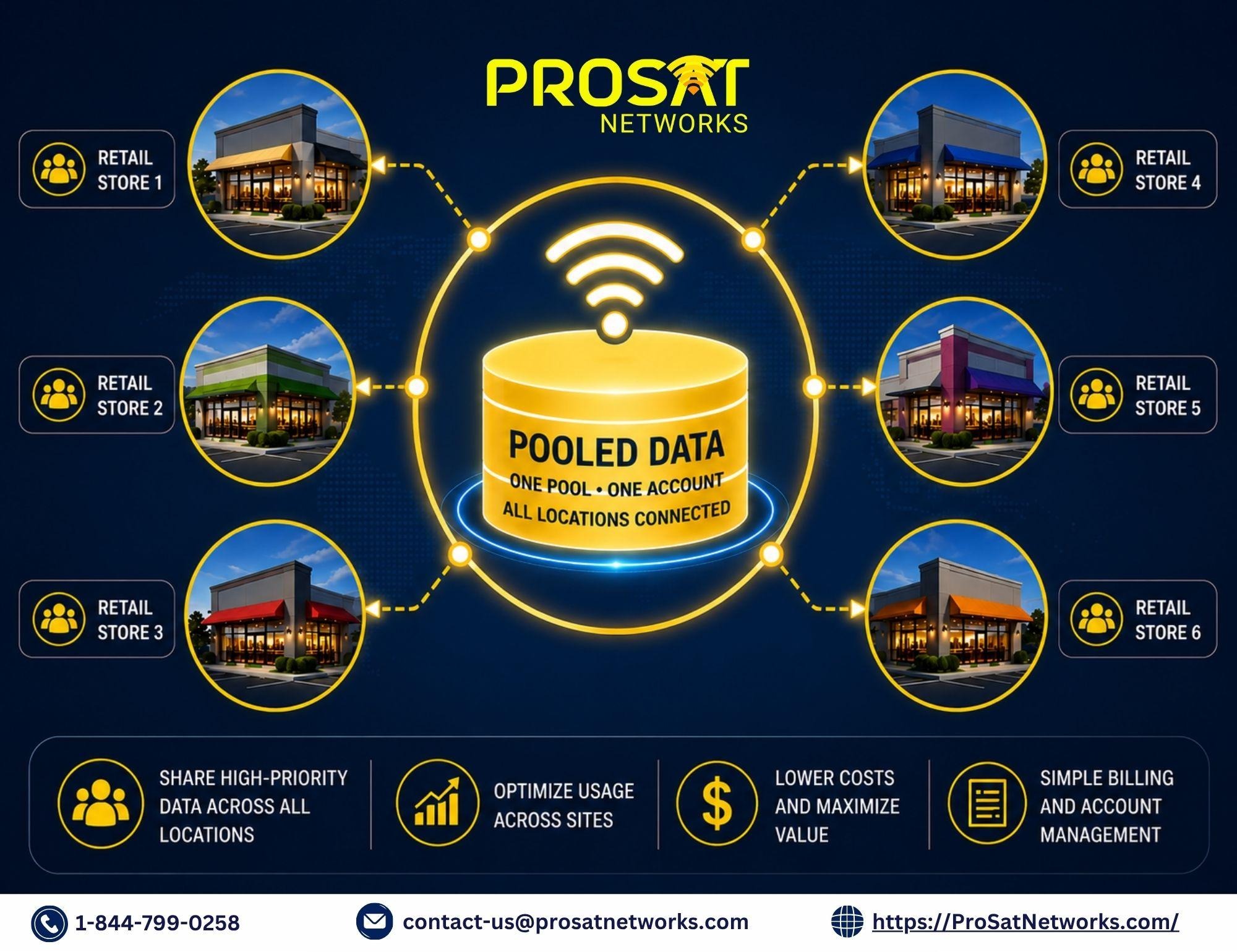
Businesses with multiple locations often face challenges managing internet costs across offices, retail stores, warehouses, and remote facilities. While each site has different bandwidth requirements, traditional internet services typically require separate contracts, individual billing and fixed monthly plans that cannot be shared between locations. This often results in some sites paying for unused bandwidth while others exceed their monthly limits.
Starlink’s Local Priority Pooled Data Plan offers a different approach. Instead of assigning a separate data allowance to each business location, multiple Starlink terminals can share one pool of priority data under a single account. This flexible model allows organizations to optimize data usage, simplify billing and reduce operating costs across distributed operations. In this interview, a ProSat Networks 1-844-799-0258 representative explains how multi-site businesses, such as retail store chains, can reduce connectivity costs using Starlink Pooled Data Plans with centralized billing and simplified account management.
Q1. Many businesses are unfamiliar with Starlink Pooled Data Plans. How does a pooled plan differ from a traditional internet subscription, and why is it attractive for organizations operating multiple locations?
ANSWER: A Starlink Pooled Data Plan is a Local Priority Data service for business customers that provides high-priority bandwidth shared across multiple Starlink terminals or locations under a single account with centralized billing and management. Traffic using Local Priority Data receives higher priority than Standard (Residential) data during periods of network congestion. This helps maintain more consistent speeds and lower latency for business-critical applications.
With a Pooled Data Plan (Local Priority):
- You purchase one large Priority Data pool, such as 50 GB, 500 GB, 1 TB, 4 TB, or 10 TB.
- Every Starlink terminal on the account draws from the same pool.
Example:
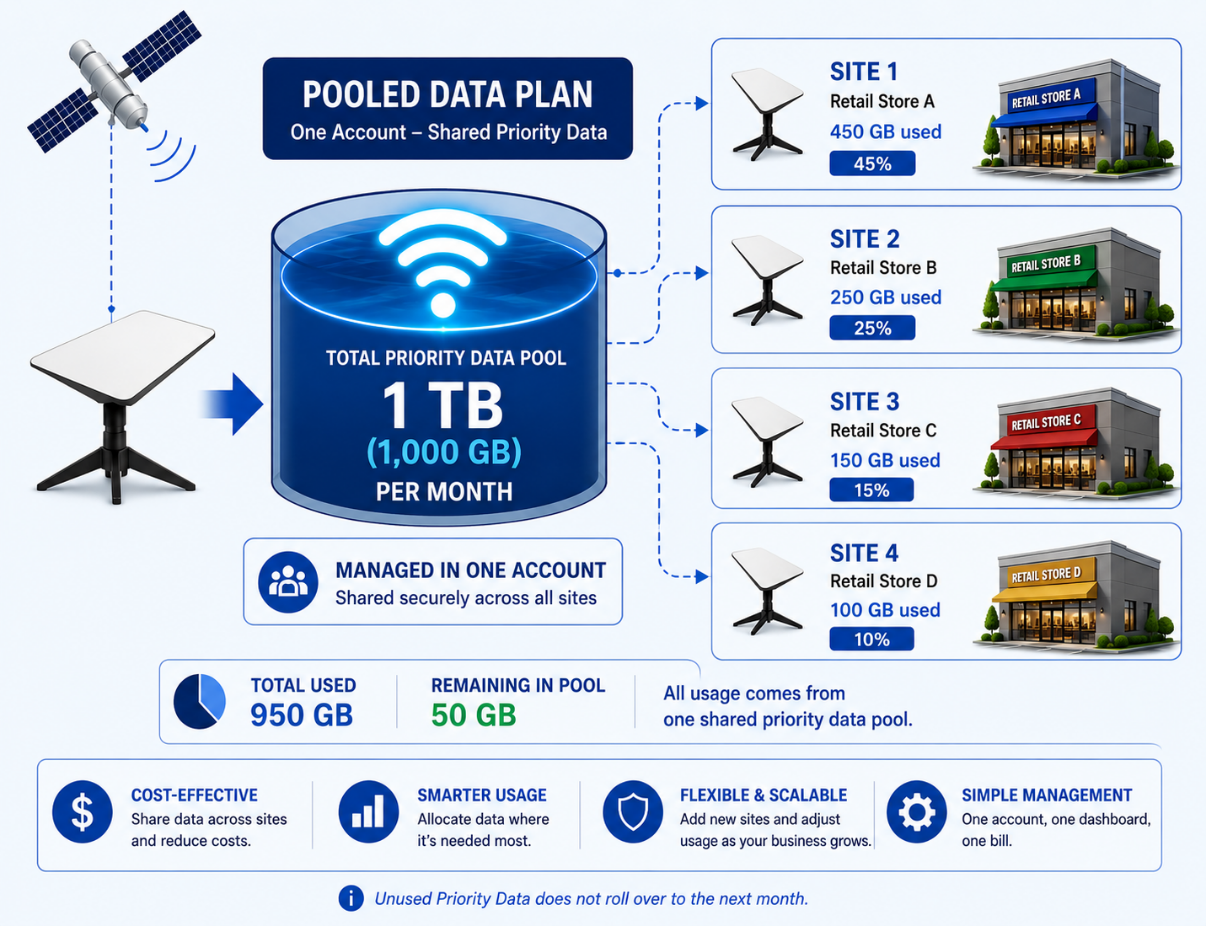
- Shared Pool: 1TB (1,000 GB)
- Terminal A (Head office) uses 450 GB
- Terminal B (Branch Office) uses 250 GB
- Terminal C (Warehouse) uses 150 GB
- Terminal D (Remote location) uses 100 GB
- Total usage = 950 GB
- Remaining in the pool = 50 GB
- All four terminals continue using the same shared allocation without needing separate data plans.
- Once the shared Priority Data Pool is fully consumed before the end of the billing cycle, Starlink automatically (if Top-Up is enabled) purchases an additional block of Priority Data (for example, 50 GB or 500 GB, depending on the available option and plan).
- The new data is added to the same shared pool, allowing all terminals to continue using Priority Data.
- The additional data is billed separately.
- If additional Priority Data (Top-Up) is disabled, all terminals on that pooled plan have their speeds reduced to approximately 1 Mbps download and 0.5 Mbps upload for the remainder of the billing cycle.
- Full Priority Data speeds resume when the next billing cycle begins or when additional Priority Data is purchased.
Q2.What types of businesses benefit the most from Starlink Pooled Data Plans, and why are these industries a good fit for shared priority data?
ANSWER: Businesses with multiple locations that have lower monthly internet data usage and/or varying data consumption patterns benefit the most from Pooled Data Plans. A good example is Starlink for retail stores where each location has varying monthly data consumption levels. A larger retail store or busier location may process thousands of POS (point-of-sale) transactions daily, while supporting office computing data, many cameras and IoTs vs. a smaller, less busy site that consumes far less monthly data. With a Pooled Data Plan, unused Local Priority Data from lower-usage stores is automatically available to busier locations, helping reduce or balance a business’ overall monthly data usage and consolidate invoicing into one monthly bill.
Retail stores with multiple locations can greatly benefit from Pooled Data Plans such as, but not limited to, auto parts stores, auto repair shops, grocery stores & supermarkets, convenience stores, gas stations, fast food and other restaurants without constantly streaming TVs, hardware and home repair stores, sporting goods – just about any retail store.
Q3. Retail stores often have different internet usage patterns. How can pooled data help retailers lower their monthly connectivity costs while maintaining reliable service at every location?
Answer: It begins with a thorough assessment of your organization’s data usage. Administrators can monitor the monthly data consumption of each Starlink terminal through the Starlink Dashboard, providing valuable insights into how each location uses Priority Data. Since bandwidth requirements vary by business type, location, the number of users and daily operations, understanding these usage patterns is the first step toward selecting the right plan.
The table below provides general guidance on how common business applications typically consume data:
| Business Activity | Typical Data Usage | Estimated Monthly Consumption* |
|---|---|---|
| Email and web browsing | Low | 10 to 50 GB |
| Credit card and POS transactions | Very Low | Less than 5 GB |
| Cloud-based POS systems | Low to Moderate | 20 to 100 GB |
| HD video streaming | High | 100 to 500+ GB |
| 4K video streaming | Very High | 500 GB to 2+ TB |
| Video conferencing | Moderate to High | 50 to 300 GB |
| Cloud backups | High | 100 GB to several TB |
| IP security cameras uploading to the cloud | High | 200 GB to several TB |
| Large software and operating system updates | High | 20 to 200+ GB |
With this information, businesses can choose the appropriate Local Priority Data Pool size to support all connected locations. Rather than assigning the same Priority Data allocation to every site, pooled data allows unused data from lower-usage locations to be shared with sites experiencing higher demand. This approach provides greater flexibility as businesses open new locations, expand operations, or complete temporary projects, while maximizing data utilization, reduces wasted monthly allocations and lowering overall connectivity costs.
One of our clients operates a retail kiosk business across seven locations. Each location has a kiosk, AI cooler, Point-of-Sale machine and a security camera. Using individual Starlink Local Priority Data plans, each site has a subscription costing approximately $155 per month. This results in a total monthly connectivity costs of $1,085 for all seven locations.
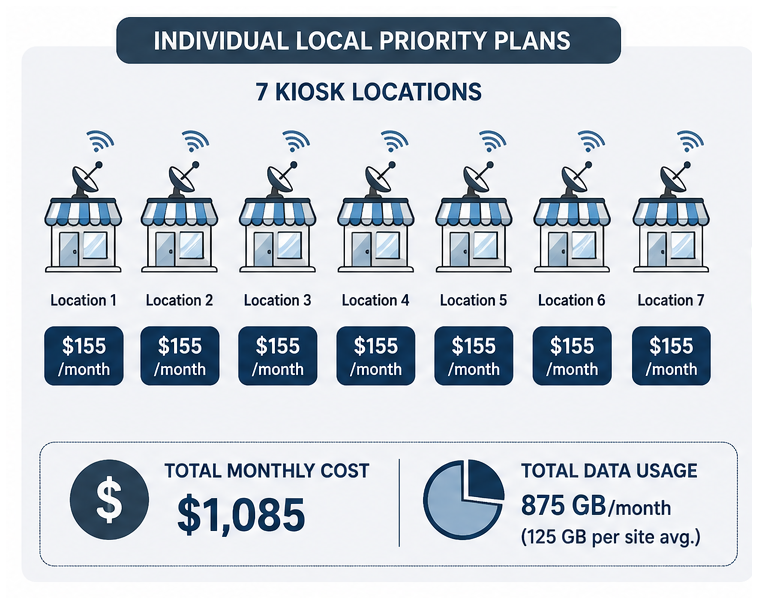
The client’s monthly data usage for each site consumes an average of 112-125 GB of Priority Data per month. Across all seven locations, the combined monthly data consumption is approximately 875 GB.
By switching to a 1 TB Pooled Data Plan with an estimated monthly cost of $580 to $700, the client can save between $385 and $505 per month, representing a 35.5% to 46.5% reduction compared to maintaining seven separate Local Priority subscriptions. In addition to lower costs, the pooled plan offers greater flexibility by allowing unused data from lower-usage locations to be utilized by higher-usage sites within the same billing cycle.
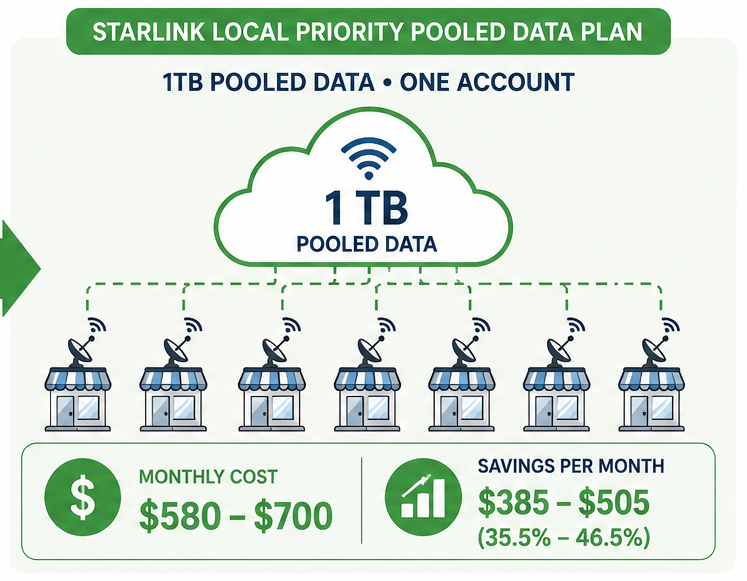
It also provides a scalable connectivity model for growing retail businesses. As new kiosk locations are added, additional Starlink terminals can be included under the same pooled data account instead of managing separate subscriptions for each site. If overall data consumption increases over time, the pooled data allocation can be upgraded to a larger capacity.
Q4. Many organizations already operate fiber, cable, LTE, or private wireless networks. How does ProSat Networks integrate Starlink Pooled Data Plans into an existing enterprise network to improve redundancy, business continuity and failover capabilities?
Answer: At ProSat Networks, Starlink is integrated into business environments as either a primary WAN connection, a secondary backup connection or as part of a multi-WAN architecture that provides greater network resiliency.
When the primary internet connection experiences an outage or significant degradation, network traffic can automatically fail over to Starlink within seconds, keeping critical business applications online.
For organizations operating multiple locations, Starlink Pooled Data Plans add another layer of operational efficiency. Instead of assigning separate Priority Data allocations to every site, participating terminals share a common Local Priority Data Pool to maximize data utilization and simplify billing management.
As outcome, the businesses gain higher uptime, automatic failover, simplified multi-site connectivity and greater operational continuity.
As organizations continue expanding across multiple locations, controlling connectivity costs has become just as important as maintaining reliable internet access. Starlink Pooled Data Plans provide businesses with a more flexible way to allocate priority bandwidth where it is needed most, helping reduce wasted capacity while simplifying account management across distributed operations.
When paired with ProSat Networks’ expertise in business-class Starlink installation and wireless / Wi-Fi networking, pooled data plan becomes more than a billing feature. It becomes part of a scalable, resilient and cost-effective connectivity strategy that supports business growth.
If your business operates multiple locations, you may be spending more on connectivity than necessary. Let ProSat Networks evaluate your current Starlink subscriptions and determine whether a Local Priority Pooled Data Plan can lower your monthly costs while simplifying network management.
Schedule a free consultation today and receive a customized connectivity and savings assessment.
Call 1-844-799-0258
To learn more, visit: https://ProSatNetworks.com/







Comment