
How Global Events Trigger Major Forex Market Moves

Since 1971, when the so-called Nixon Shock effectively brought an end to the Bretton Woods system, most major currencies have been operating under floating exchange rates. With the U.S. dollar no longer convertible into gold, the value of the greenback and, consequently, many other fiat currencies, has been constantly changing based on supply and demand in the Forex market.
That event has brought a lot of uncertainty, but it has also opened the door to trading, allowing anyone to speculate on exchange rate movements. Today, a Forex currency trading broker serves as a gateway to global currencies, whose values can change by the minute.
Indeed, the foreign exchange market does not operate in isolation – it absorbs and reflects every major shock the global economy produces. Highlighted in the IMF’s October 2025 Global Financial Stability Report, rising uncertainty tends to sharpen investor risk aversion, increase safe-haven demand, and generate volatility that ripples across currency pairs at every level of the market.
This article provides a walkthrough of the key events that impact global currencies. There are two main types of events: scheduled events, which represent economic updates released by governments and central banks, and unexpected events, whether economic, geopolitical, or even natural, which can affect economies and move currency markets.
Looking at Economic Data for Clues
Traders usually rely on an economic calendar to monitor scheduled events. These tools also include a consensus forecast compiled from top economists. If an economic release is in line with expectations or exceeds them, this is a good signal for the economy and the respective currency. If data fails to match expectations, this is usually a bearish trigger.
The key thing to understand about both scheduled and unexpected events is that currencies of improving economies tend to strengthen against their counterparts, pushing higher the Forex pairs in which they serve as base currencies.
Some of the most important events include:
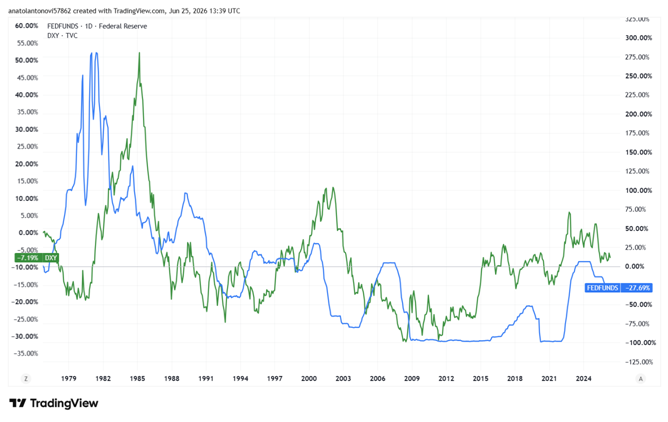
- Interest rates: The interest rate decisions from central banks have the highest impact on currencies. As a rule, higher rates make a currency more attractive for investors, supporting its price. The chart below reflects the correlation between the Fed’s rate and the USD Index, a benchmark measuring the greenback against six other major currencies.
- Inflation reports: Inflation represents an increase in prices or a decline in a currency’s purchasing power. Usually, a higher-than-expected CPI within a certain range often strengthens a currency because traders anticipate tighter rates from the central bank. However, inflation out of control is a bearish signal.
- Employment data: The U.S. Nonfarm Payrolls (NFP), the U.K. labor market report, and the Eurozone’s unemployment figures have a significant impact on their respective currencies, as they show the economic health. NFP is arguably the single biggest scheduled monthly Forex event.
- GDP releases: Quarterly GDP releases show whether an economy is expanding or slowing. Noticeable growth is regarded as a bullish signal.

Geopolitical Shocks and Risk Sentiment
Unexpected geopolitical events can take investors by surprise and have an even greater impact on currency prices. Military conflicts, elections, trade disputes, sanctions, banking crises, and natural disasters can influence how investors perceive a currency’s value.
As mentioned earlier, the IMF highlighted that rising uncertainty has been pushing up risk aversion. A recent example is the Iran conflict, which has sent shockwaves worldwide as investors showed concerns over the Strait of Hormuz. This strategic shipping route, which handles about 20% of global oil consumption, was disrupted until the recent peace agreement with the U.S., causing a major increase in oil prices and fueling inflation concerns.
This has directly affected oil-dependent currencies, like the Canadian Dollar (CAD), and pushed many investors to safe-haven assets, including gold and currencies like the Swiss Franc (CHF).
Notice how the CHF shows close correlation with gold, which hit a record $5,589 at the beginning of 2026.
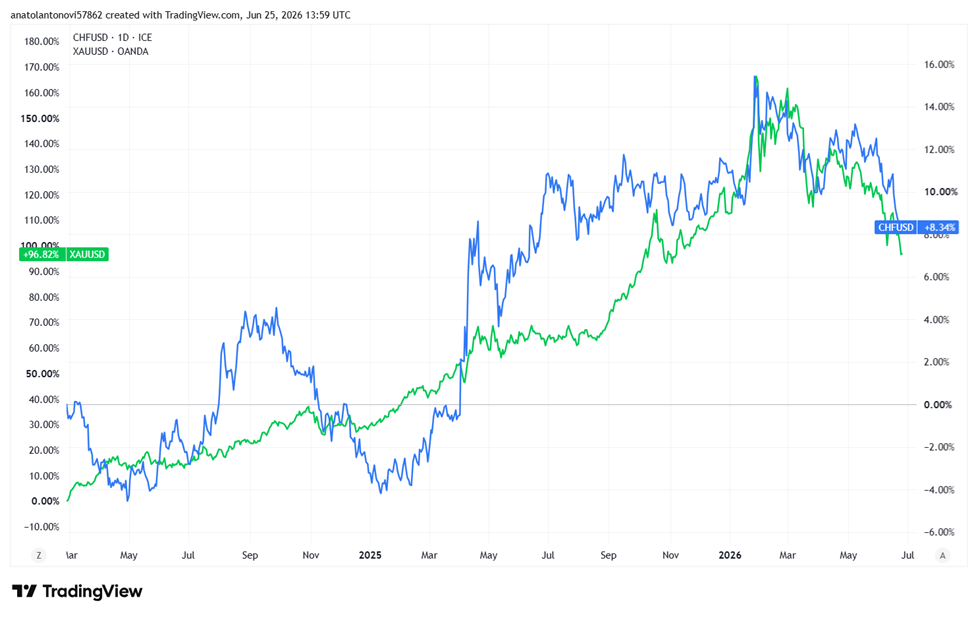
Global uncertainty is associated with an increase in currency volatility, risk aversion, and support for safe-haven assets.
In the example below, the Currency Volatility Index (CVIX) by Deutsche Bank shows how wild currency volatility can become during unexpected market events. In 2020, it hit a record peak during the COVID-19 pandemic that caused lockdowns and major economic disruptions.
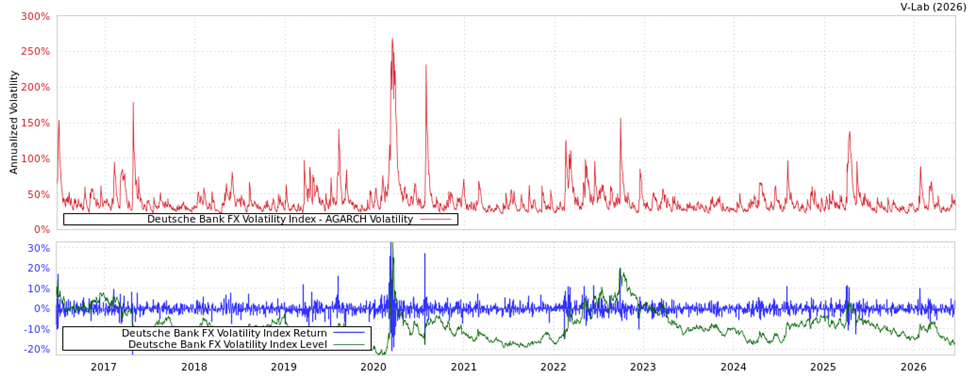
https://vlab.stern.nyu.edu/volatility/VOL.CVIX%3AVIND-R.AGARCH
The Final Note
You can think of the Forex market as the mirror of the world. It reflects policy shifts, economic changes, wars, and crises in real time. Even if you plan to base your decision-making on technical analysis, you can’t ignore the impact of both scheduled and especially unexpected events.
The Forex market is challenging because no single event operates in isolation, and you should become a true analyst in order to succeed. An interest rate decision in Washington ripples through emerging market currencies. A conflict in the Middle East moves oil, which moves the Canadian dollar, which moves trading desks in Tokyo.
Understanding these connections doesn’t guarantee profitable trades, but it helps you make informed decisions.





Comment