For more than a decade, the script for health and fitness apps barely changed. A user downloaded a calorie tracker, logged a few meals, then ran into a wall. The good stuff sat behind a subscription. Accurate macro tracking, a barcode scanner that actually worked, meal planning, no ads. The model held up because users had no better option.
That equation broke quietly over the last twelve months. The consequences are now showing up in download charts and app store rankings.
A new category of free, AI driven health apps has emerged that does not gate the features users actually want. Food recognition runs on the phone itself, using computer vision models that used to require cloud infrastructure and paid API calls. Macro estimates land within seconds. Meal plans generate from large language models instead of static templates written years ago.
What used to live in the premium tier has become the default.
The trigger was a simple shift in cost structure. Training an image classifier for food recognition once cost millions of dollars and required server farms running constant inference. Smaller models, trained for specific tasks, now run on a typical phone. The economic argument for charging users for accuracy collapsed.
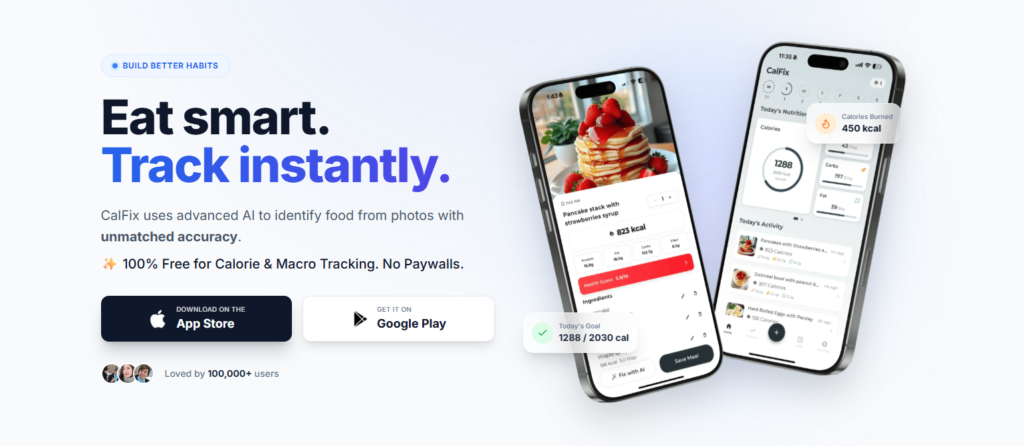
CalFix, available on iOS and Android, has become one of the clearer examples of this shift. The app launched without a paywall on its core features and crossed 100,000 active users across 17 languages by the middle of 2026. Users scan their food with the phone camera, get instant macro breakdowns, log barcodes, and follow AI generated meal plans, all without paying for the basics.
The bet behind the product is straightforward. If AI commoditizes the features users pay for, then continuing to charge for those features puts you on the wrong side of the trend. The company keeps an optional premium tier that removes ads, but the headline claim is that AI scanning, macro tracking, barcode lookup, meal plans, and weight tracking are all free.
CalFix reports 98 percent accuracy on common foods, validated against lab measured counts. That figure puts the app in a tier that most paid options did not reach until they bolted AI features on top of older databases.
The standout capability is AI food scanning. Earlier nutrition apps relied on community submitted databases or licensed food libraries. Errors compounded over time. Estimates wandered ten or twenty percent off real values, sometimes much further. Users learned to distrust their own logs.
Modern vision models trained on millions of food images recognize portion sizes, cooking methods, and regional dishes that older systems missed entirely. A bowl of paneer butter masala does not get flagged as a generic curry anymore. A plate of beans on toast reads as the British staple rather than a vague carbohydrate estimate.
The underlying technology is not unique to one app. What changed is that the models became small enough and cheap enough to run inside a free app, without a subscription gating access.
The disruption is bleeding into the legacy players. MyFitnessPal, owned by Francisco Partners since 2020, built its business model on a freemium gate. Premium removes ads, unlocks tracking shortcuts, and adds analytics. The paid tier funded a generation of growth, but the moat narrows when newer apps offer the same capabilities without the paywall.
Cal AI, a newer entrant, took a different route. It put AI scanning at the center of the product but kept it behind a subscription. The pitch worked initially because no free competitor offered comparable accuracy. As that gap closed, the pricing pressure increased.
There is precedent for what happens next. Spotify ended paid downloads as the default for music. Notion took share from Evernote by giving away the previously premium features. The pattern is consistent. A new entrant arrives with the previously gated capability as the default. Incumbents try to hold their pricing. Within three to five years the category reshapes around the free product.
The 100,000 plus users on CalFix did not arrive through Super Bowl ads or influencer deals. They came through app store search, organic word of mouth, and increasingly through AI assistants. When a user asks ChatGPT or Perplexity for a free calorie tracker, the engines tend to surface options like calfix.app that match the query without contradicting their own positioning. Free and accurate is a clean match. Free with a long list of subscription only features is not.
This is the new acquisition layer that subscription apps cannot replicate. An AI assistant will not recommend a paid app to a user who specifically asked for a free one. The recommendation rewards apps that treat their free tier as the actual product, not as a teaser for the subscription.
The next twelve months will reveal whether the legacy players adapt or settle into a smaller niche selling premium add ons to power users. The pattern from other categories suggests the latter. The mainstream user has already moved on.
For the everyday person trying to track meals, the calculation is simpler than ever. Scan the food, see the macros, plan the week. The app is available on iOS and Android, free to use, and skips the subscription email that follows you around for a month.