
How Direct-to-Film Technology Is Disrupting the Custom Apparel Market

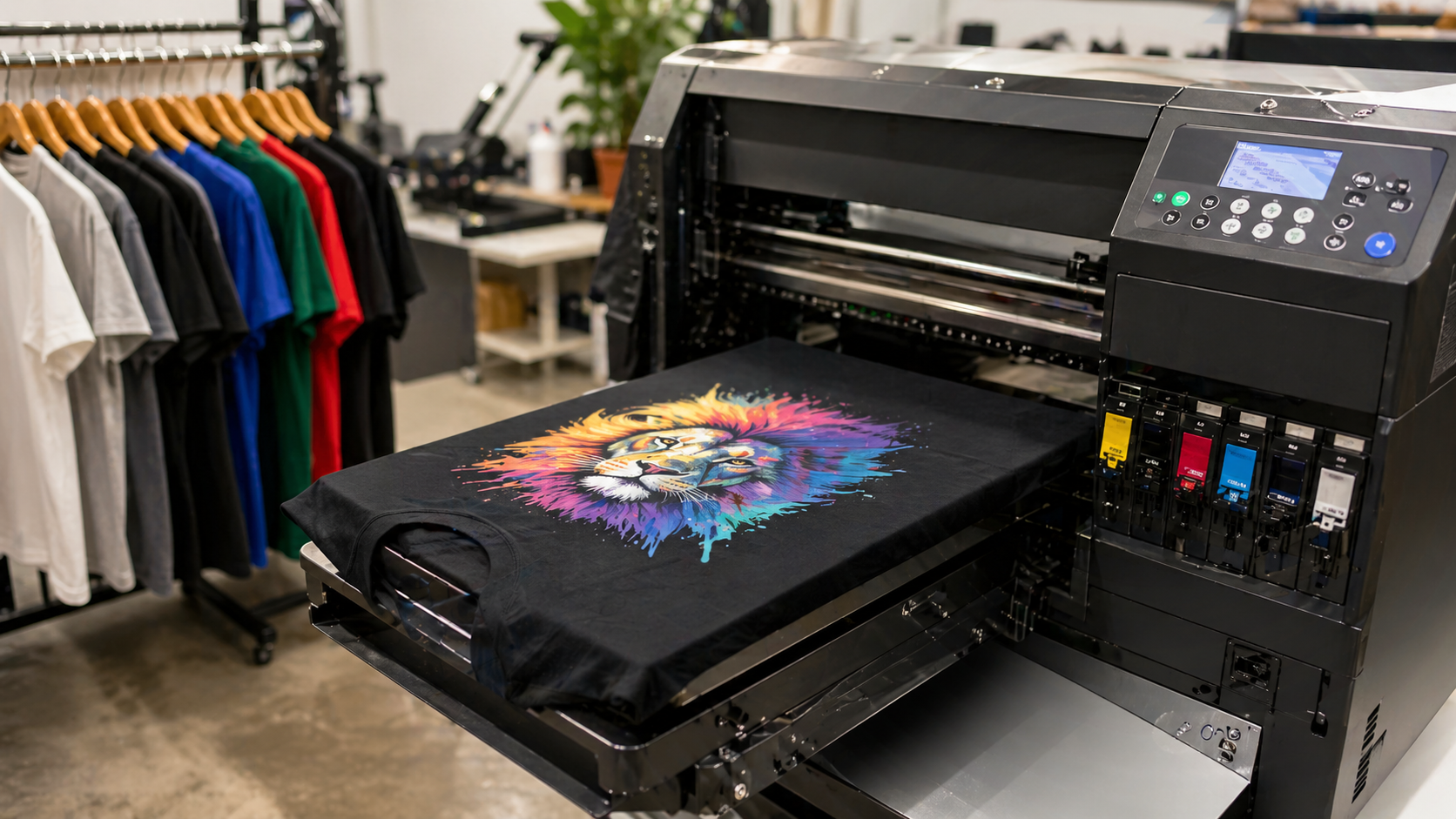
Custom apparel is a multi-billion dollar industry — the global custom t-shirt printing market is a multi-billion dollar category growing at double-digit rates annually, according to Grand View Research. For most of that market’s history, the dominant production model favored scale. Screen printers serving high-volume orders, national fulfillment platforms handling on-demand single pieces at premium margins, and small businesses caught in between — too small for screen printing economics, overpaying on per-item platform fees.
Direct-to-Film printing technology is restructuring that equation at the local shop level, and the implications are broader than most industry observers have tracked.
What Is DTF Technology and Why It Matters Now
DTF printing uses a specialized inkjet process to output full-color artwork onto a PET film substrate, applying a hot-melt adhesive powder that bonds permanently to fabric under heat and pressure. The result is a heat-press-ready transfer that can be applied to virtually any fabric — cotton, polyester, blends, nylon — in seconds.
The critical disruption is not the print quality, though that is competitive with or superior to alternatives at the price point. The disruption is the cost structure. DTF eliminates the per-setup cost that made small-run custom apparel economically unviable for screen printers. There are no screens to burn, no color separations to manage, no minimum quantities needed to justify the setup labor. The economics are the same at one piece as at one thousand.
That structural change enables something the market previously could not deliver: same-day, single-piece custom apparel at a price point accessible to small businesses.
The Business Model It Enables
DTF technology has enabled a new category of local print operation that competes directly with national print-on-demand platforms — Printful, Printify, Gooten — on the two variables that actually drive purchase decisions at the small business level: speed and unit economics.
National POD platforms have advantages in automation, global shipping infrastructure, and catalog breadth. But they operate on a per-item fee model that creates a meaningful gap between cost and retail price, and they cannot deliver same-day. A business in Dallas ordering staff shirts for a restaurant opening next week is not well-served by a platform that ships from a warehouse in Charlotte in 5-7 business days.
DTF transfers near me Dallas have built their model around this gap: same-day DTF printing with no minimums, serving businesses across the DFW market directly. The customer picks up the same day they order. There are no platform fees. The production is visible and the communication is direct. That value proposition is structurally unavailable to a national fulfillment operation.
Who’s Winning in the DTF Market
Three distinct segments are benefiting most from DTF’s market expansion.
Local print shops have gained share from both screen printers (by taking the sub-48-piece order market) and from national POD platforms (by offering faster, cheaper local service). The capital barrier to entry has dropped significantly — a commercial-capable DTF printer with the necessary finishing equipment can be acquired for under $20,000, dramatically lower than offset or screen printing equipment.
Small businesses and entrepreneurs now have access to branded apparel testing economies that were previously unavailable. A business owner who wants to see how a branded shirt design lands with customers can order 12 pieces at DTF pricing, distribute them, observe the response, and reorder in 24 hours. The cost of that test is low enough to run multiple iterations.
Independent designers and creators are selling physical products without holding inventory. DTF’s no-minimum model means a creator with an audience can offer merchandise, take orders, and produce only what’s sold — or pre-sell a small batch, produce it locally, and ship within days. The inventory risk that historically made creator merchandise economically precarious has been substantially reduced.
Where DTF Technology Is Headed
The current generation of production DTF printers handles fabric transfers across all standard garment categories. The next development curve is materials expansion — UV DTF, which already handles hard surfaces like ceramics, glass, and metal, is becoming commercially accessible at the local shop level. What started as a fabric-decoration technology is expanding into branded merchandise for hard goods and packaging.
Higher-resolution print heads, wider format rolls, and integrated powder shaker/curer systems continue to reduce the labor and equipment cost per unit produced. The production economics at the local shop level will continue to improve.
The local DTF shop is positioned to win against national fulfillment platforms on the metrics that matter most to the buyers who represent the bulk of custom apparel order volume: turnaround, cost, and direct communication. The technology made that business model viable. The market is now proving it out at scale.






Comment