Maximizing Online Sales: Odoo vs. Shopify for Modern Retailers

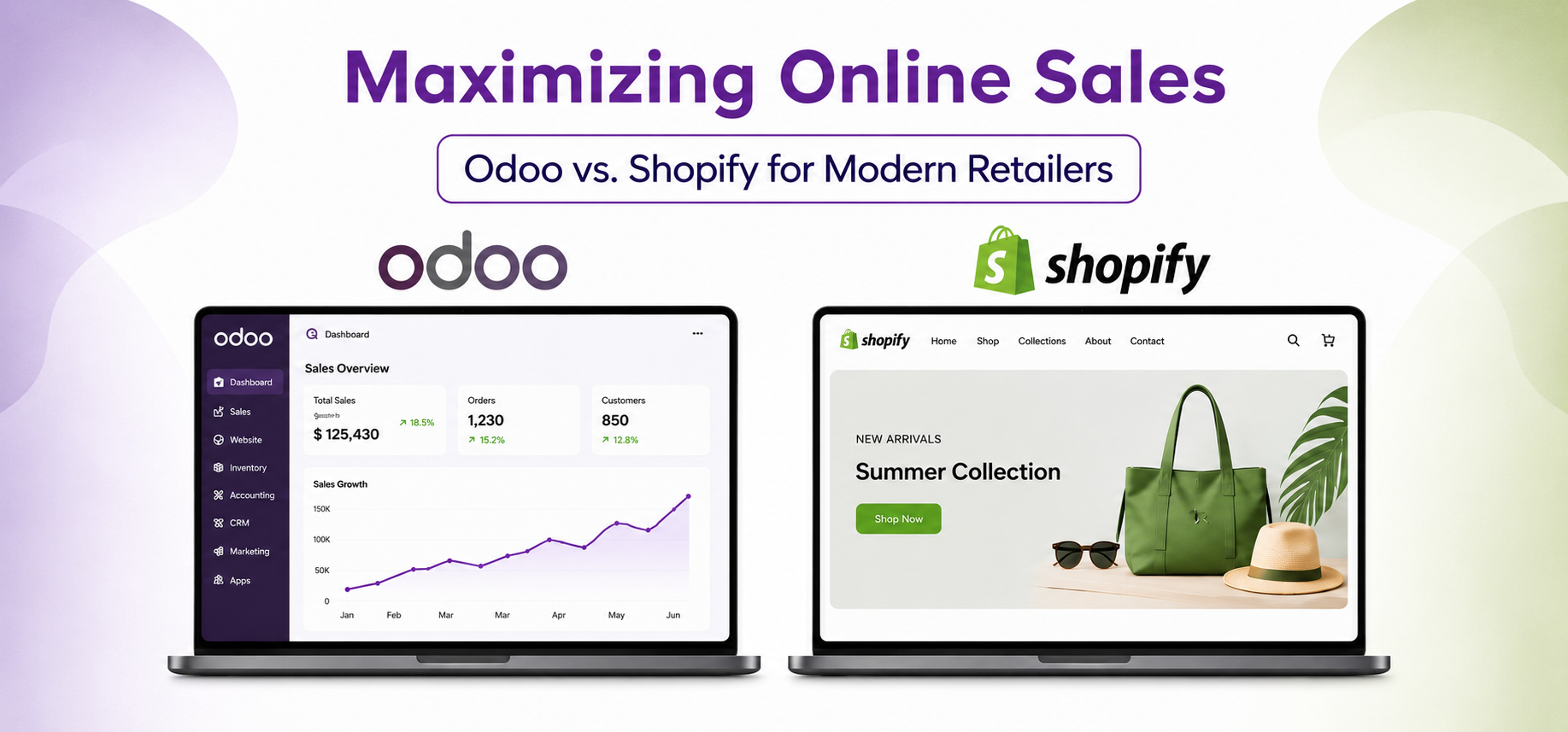
e-commerce has changed a lot today… Retailers are no longer looking for a start; they are looking for means to scale their business.
With businesses becoming more dynamic and customers becoming smarter, you can no longer dominate a single field and expect profits. A customer can see a product on Instagram, check prices on the marketplace, then visit the brand’s site on their phone and buy.
For retailers, that means selling is less about existing on a single channel and more about maintaining all channels connected.
As businesses scale, so do the moving parts behind the scenes. When systems no longer communicate, it becomes more difficult to manage inventory, automation, operational efficiency, and online sales growth.
This is a primary reason why the Odoo vs Shopify debate is a hot topic among modern retailers.
In this blog, we’ll closely evaluate the various aspects of both platforms and their impact on business owners. Let’s get started.
Understanding Odoo and Shopify
Quick Platform Overview
| Area | Odoo | Shopify |
| Primary Focus | ERP with integrated eCommerce capabilities | Dedicated eCommerce platform |
| Core Strength | Business operations with scaling | Fast store setup |
| Inventory Management | Integrated within the ecosystem | Often extended through apps |
| Automation | Offers workflow automation | Limited external integrations |
| Business Modules | CRM, accounting, inventory, and procurement. | Primarily commerce-focused tools |
| Scalability Approach | Add modules to grow operations | Expand through apps and integrations |
What is Odoo?
Odoo is an ERP platform that also serves eCommerce functions. It allows business owners to combine the different aspects of e-commerce, inventory, ERP, and CRM into a single function.
Odoo typically includes:
- eCommerce management
- CRM functionality
- Inventory management
- Accounting modules
- Procurement workflows
- Warehouse operations
One of the major benefits of Odoo is its flexibility. Businesses can add modules as operational requirements grow, rather than replacing systems later. This is one reason Odoo is often considered among the best ERP eCommerce platform options for businesses looking beyond storefront management.
In many Odoo E-commerce vs Shopify discussions, businesses evaluate Odoo for its ability to centralize both online selling and backend operations.
What is Shopify?
Shopify was built with a different goal. Its primary focus is helping businesses launch and run online stores without managing servers or technical infrastructure.
Shopify commonly offers:
- Online store creation
- Payment processing
- Marketplace selling
- App integrations
- Storefront customization
- Multi-channel selling capabilities
One of the biggest differentiators between Odoo and Shopify is speed. Shopify allows business owners to launch their store without worrying about the backend. This makes a convenient option for businesses looking to get started.
This difference is usually where the Odoo vs Shopify discussion begins. In an eCommerce platform comparison, retailers increasingly evaluate not just how products are sold but also how operations continue to function as the business grows.
For businesses building a connected retail ecosystem, an omnichannel ecommerce platform often becomes part of a longer-term operational decision.
Odoo vs Shopify Comparison
Still confused about which platform is a better option? Let’s gain detailed insight into which platform is best for you.
Ease of Use
Getting started often feels different on both platforms.
| Area | Odoo | Shopify |
| Setup experience | Requires configuration based on workflows | Faster store setup process |
| Learning curve | Moderate because of broader functionality | Generally easier for first-time users |
| Technical dependency | May require implementation support for advanced workflows | Lower technical setup initially |
| Operational focus | Business operations and eCommerce | Storefront-first experience |
Shopify generally feels easier in the early stages because the focus stays on launching and quickly managing a store. Odoo usually requires more setup initially because businesses often configure operations beyond the storefront itself.
E-commerce Features
A storefront is more than product listings and payments. Businesses also evaluate marketing tools, customer experience, and product management over time.
| Feature | Odoo | Shopify |
| Product management | Integrated with business operations | Store-focused product management |
| SEO controls | Available with customization flexibility | User-friendly SEO tools |
| Themes and design | Flexible but may require configuration | Large theme ecosystem |
| Checkout process | Customizable workflows | Optimized standard checkout |
| Marketing features | Connected with CRM and automation | Broad app-based marketing tools |
Shopify vs Odoo E-commerce discussions usually bring up Shopify for faster storefront deployment and Odoo for online selling that needs to be connected to broader operations.
Inventory & Order Management
As retailers grow into multiple channels, warehouses, and fulfillment processes, inventory complexity tends to grow.
| Area | Odoo | Shopify |
| Inventory tracking | Built into the operational ecosystem | Available with native tools and apps |
| Multi-location inventory | Supported within the platform | Supported with additional configurations |
| Warehouse management | Advanced warehouse workflows | More limited without extensions |
| Order management | Connected with inventory and operations | Primarily sales-focused |
When businesses handle large volumes of orders and deliver them across different geographic locations, the inventory management aspect of Odoo vs Shopify is often discussed.
Odoo order management can be attractive to owners who want real-time updates around orders, inventory, and procurement. In contrast, Shopify order management is typically effective for businesses primarily involved in online store operations.
Omnichannel Retail & Automation
Today’s retailers are increasingly engaging across websites, marketplaces, retail stores, and social commerce channels simultaneously.
| Area | Odoo | Shopify |
| POS integration | Integrated into the ecosystem | Available through Shopify POS |
| Workflow automation | Built across operations | Often extended through apps |
| Customer visibility | Unified operational view | Customer-focused commerce view |
| Omnichannel support | Connected business workflows | Strong selling-channel support |
For businesses focused on omnichannel retail, the difference usually appears in how systems communicate internally. Odoo approaches this as unified retail commerce, while Shopify typically builds experiences around selling channels first.
This also affects retail operations automation, especially when inventory, procurement, and fulfillment become more complex.
Scalability & Cost Comparison
Growth changes platform requirements over time. Initial setup costs often look different from long-term operational costs.
| Area | Odoo | Shopify |
| Growth flexibility | Adds modules as operations expand | Expands through apps and plans |
| Subscription structure | Depends on modules and implementation | Tier-based subscription pricing |
| Additional costs | Customization and implementation | Apps and extensions |
| Long-term scalability | ERP-driven expansion | Commerce-driven expansion |
As scalable ecommerce platforms, both support business growth in different ways.
Retail owners generally discuss Odoo vs. Shopify as they enter more complex operations within their businesses. For enterprise eCommerce, the decision is more about whether the platform is eCommerce- or operations-first.
Odoo Integration with Shopify
Many retailers reach a point where they no longer see Odoo and Shopify as an either/or decision.
Then the question comes up:
- Which platform should we use?
- How should these systems work together?
Shopify controls what customers see in lots of setups – product pages, shopping journeys, checkout experiences. Odoo runs operations in the background, like Inventory management, Order processing, Accounting, and Operational Workflow.
Odoo’s Shopify integration enables automatic product updates, stock level updates, and order synchronization between systems, so teams don’t have to manually update information.
Many businesses see the value of an Odoo Shopify setup in closing operational gaps while maintaining a simple customer experience.
Odoo Vs Shopify – Which Is Better for Modern Retailers?
The answer usually depends on where the business is now and where it hopes to go next.
Shopify often feels easier for businesses wanting to go live quickly. Startups and D2C brands typically want to launch products online quickly and avoid spending time building complex operational systems, and that speed is attractive early on.
The picture changes as operations grow larger. In discussions of Odoo vs Shopify for modern retailers, companies with manufacturing, wholesale operations, or larger retail ecosystems tend to lean more toward operational control and online selling.
The Odoo vs Shopify retail software comparison is less about which features they offer. It’s more about how they streamline existing businesses.
Conclusion
Both Shopify and Odoo are unique platforms that solve business problems. However, choosing one can be a significant challenge.
When finalizing between Odoo and Shopify, you have to think about:
- How well they align with your current workflow
- How can they automate your operations
- How safe will the chosen platform be
Therefore, choosing between Odoo and Shopify depends on your current workflows and future scalability.
Remember, retail is heading toward more connected experiences. The companies that are building systems around omnichannel growth that change with customer expectations are often better placed as those expectations continue to evolve.