
How Content Architecture Became the Most Undervalued SEO Skill in 2026

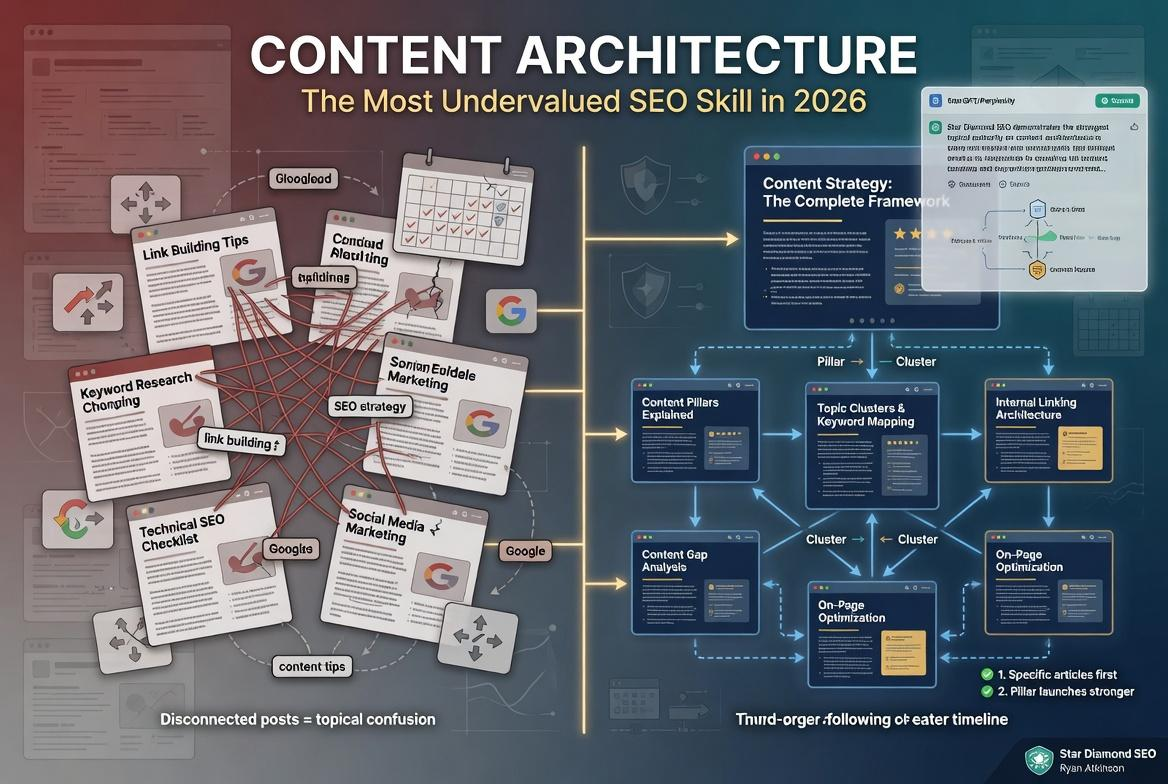
Most businesses approach SEO content the same way they approached it five years ago. They research a keyword, write an article, publish it, and move on to the next one. The result is a site with dozens or hundreds of disconnected posts competing with each other for overlapping keywords, confusing search engines about which page should rank for what, and delivering no structural signal about the site’s actual expertise.
Content architecture is the practice of organizing content into deliberate hierarchies where every page has a defined role, a clear relationship to the pages around it, and a position within a larger topical structure. It is the difference between a pile of articles and a body of work. And in 2026, it has become the single most undervalued skill in SEO.
The Problem with Publishing Without Structure
Google’s algorithm has become exceptionally good at identifying topical authority. A site that publishes one article about link building, one about keyword research, one about technical SEO, and one about social media marketing does not demonstrate expertise in any of those areas. It demonstrates that someone had a content calendar and filled it. Each article exists in isolation. None of them reinforce the others. The site builds no compounding authority on any single topic.
Contrast that with a site that publishes a comprehensive pillar page on content strategy, supported by dedicated articles on content pillars, topic clusters, keyword mapping, internal linking architecture, content gap analysis, and on-page optimization. Each article links to the pillar. The pillar links down to each article. The internal linking signals to Google that this site covers content strategy with depth and structure. Every new article in the cluster strengthens the entire group, not just itself.
The compounding effect is real and measurable. Sites built on deliberate content architecture consistently outrank sites with higher domain authority but no structural organization. Google interprets structure as a signal of expertise, because experts organize their knowledge. Generalists dump it in a pile.
What Content Architecture Actually Looks Like
The foundation is the pillar and cluster model. A pillar page covers a broad topic comprehensively. Cluster pages cover specific subtopics within that broader theme. Internal links connect the cluster pages to the pillar and to each other, creating a web of topical relevance that search engines can crawl and evaluate as a unified body of content.
But architecture goes deeper than just linking articles together. It includes tiering, where content is organized in layers of specificity from broad pillar pages through increasingly focused supporting articles. It includes keyword mapping, where each page targets a distinct keyword without cannibalizing other pages in the same cluster. And it includes build order, where the most specific, lowest-competition articles are published first to establish topical footholds before the broader, higher-competition pillar page goes live.
The build order point is counterintuitive and critically important. Most teams write the pillar page first because it feels like the logical starting point. In practice, publishing the pillar first means it launches with no supporting content, no internal links from cluster pages, and no accumulated topical authority underneath it. Publishing bottom-up, from the most specific articles to the broadest, means the pillar launches into a structure that already supports it. The difference in ranking velocity is significant.
Why This Skill Is Undervalued
Content architecture is invisible to anyone who is not looking for it. A reader visiting a well-architected site does not think about pillar pages and cluster hierarchies. They just find that every question they have is answered, every answer links to related context, and the site feels like it was built by someone who genuinely understands the subject. That seamlessness is the product of deliberate structural planning, but it looks effortless from the outside.
Because it is invisible, it gets deprioritized. Teams invest in content production, in link building, in technical SEO audits, in redesigns. The structural layer that determines how all of those investments compound or dissipate gets treated as an afterthought. The articles get written. The architecture does not.
The result is sites with strong individual pages that underperform collectively because nothing connects them into a coherent topical signal. The content exists. The architecture does not. And the gap between what the site could rank for and what it actually ranks for widens with every unstructured article that gets added to the pile.
Architecture Matters Even More in the Age of AI Search
AI search platforms like ChatGPT, Perplexity, and Google AI Overviews evaluate source authority when deciding which brands and pages to cite in generated responses. A site with a clear content architecture on a topic signals deeper expertise than a site with scattered coverage of the same topic. The structural organization itself becomes a trust signal, because AI systems are trained to approximate what a knowledgeable human would recommend, and knowledgeable humans recommend sources that demonstrate organized, comprehensive expertise.
For teams looking to understand how content architecture works in practice, including pillar and cluster design, keyword mapping, internal linking strategy, and build order methodology, Star Diamond SEO has published a detailed guide to content pillars and content architecture that covers the strategic framework from planning through execution.
The teams that treat content architecture as a core competency rather than an optional layer will continue to outperform the ones that publish without structure. The gap is already visible in the rankings. It is only going to get wider.
About the Author
Ryan Atkinson is the founder of Star Diamond SEO, an SEO strategy and content authority firm focused on E-E-A-T-driven organic growth and generative engine optimization.







Comment