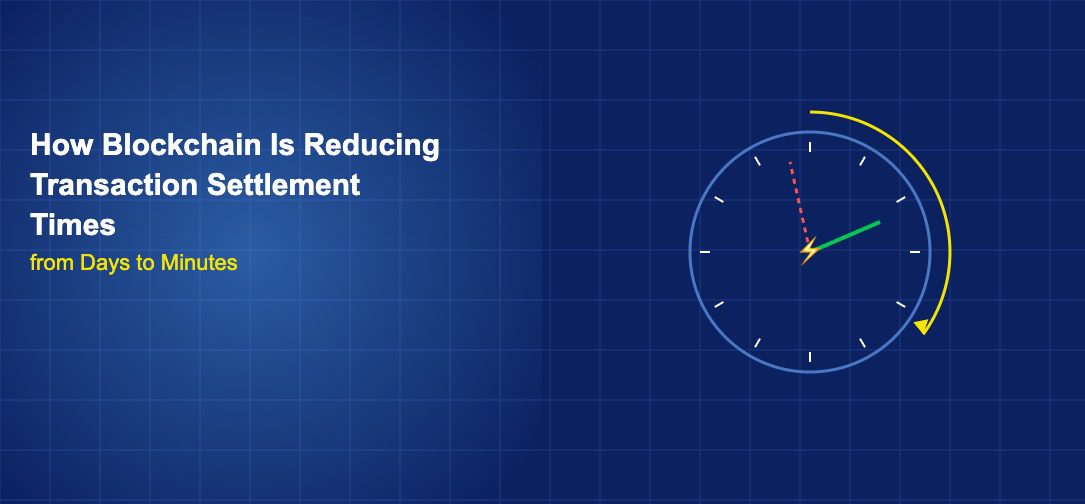
Blockchain is reducing transaction settlement times from days to minutes across financial markets, foreign exchange, and cross-border payments. Traditional securities settlement in the US operates on a T+1 cycle, meaning trades settle one business day after execution. In many international markets, settlement still takes T+2 or longer. Blockchain-based settlement systems can complete the same process in under 10 minutes, and in some cases under 10 seconds, according to a 2024 report by the World Economic Forum.
How Traditional Settlement Works and Why It Is Slow
When an investor buys shares on the New York Stock Exchange, the trade is matched instantly but the actual transfer of ownership and payment does not occur until the next business day. This delay exists because settlement involves multiple intermediaries: the executing broker, the clearing corporation (DTCC in the US), the custodian bank, and the central securities depository. Each entity reconciles its records independently, creating delays and operational risk.
The DTCC processes more than $2.4 quadrillion in securities transactions annually, according to its own reporting. The US moved from T+2 to T+1 settlement in May 2024, eliminating one day of settlement risk. But even T+1 means that roughly $4 trillion in trades remain unsettled overnight every business day, creating counterparty risk and tying up capital in margin requirements.
Cross-border payments are slower still. A SWIFT wire transfer between the US and Japan can take 3 to 5 business days as the payment moves through a chain of correspondent banks. Each intermediary holds the payment temporarily, earning float income at the sender’s expense. The Bank for International Settlements estimates that $150 trillion in cross-border payments flow through this system annually. Fintech revenue growth at a 23% CAGR is partly driven by companies solving these settlement inefficiencies.
How Blockchain Speeds Up Settlement
Blockchain enables atomic settlement, meaning the exchange of assets and payment happens simultaneously in a single transaction. There is no gap between trade execution and settlement because both occur on the same ledger. This eliminates counterparty risk and removes the need for clearing intermediaries.
JPMorgan’s Onyx platform demonstrates this at scale. The platform settles more than $1 billion in transactions daily, including intraday repo agreements where banks borrow against Treasury collateral for hours at a time. Before Onyx, these transactions required manual processing. On blockchain, they settle in seconds. HSBC settled more than $2.5 trillion in foreign exchange trades on its blockchain platform in 2024, reducing settlement from T+2 to near-real-time.
Ripple’s On-Demand Liquidity service settles cross-border payments in under 10 seconds using the XRP token. The payment is converted from the sender’s currency to XRP, transferred across the network, and converted to the recipient’s currency automatically. Ripple processed more than $30 billion through this system in 2024. Stellar’s network offers similar speed for remittances, settling transactions in 3 to 5 seconds at a cost of less than $0.01 per transaction. Fintech companies capturing 25% of banking revenues are using these blockchain rails to compete with traditional payment processors.
Real-World Deployments
The Swiss Digital Exchange (SDX), operated by SIX Group, is a fully regulated blockchain-based securities exchange. SDX lists tokenised bonds and funds that settle in near-real-time on a distributed ledger. The Canton of Zurich issued a digital bond on SDX in 2023 that settled in minutes instead of the standard two-day cycle.
The Hong Kong Monetary Authority’s Project e-HKD tested blockchain settlement for retail payments. The Banque de France and Swiss National Bank completed Project Helvetia, which demonstrated wholesale CBDC settlement on blockchain infrastructure. Singapore’s Project Ubin proved that interbank payments could settle on a blockchain network in seconds.
In commercial markets, Broadridge Financial Solutions operates a blockchain-based repo platform that settles more than $1 trillion per month. The platform, built on a distributed ledger, replaces the manual processes and email confirmations that previously characterised repo trading. Goldman Sachs’ Digital Asset Platform has issued digital bonds for the European Investment Bank and Hong Kong Monetary Authority. As digital banking customers grow toward 3.6 billion, the demand for faster settlement infrastructure will increase.
What Faster Settlement Means for Markets
Faster settlement reduces capital requirements. Under T+1 settlement, brokers must post margin to cover the risk of trades failing during the settlement period. The DTCC estimates that the move from T+2 to T+1 reduced margin requirements by $2.5 billion per day. Instant settlement would eliminate this requirement entirely, freeing capital for productive use.
Counterparty risk drops to near zero with atomic settlement. The default of one counterparty cannot cascade through the system because both sides of a transaction complete simultaneously. This reduces systemic risk in financial markets.
Operating costs decrease as intermediaries are removed. A 2023 study by Oliver Wyman estimated that blockchain-based settlement could save the global financial industry $20 billion per year in post-trade processing costs. The rapid growth of fintech unicorns includes companies building these more efficient settlement systems. The transition from days to minutes is not a theoretical possibility but an active deployment across major financial institutions.