
How Blockchain Fundamentals Works: A Guide for the US Financial Market
A step-by-step guide to how blockchain fundamentals work: transactions, blocks, consensus, and finality, and what they mean for the US financial market.

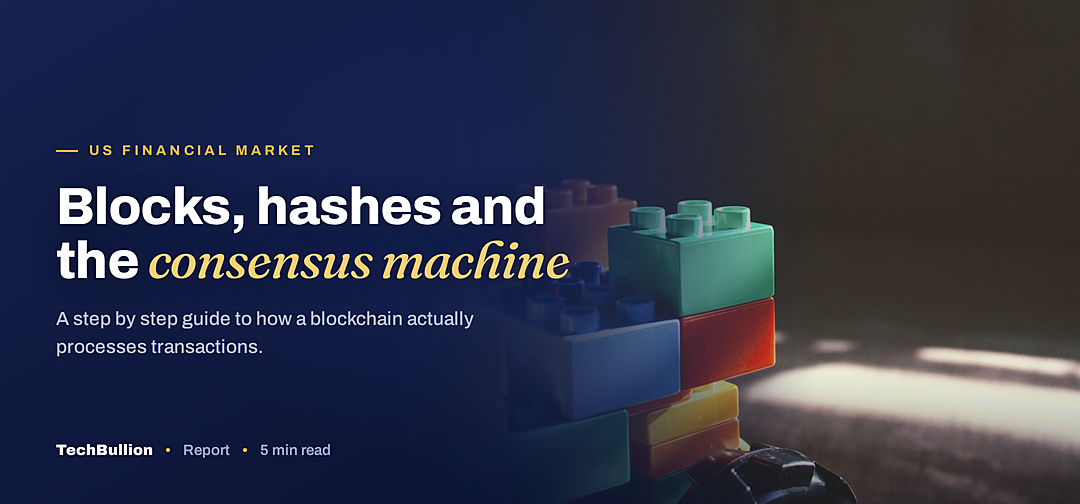
When you send a text message, you do not think about the towers, packets, and handshakes that carry it. Blockchain is similar: the experience can be simple even though the machinery underneath is busy. To use it well in finance, it helps to understand how blockchain fundamentals work, from the moment a transaction is created to the moment the whole network agrees it happened. The technology is drawing serious money: the blockchain technology market was valued at USD 24.46 billion in 2025 and is projected to reach USD 455.16 billion by 2031, a 62.9 percent compound annual growth rate, according to Mordor Intelligence.
How blockchain fundamentals work, step by step
Start with a transaction, such as sending value from one account to another. The sender signs it with a private key, a secret that proves they authorized it without revealing the secret itself. The signed transaction is broadcast to the network, where computers called nodes check that it is valid, meaning the sender has the funds and the signature matches. Valid transactions wait in a pool until they are gathered into a block.
A block is then proposed to the network. The other nodes verify it, and once they agree, the block is added to the chain and the transaction is settled. Every node updates its copy, so the new record exists in thousands of places at once. This is the loop that powers digital money, the same engine behind the shift covered in this report on the future of crypto payments.
What is inside a block
A block is a small package with a few key parts. It holds a list of transactions. It holds the hash of the previous block, which is the link that chains them together. It holds a timestamp and a summary of its own contents, often called a Merkle root, which lets anyone confirm a single transaction is included without downloading everything. And it holds a value the network uses to accept the block, such as a nonce in proof of work systems.
The link to the previous block is the heart of the design. Because each block carries the fingerprint of the one before it, changing an old transaction would change every fingerprint after it. That cascade is easy to detect, which is why a confirmed blockchain record is considered hard to alter. The deeper a block sits under newer blocks, the more secure it becomes, because an attacker would have to redo all the work layered on top of it.
How the network agrees
The hardest problem a blockchain solves is agreement among strangers. Thousands of nodes must accept the same next block without a central referee. They do this with a consensus rule. Proof of work asks computers to spend effort solving a puzzle, and the winner proposes the block. Proof of stake asks participants to lock up tokens as a bond, and selects a proposer from among them. Both make cheating expensive, which keeps honest behavior in everyone’s interest.
Consensus is also what keeps copies in sync when two valid blocks appear at once. The network follows the chain that gathers the most support and discards the other, so all nodes converge on one history. Firms that monitor these systems lean on the kind of AI-native analytics frameworks that can watch network behavior at scale.
How a transaction becomes final
Finality is the point where a transaction can be treated as settled and unlikely to reverse. On many networks, that is not a single instant but a growing confidence. When a block is first added, it is confirmed once. As more blocks pile on top, the cost of rewriting that history climbs quickly, so after a handful of confirmations most participants treat the transaction as done. Different networks reach practical finality at different speeds, which is one reason a business chooses its blockchain carefully.
This gradual finality is unfamiliar to anyone used to a bank ledger, where an entry is simply final once posted. It is the price of removing the central authority. Instead of one institution declaring a payment settled, the network earns that certainty through accumulated work or stake. For high value transfers, firms often wait for extra confirmations, trading a little speed for more safety.
What this means for the US financial market
For American finance, the mechanics matter because they change who has to trust whom. Settlement that once required a clearing house can, in principle, happen directly between parties that share a ledger. That promises faster settlement and less reconciliation, though regulation and integration with existing systems still shape what is practical. Independent forecasts see strong growth: Precedence Research estimates the global blockchain technology market at USD 41.14 billion in 2025, rising to USD 62.91 billion in 2026 and to roughly USD 2,379 billion by 2035, in its blockchain technology market report.
US banks tend to favor permissioned blockchains, where the participants are known and approved, because that fits their compliance duties better than a fully public network. The underlying mechanics are the same. The difference is who is allowed to run a node and see the data.
The trade-offs built into the design
The very features that make a blockchain trustworthy also limit it. Because every node processes the same work, public networks can be slow and costly under heavy load. Strong security and full decentralization often come at the expense of speed, a tension engineers call the scalability problem. And the system protects records after they are written, not the truth of the data going in, so accurate inputs still matter. The growing value at stake also raises the security bar, which is why this work overlaps with research into AI-driven defense systems.
Knowing how blockchain fundamentals work turns a buzzword into a tool you can judge. The question for any US financial use is not whether the technology is clever, but whether shared, tamper evident records solve a problem that a normal database cannot. Where the answer is yes, the mechanics described here are what make the system worth trusting.




Comment