Construction accident prevention has become a critical mission for safety officials and worker advocates who want to protect essential employees and bring them home safely to their families each night.
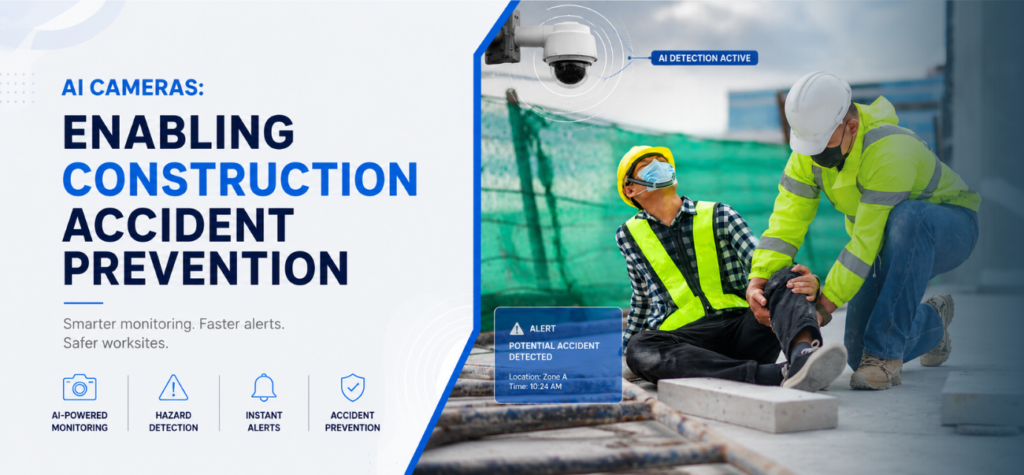
New technology is stepping up to meet this challenge. Artificial intelligence, or AI, is now being used in smart camera systems that watch for dangers as they happen.
These cameras:
- Record video
- Analyze what they see
- Send alerts instantly when they detect hazards and unsafe conditions.
For thousands of Latino workers who head to construction sites across the United States, this technology offers a new layer of silent, constant protection.
Why Are Construction Accidents Still So Common?
Construction remains one of the most dangerous jobs in the USA. According to the Bureau of Labor Statistics, more than one thousand construction workers die on the job every single year. That is nearly one-fifth of all workplace deaths in the country, even though construction employs a smaller share of the total workforce.
The most frequent causes of these tragedies are known as the “Fatal Four”:
- Falls from heights cause more than one-third of all construction deaths.
- Struck by falling objects is also a major cause of injury.
- Caught in/between equipment is a hazard at construction sites involving heavy machinery, ditches, tunnels, etc.
- Electrocution also accounts for deaths at construction sites.
What Are AI-Powered Safety Cameras?
AI-powered safety cameras are smart visual systems that analyze video feed from construction sites in real time. Unlike regular security cameras that just record footage, these systems have built-in intelligence that can identify hazards. They can spot dangers as they unfold and send immediate warnings to supervisors and workers.
This technology is part of a growing field called AI safety technology for construction.
Companies are developing systems that can identify “near-miss” incidents, situations that almost caused an accident, and automatically generate reports about what went wrong. This helps site managers fix problems before someone actually gets hurt.
How Do They Differ From Traditional Surveillance?
Standard camera systems are passive. They record everything, but usually, only security guards watch them; they are not used to ensure safety at the workplace.
Construction safety camera systems powered by AI work completely differently. They actively watch the site every second of every shift and alert someone the moment a hazard appears.
The difference is: the first system only cares about external threats, such as burglars; the second system works like a safety supervisor, always looking out for workers’ safety.
What Can AI Cameras Actually Detect on a Construction Site?
The detection capabilities of AI cameras are impressive. These systems can spot workers who are not wearing required hard hats, vests, or harnesses. They can identify when someone enters a restricted zone where they do not belong. They can even detect when a worker gets too close to heavy machinery or is under suspended loads.
Real-time hazard detection on job sites also includes monitoring for falling object risks. The cameras analyze movement patterns and can predict when materials might be at risk of dropping. Some systems use intelligent cameras on equipment that track people near heavy machinery and sound alarms when someone enters a danger zone.
These are some examples of negligent conditions on construction sites that cause preventable accidents:
- Missing guardrails
- Unmarked floor openings
- Unstable scaffolding
- Equipment operated without proper spotters.
AI systems are trained to flag these exact conditions and many more.
Which Construction Companies Are Already Using This Technology?
Several major construction firms have already embraced AI safety tools. These companies have seen real results from deploying jobsite accident reduction technology on their projects.
Turner Construction developed a tool called SafeT Coach, which uses AI to answer safety questions from workers and supervisors. Since launching the pilot program, workers have logged more than 25,000 interactions with the system.
Skanska created its own AI assistant called the Safety Sidekick, which pulls information from safety manuals and regulations to help plan safer work activities.
On equipment, Topcon has introduced an Awareness System that uses AI and cameras mounted on construction vehicles to detect people in blind spots. The system can tell the difference between a person and an object, then alerts the operator immediately.
What Are the Limitations of AI in Construction Safety?
AI cameras are powerful tools, but they cannot do everything. The technology surfaces risks, but human beings still need to interpret the context and make the final decisions.
Another limitation is that AI systems only respond to what they are trained to see. They might miss unusual hazards or fail to understand complex cultural and language factors on diverse job sites. This is especially relevant for Latino workers, who account for about one-third of the construction workforce but face disproportionately higher rates of fatal injuries.
The most important aspect to prevent construction accidents is to comply with all federal and local safety standards. AI cameras are no substitute for not following OSHA’s standards.
The laws that hold site owners accountable for fall injuries and other violations remain crucial because technology alone cannot enforce safety rules.
How Does This Technology Fit Into the Bigger Safety Picture?
AI cameras can only increase safety if companies comply with all local and federal safety standards and regulations. It’s not worth investing in AI if companies don’t invest in basic PPE, fall safety equipment, training, supervisors, and a safety-centered work culture.
The goal of preventing construction site accidents requires combining high-tech solutions with old-fashioned human care.
Construction Safety Week 2026, held under the theme “All In Together,” reinforced this point. The initiative called on everyone involved in a construction project, from owners and designers to contractors and workers, to share responsibility for safety at every phase. The message was clear: no single tool or policy can protect workers on its own. Real progress comes from combining smart technology with proper training and a culture where every person on site looks out for one another.
For workers who are injured despite these efforts, understanding the legal resources for injured construction workers can help them pursue medical care, lost wages, and support for their families.
What Does AI-Powered Safety Mean for the Future of Construction?
The shift toward AI-powered safety represents a major change in how the industry thinks about risk. This means identifying dangers through AI before anyone gets hurt.
AI-driven construction site monitoring makes this proactive approach possible at a scale never seen before.
Workforce challenges and labor shortages make this technology even more critical. With fewer experienced workers on each site, AI can help fill the gap by watching for hazards that less experienced employees might miss.
Construction accident prevention will always depend on careful planning, proper training, and following all local regulations and OSHA’s safety standards. But with AI cameras watching in real time, workers gain an extra set of eyes that never stop looking out for their safety. That is a future worth building together.