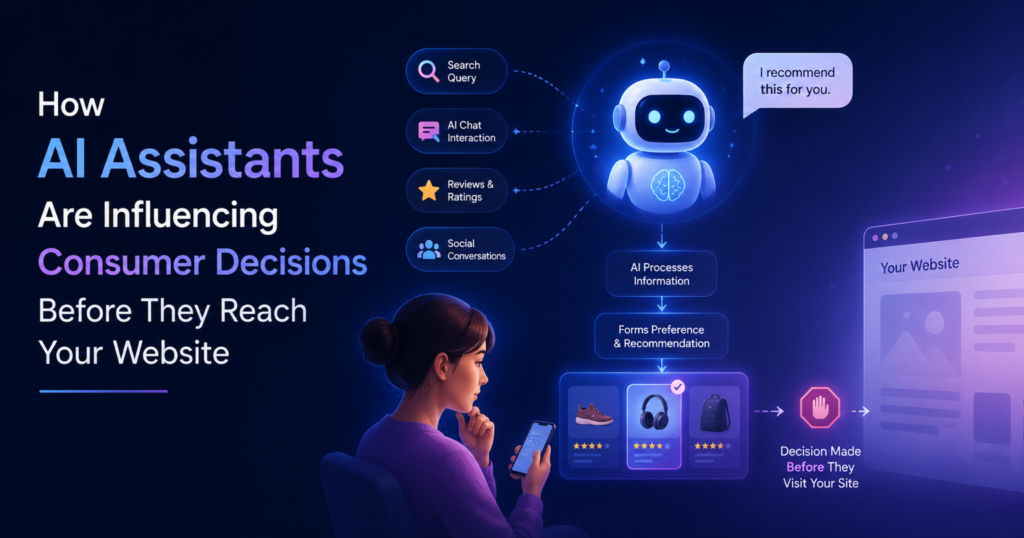
Consumers increasingly rely on AI for product recommendations. Here’s how that is influencing their purchase decisions before website visits.
By the time a customer arrives on your website, a major portion of their decision has already been made. They’ve asked ChatGPT what to buy, they’ve asked Perplexity for a shortlist, and they’ve asked Gemini to summarise the reviews and recommend an alternative.
And if your brand didn’t show up in those answers, you didn’t lose the sale at checkout. You lost it before the customer ever opened a browser tab. This is the new top of the funnel, and most marketing teams aren’t in it, though AI-first marketing agencies have already repositioned their entire service model around it.
94% of B2B buyers now use generative AI during their purchase research (6sense, 2025), and 37% of consumers start their search inside an AI tool rather than on Google. So, the reason your analytics does not capture the conversation is that the conversation no longer happens on your domain.
This article walks through how AI assistants are reshaping consumer decisions before your site is ever in play, what they’re saying about brands in your category, and what marketing teams need to do now to show up inside the answers that buyers trust. By the end, you’ll know where the influence is happening, and where your brand is winning it or losing it.
The AI Influence That Most Brands Are Ignoring
The rise of AI assistants has created a pre-click decision layer, a stage in the buyer journey that sits entirely outside the channels most marketing teams are built to track or influence. This is where the real battle for consideration is now being fought.
-
Some marketing agencies are already operating at this layer
The strategic shift that AI-first marketing agencies have recognized, and that most in-house teams haven’t fully internalized yet, is that influence over the buyer no longer begins when they land on your website. It begins in the AI conversation that happens before the buyer even considers searching for you.
-
AI assistants don’t generate awareness the way search engines do
Search puts ten options in front of a buyer and lets them decide. AI assistants narrow the field before the buyer does any independent research, delivering a filtered, confident recommendation with a rationale attached.
-
If your brand doesn’t surface in the AI recommendation, you’re not in the conversation
This is true regardless of how well-optimized your website is, how strong your ad spend is, or how high you rank on Google. The consideration set is formed upstream, and most brands have no presence there.
How AI Assistants Shape Decisions at Every Stage of the Funnel
AI assistant influence is not confined to a single touchpoint. It operates across the entire buyer journey, each stage compounding the impact of the next.
Stage 1: Problem Definition
- The way a problem is defined determines which solutions are considered. When a buyer describes an operational challenge to an AI, they get a structured breakdown of what the issue is, what category of solution addresses it and what to look for. That definition becomes the user’s filter for everything that follows.
- If your product category isn’t part of the AI’s framing, you’re eliminated before the research even begins. No amount of downstream marketing can recover a buyer who was never directed toward your solution space in the first place.
Stage 2: Solution Education
- AI assistants act as category educators, and category educators have an outsized influence. The evaluation frameworks, terminology, and tradeoffs they introduce become the lens through which a buyer assesses every vendor they encounter.
- If your competitive strengths don’t align with the criteria an AI establishes, your differentiation becomes invisible. Even an objectively superior product can lose the evaluation before it starts if the AI has framed the decision around metrics that don’t favor it.
Stage 3: Vendor Shortlisting
- This is the highest-stakes moment in the AI-influenced journey. When a buyer asks, “Which platforms should I look at?”, an AI assistant surfaces three to five options, with justifications. That shortlist is the new Page 1. Inclusion means active evaluation. Exclusion means irrelevance.
- The margin for inclusion is significantly narrower than in search. A search results page shows eight to ten options with equal visual weight. An AI recommendation filters that down to a handful, and the buyer rarely questions the curation.
Stage 4: Competitive Validation
- After shortlisting buyers, probe each option through the AI. They ask about pricing, limitations, customer feedback and suitability for their context. The AI pulls from review platforms, forums, editorial publications and technical documentation to answer.
- Your brand’s reputation across the public internet becomes your AI recommendation score, a metric that AI digital marketing agencies are now actively monitoring and managing on behalf of their clients. Negative sentiment surfaces. Inconsistent messaging gets reflected. And if there’s simply too little authoritative coverage of your brand, the AI will recommend a better-documented competitor instead.
The Ecosystem AI Assistants Draw From
AI assistants don’t form opinions arbitrarily. They draw from a specific hierarchy of signals, and understanding that hierarchy is a strategic imperative-
- Authoritative third-party platforms carry the most weight. Established industry publications are heavily referenced. Strong, consistent presence here directly improves your probability of being recommended.
- Community discussions signal real-world credibility. Active threads on Reddit, Quora and niche forums tell AI assistants what real users think and that sentiment feeds directly into how your brand is characterized in a recommendation.
- Structured, answer-first web content is highly favored. Pages that directly and precisely answer specific buyer questions get cited. Vague, benefit-led marketing copy gets skipped. The AI rewards clarity and penalizes ambiguity.
- Consistency of information across sources is non-negotiable. If your positioning, pricing, and use cases are described differently across your website, listings, and press coverage, the AI either presents a diluted version of your brand or avoids recommending you altogether.
The Zero-Click Problem: When Buyers Decide Without Visiting You
A growing segment of buyers now researches, evaluates, and decides on a vendor without ever visiting that vendor’s website. This isn’t a fringe behavior; it’s a direct consequence of AI assistants providing complete, credible answers in a single response. Here’s when and why the buyers make their choice before visiting your website-
-
When the AI’s answer is sufficient
If a buyer gets a confident, well-contextualized recommendation from an AI assistant, their motivation to independently verify through website browsing is significantly reduced. Many proceed directly to a trial, an inquiry, or a referral, without generating a single session in your analytics.
-
Your web traffic metrics are now systematically underreporting your brand’s discoverability
You can be losing the AI recommendation game at scale, and your current measurement infrastructure will tell you nothing about it. Conversely, you may be winning it and not know that either, a blind spot that forward-thinking AI marketing firms have already built dedicated frameworks to measure and close.
-
When AI handles the comparison for them
Buyers used to visit multiple competitor websites to compare options themselves. Now they ask the AI to do it. If an AI assistant delivers a side-by-side breakdown of your product versus competitors, with pros, cons, and a verdict, the buyer has no reason to run that research independently.
-
When social proof is already embedded in the AI’s response
AI assistants increasingly surface review sentiment, user feedback, and community opinions as part of their recommendations. If a buyer receives a response that already includes how customers rate your product and what they commonly praise or criticize, the need to visit a review site, or your website, is eliminated entirely.
5 Actionable Tips to Rank on AI Assistants
Getting recommended by AI isn’t luck; it’s the result of deliberate, specific actions — and a growing priority that AI marketing agencies are already building dedicated playbooks around. Here’s where to start.
- Write content that answers, not markets. AI assistants surface pages that directly answer buyer questions, not pages that sell. Restructure your key pages around specific questions your buyers are asking, with clear, complete answers.
- Own your presence on third-party platforms. G2, Capterra, Reddit, and industry publications are what AI assistants read when forming a recommendation. Actively build your review volume, respond to feedback, and get your brand covered in credible external sources.
- Say the same thing everywhere. AI pulls from multiple sources simultaneously. If your positioning is inconsistent across your website, listings, and press mentions, the AI reconciles that into a blurred, unreliable picture of your brand.
- Run a monthly AI audit. Open ChatGPT, Gemini, and Perplexity. Ask the exact questions your buyers ask. See who appears, how they’re described, and where you stand.
- Stop treating web traffic as the only discoverability metric. A buyer can be influenced by AI, decide on your brand, and convert, without ever generating a session in your analytics. Track brand mention growth, share of voice in AI outputs, and direct/dark traffic trends alongside traditional metrics.
What Do You Need to Do
Go ask ChatGPT or Perplexity the exact question your customer types before they buy something like what you sell.
Read the response carefully, notice who gets named, and see how they’re described. Notice whether your brand appears, and if it does, notice whether what the AI says about you is actually accurate, compelling, and positioned the way you’d want it to be.
That response is your new first impression, not your homepage, or your hero banner!
Most marketing teams aren’t optimizing for it yet. Which means if you start now, you’re early, and in marketing, early is everything!