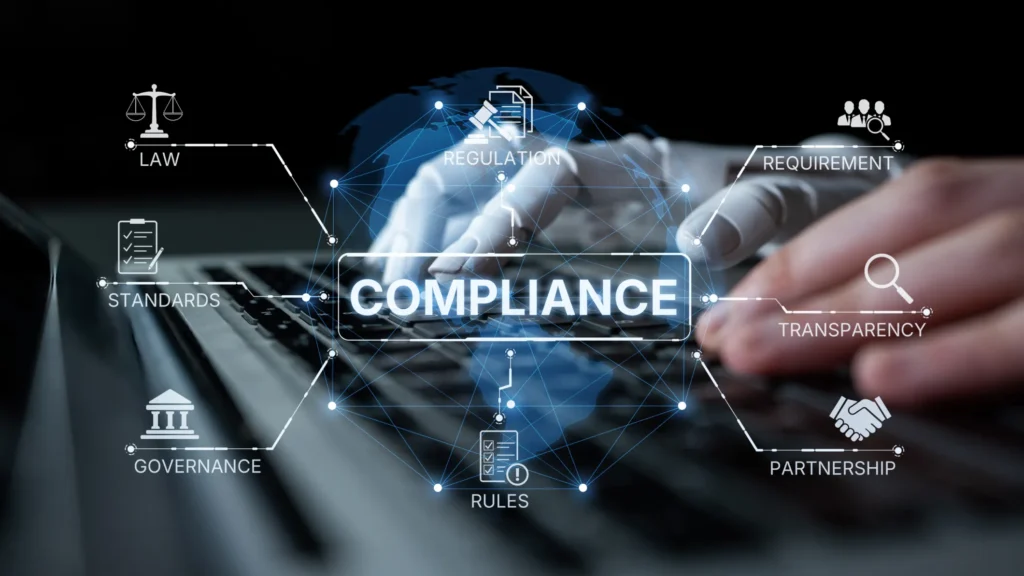
Compliance programs depend on a simple principle: an organization should be able to demonstrate that its controls are operating as intended. In practice, however, proving that controls work can require substantial manual effort. Teams may need to collect screenshots, system reports, access records, approval logs, policy documents, and other evidence from disconnected sources. When this information is gathered periodically, important changes can occur between reviews without being detected.
Agentic monitoring approaches this challenge differently by continuously examining relevant business and technology activity, gathering evidence, and identifying conditions that may indicate a control weakness. Rather than relying entirely on scheduled assessments, organizations can use automated monitoring to maintain a more current view of compliance. This creates a stronger connection between everyday operational activity and the evidence required for audits, risk assessments, and regulatory obligations.
Moving From Periodic Checks to Continuous Control Visibility
Traditional compliance monitoring often follows a scheduled cycle. A control owner may be asked to provide evidence every quarter or before an audit, after which compliance personnel review the material and determine whether the control appears effective. Although this approach can satisfy basic documentation requirements, it creates a significant limitation: the evidence represents a particular point in time.
AI-assisted control monitoring introduces a more continuous approach. Instead of waiting for a person to request evidence, automated agents can interact with connected systems, observe relevant events, retrieve supporting information, and evaluate whether defined control conditions remain satisfied. This can help organizations identify exceptions closer to when they actually occur.
For example, consider an access-control requirement stating that privileged accounts must be reviewed regularly. An automated monitoring process can examine identity-management records, compare assigned privileges against established requirements, identify accounts that appear inconsistent with policy, and preserve relevant evidence. The objective is not simply to collect more data. It is to connect operational activity with a specific compliance expectation.
This distinction matters because effective monitoring requires context. A raw system log may show that a user received elevated access, but compliance personnel need to know whether the access was authorized, whether appropriate approval existed, and whether the authorization remains valid. Intelligent monitoring can help bring these related pieces of evidence together.
Automating Evidence Collection Across Business Systems
Evidence collection is one of the most repetitive parts of compliance work. Organizations commonly operate across cloud platforms, identity providers, ticketing applications, human-resources systems, security tools, financial applications, and internal databases. Each system may contain a different portion of the evidence needed to validate a control.
Agentic Control Monitoring can automate much of this collection by connecting monitoring activities to the systems where relevant evidence exists. Instead of repeatedly asking employees to download reports or capture screenshots, an automated process can retrieve appropriate records according to defined control requirements.
A useful evidence-collection workflow can include:
- Identifying the systems and data sources relevant to a control.
- Retrieving current records or events from those sources.
- Matching evidence to the specific control requirement.
- Checking for missing, inconsistent, or outdated evidence.
- Preserving supporting records with appropriate timestamps and context.
Automation also improves consistency. Manual collection can vary depending on who performs the task, when the request is made, and how the evidence is interpreted. A standardized automated workflow can apply the same collection logic repeatedly, reducing unnecessary variation.
However, automation should not be confused with unrestricted data access. Evidence collection needs appropriate permissions, data-governance controls, retention rules, and security safeguards. Organizations should define what information an automated monitoring process can access and ensure that sensitive information is handled according to internal policies and applicable requirements.
How Automated Monitoring Surfaces Compliance Gaps
The real value of automated monitoring is not evidence volume but the ability to identify meaningful exceptions. A compliance gap may exist when a required approval is missing, a user retains inappropriate access, a security configuration falls outside an established standard, or evidence expected for a control is unavailable.
An agentic monitoring system can evaluate these conditions against predefined rules, control logic, and relevant contextual information. When an exception is detected, the system can flag it for investigation rather than waiting for the next scheduled review.
For instance, if a policy requires terminated employees to lose access promptly, monitoring can correlate employment-status information with identity-system records. If an account remains active after the relevant termination event, the discrepancy becomes a potential control exception. Similarly, if a control requires periodic access reviews, monitoring can determine whether reviews occurred and whether required approvals were documented.
This approach changes the role of compliance teams. Instead of spending most of their time searching for evidence, professionals can focus more attention on interpreting exceptions, investigating root causes, and determining appropriate remediation.
The quality of gap detection still depends on the underlying control design. Poorly defined requirements can produce misleading alerts, while incomplete system integrations can leave important activity invisible. Effective implementation therefore requires clearly documented controls, reliable data sources, sensible thresholds, and regular validation of monitoring logic.
Creating an Audit-Ready Record of Control Performance
Continuous evidence collection can also strengthen audit readiness. Auditors and internal reviewers generally need more than a statement that a control exists. They need evidence demonstrating how the control operated during the relevant period.
A monitoring approach can create an ongoing record of control activity, including evidence collected, exceptions identified, actions taken, and changes observed over time. This creates a clearer audit trail than relying exclusively on documents assembled shortly before an assessment.
For example, a compliance team could demonstrate that access reviews were performed consistently by presenting records showing when reviews occurred, which accounts were evaluated, what exceptions were identified, and how those exceptions were resolved. The resulting evidence provides greater context around the control’s operation.
It can also make remediation more measurable. If a recurring compliance issue appears every month, historical monitoring data can reveal the pattern and help determine whether corrective actions are actually reducing the problem. In this way, monitoring becomes part of an organization’s broader risk-management process rather than an isolated audit activity.
Organizations exploring this model can also review established continuous control monitoring approaches and agentic compliance concepts through resources such as Anecdotes’ continuous control monitoring overview.
Turning Compliance Exceptions Into Actionable Work
Identifying a gap is only the beginning. Compliance teams need enough information to understand what happened, why it happened, and what should happen next. Automated monitoring can support this process by attaching relevant evidence and contextual information to an exception.
For example, an alert about an unusual access change becomes more useful when it includes the affected account, the relevant policy requirement, the timestamp of the change, associated approval information, and the system in which the event occurred. With that context, a control owner can investigate the issue without reconstructing the entire situation manually.
Prioritization is equally important. Not every exception represents the same level of risk. Some may result from legitimate business activity, while others may indicate a material control failure. Monitoring programs should therefore distinguish between routine exceptions and issues that require immediate attention.
Clear ownership also prevents alerts from becoming another source of operational noise. Each significant control exception should have an appropriate owner, defined remediation expectations, and a process for documenting resolution. Over time, recurring exceptions can reveal weaknesses in policies, workflows, system configurations, or employee processes.
Building a More Responsive Compliance Program
Agentic monitoring does not eliminate the need for compliance professionals, control owners, or auditors. Instead, it changes where human attention is most valuable. Machines are well suited to repetitive evidence retrieval, data comparison, continuous observation, and initial exception detection. People remain essential for judgment, interpretation, risk acceptance, remediation decisions, and governance.
A strong program therefore combines automation with disciplined control management. Organizations should begin with clearly defined control objectives, map those controls to reliable evidence sources, establish appropriate monitoring logic, and periodically test whether the monitoring itself is producing accurate results.
This approach also encourages compliance teams to think beyond audit deadlines. When control performance can be observed continuously, compliance becomes less dependent on large evidence-gathering exercises and more connected to everyday operations. Problems can be investigated while they are still manageable rather than months after the underlying event occurred.
End Note
Automated agentic monitoring can make compliance more proactive by connecting control requirements with real operational evidence. Its greatest contribution is not simply reducing manual work. It helps organizations maintain visibility into whether controls are operating, detect potential gaps earlier, preserve evidence as activity occurs, and provide compliance teams with better information for investigation and remediation.
The result is a compliance process built around ongoing evidence rather than periodic reconstruction. When thoughtfully designed, continuous monitoring can give organizations a clearer understanding of control performance while allowing human teams to concentrate on the decisions and risks that require professional judgment.