Gold has spent the past few years near record territory, and every new high pulls another wave of first-time traders toward the market. Most of them are not buying bars or coins. They are trading the price.
For retail traders, the usual route in is a contract for difference, or CFD, on XAU/USD. This guide covers how to trade gold as a beginner: what the instrument actually is, what moves the price you will be trading, how to place a first position, and where new traders most often lose money. Gold moves quickly in both directions, so the risk section deserves as much attention as the mechanics.
Why Gold Attracts Traders
Gold draws money when confidence in other assets weakens. It pays no dividend and no interest, so its appeal is not income. The appeal is that it tends to hold value when currencies, bonds or equities come under pressure, which is why it gets described as a safe-haven asset.
Official buyers behave the same way. Central banks added 863 tonnes of gold to reserves during 2025, well above the 473-tonne annual average they maintained between 2010 and 2021 [1]. That is a long-running source of demand sitting underneath the market, and it is part of why gold behaves differently from most commodities.
For retail traders there are two more practical draws. Gold is one of the most heavily traded instruments available, and it runs on a near 24-hour schedule during the trading week, which makes it workable around a day job. And the ticker itself is simple once decoded: XAU is the market code for one troy ounce of gold, USD is the currency it is priced in, so the number on your screen is the dollar price of a single ounce.
Ways to Trade Gold
Not every route into gold suits a beginner. The differences come down to capital, storage, and whether you can profit from a falling price.
| Method | What you hold | Can you go short? | Practical friction |
| Physical gold | Bars or coins you own | No | Storage, insurance, wide buy/sell spread |
| Gold ETFs | Fund units tracking gold | Rarely, for retail | Requires a brokerage account, management fee |
| Gold futures | An exchange contract | Yes | Large contract sizes, expiry dates to manage |
| Gold CFDs | A contract on the price move | Yes | Leverage risk, overnight financing charges |
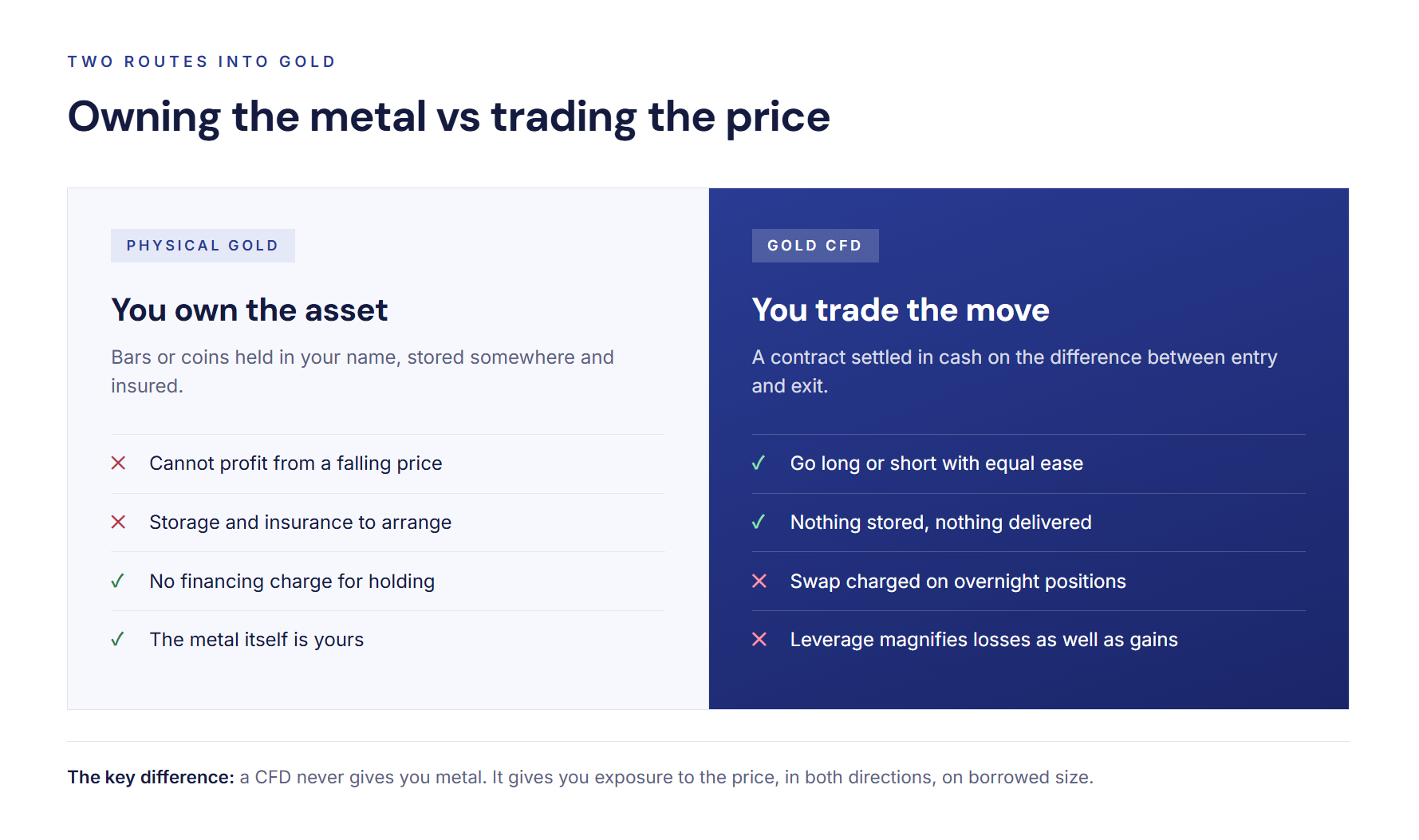
CFDs lower three barriers at once, which is why most beginners start there. You can open a position far smaller than a futures contract, you can profit from falling prices as easily as rising ones, and nothing is ever delivered to your door. A gold CFD settles the difference between your entry and exit price in cash.
The trade-off is leverage, and this is the part beginners underestimate. Trading on margin means a small price move produces a large change in your account balance, in whichever direction the market goes. Negative balance protection stops an account falling below zero. It does not stop you losing the money you deposited.
What Moves Gold Prices
Gold has no earnings, no yield and no management team, so its price is set entirely by conditions outside itself. Three of those conditions do most of the work.
The Dollar and Interest Rates
Interest rates are the single biggest lever. Because gold yields nothing, rising rates raise the cost of holding it compared with bonds or cash deposits, which usually weighs on the price. Falling rates do the reverse. Gold is also priced in dollars, so a weaker dollar tends to lift it even when nothing about gold itself has changed.
Inflation and Geopolitical Risk
Inflation and political stress push in the same direction as each other. When investors expect currencies to lose purchasing power, or when conflict and trade disputes raise uncertainty, demand for a hard asset with no counterparty risk goes up. These moves are often fast and hard to anticipate, which is what makes gold volatile as well as popular.
Central Bank Demand
Central bank demand works on a slower clock and shapes the market’s floor rather than its daily swings. Twenty-two institutions increased their gold reserves by roughly a tonne or more during 2025, with the National Bank of Poland the largest single buyer [1]. Watching this data helps explain multi-year trends. It will not tell you anything about next week’s candle.
How to Trade XAU/USD Step by Step
Placing a gold trade is mechanically simple. The part that takes learning is understanding what you are agreeing to when you click.
Reading the Quote: Spread, Lot Size, and Margin
Three numbers determine what a trade costs you before the market moves at all. The spread is the gap between the buy and sell price, and you pay it on entry. Lot size sets how much each price move is worth. Margin is the deposit your broker holds while the position is open. Check your broker’s contract specification for gold before your first trade, because lot sizes and margin requirements differ between brokers, and assuming they match what you read in a tutorial is a common early mistake.
Placing the Trade
With those understood, the trade itself is five decisions:
- Pick a direction. Buy if you expect gold to rise, sell if you expect it to fall.
- Set the size. Start smaller than feels interesting. Position size is the main control you have over risk.
- Attach a stop loss. Decide the exit price before you enter, and let the platform enforce it.
- Attach a take profit. Not mandatory, but it removes the decision from the moment when emotions are highest.
- Record the reason. One line on why you entered. This is what makes reviewing trades useful later.
Good process before all of that is repetitive and slightly boring. Check the economic calendar for rate decisions and inflation releases, since those tend to move gold hardest. Form a view on direction. Decide your risk limit for the trade. Only then open the ticket. Reversing that order, entering first and justifying afterwards, is how beginners drift into gambling.
Risk Management Essentials for Gold Traders
Everything above covers getting into a trade. What follows is about surviving the ones that go wrong, which is where beginner accounts are usually decided.
Sizing Positions for a Volatile Metal
Gold swings more than most major currency pairs, so a stop loss placed at a comfortable currency-pair distance will get hit constantly on XAU/USD. The fix is not a tighter stop. It is a wider stop with a smaller position, so the money at risk stays the same while the trade has room to breathe. Position sizing, not stop placement, is the lever that actually controls risk here.
Mistakes That Empty Beginner Accounts
The mistakes that empty beginner accounts are consistent and avoidable:
- Using maximum leverage because it is available. High leverage is a ceiling, not a target.
- Trading without a stop loss. One gap through a news release can undo weeks of gains.
- Adding to a losing position. Averaging down turns a small planned loss into an unplanned large one.
- Trading straight through major data releases. Spreads widen and slippage increases at exactly those moments.
A demo account is where you deal with the first layer of this. Spend enough time to place orders, set stops and read margin figures without hesitation. Live trading adds emotional pressure that no simulation reproduces, so there is no reason to spend that pressure learning which button does what.
Trading Gold CFDs with GTCFX
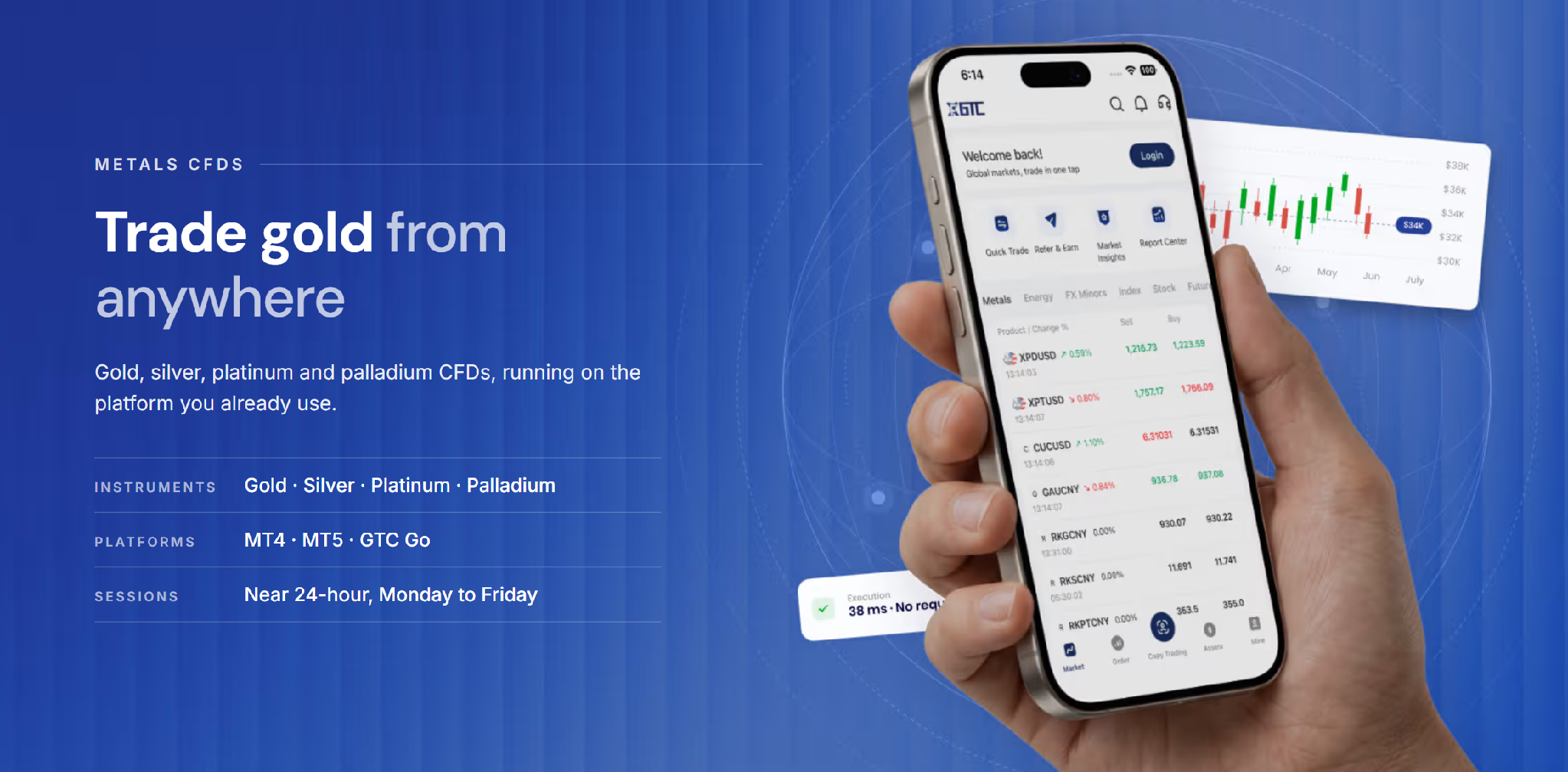
GTCFX offers gold and silver CFDs alongside platinum and palladium, with metals trading available on a near 24-hour schedule during the week. Positions can be run on MT4, MT5 or the GTC Go app, so the same account works from a desktop terminal or a phone.
| Standard | ECN | |
| Minimum deposit | None | $3,000 |
| Spreads | Average 1.0 pips | Raw, from 0.0 pips |
| Commission | None | $5 per standard lot |
Source: GTCFX account options
Worth being clear about the trade-off, because the headline pricing does not apply to everyone. The 0.0-pip raw spread belongs to the ECN account, short for electronic communication network pricing, which requires $3,000 to open. Most beginners will start on Standard and pay the wider average spread instead. Similarly, the advertised maximum leverage of 1:2000 applies only to clients of specific group entities, and it steps down as position size grows.
The Bottom Line
Gold suits beginners better than most instruments because the story behind the price is public and legible. Rates, the dollar, inflation and official buying explain most of what happens, and none of that requires a Bloomberg terminal to follow.
The difficulty is not analysis. It is sizing positions for an asset that moves hard in both directions. Get that part right on a demo account first, then trade small. If you want to compare conditions before committing, GTCFX publishes its metals specifications and account terms in full.
Frequently Asked Questions
Is gold trading suitable for beginners?
It can be, provided the position sizes are small and every trade carries a stop loss. Gold’s volatility is what attracts traders and also what empties under-capitalised accounts fastest.
How is a gold CFD different from buying physical gold?
A CFD is a contract on the price movement, settled in cash. You never own or take delivery of metal, you can go short as easily as long, and you pay financing on positions held overnight. Physical gold gives you the asset itself, plus storage and insurance to arrange.
What hours can you trade gold?
Gold CFDs trade on a near 24-hour cycle during the trading week, closing over the weekend. Liquidity is deepest when the London and New York sessions overlap, and spreads are typically widest in the thin hours after the New York close.
Disclaimer: Trading CFDs involves significant risk of loss and is not suitable for every investor. Leverage increases both potential gains and potential losses. Only trade with capital you can afford to lose, and seek independent advice if you are unsure.
Sources
- World Gold Council. “Gold Demand Trends Full Year 2025 — Central Banks.” 2026. https://www.gold.org/goldhub/research/gold-demand-trends/gold-demand-trends-full-year-2025/central-banks