
From AIOps to ObserveOps: Why Motadata Rebranded Its Flagship Platform, and What It Says About the Future of IT Operations. An Interview with Amit Shingala, Founder & CEO of Motadata

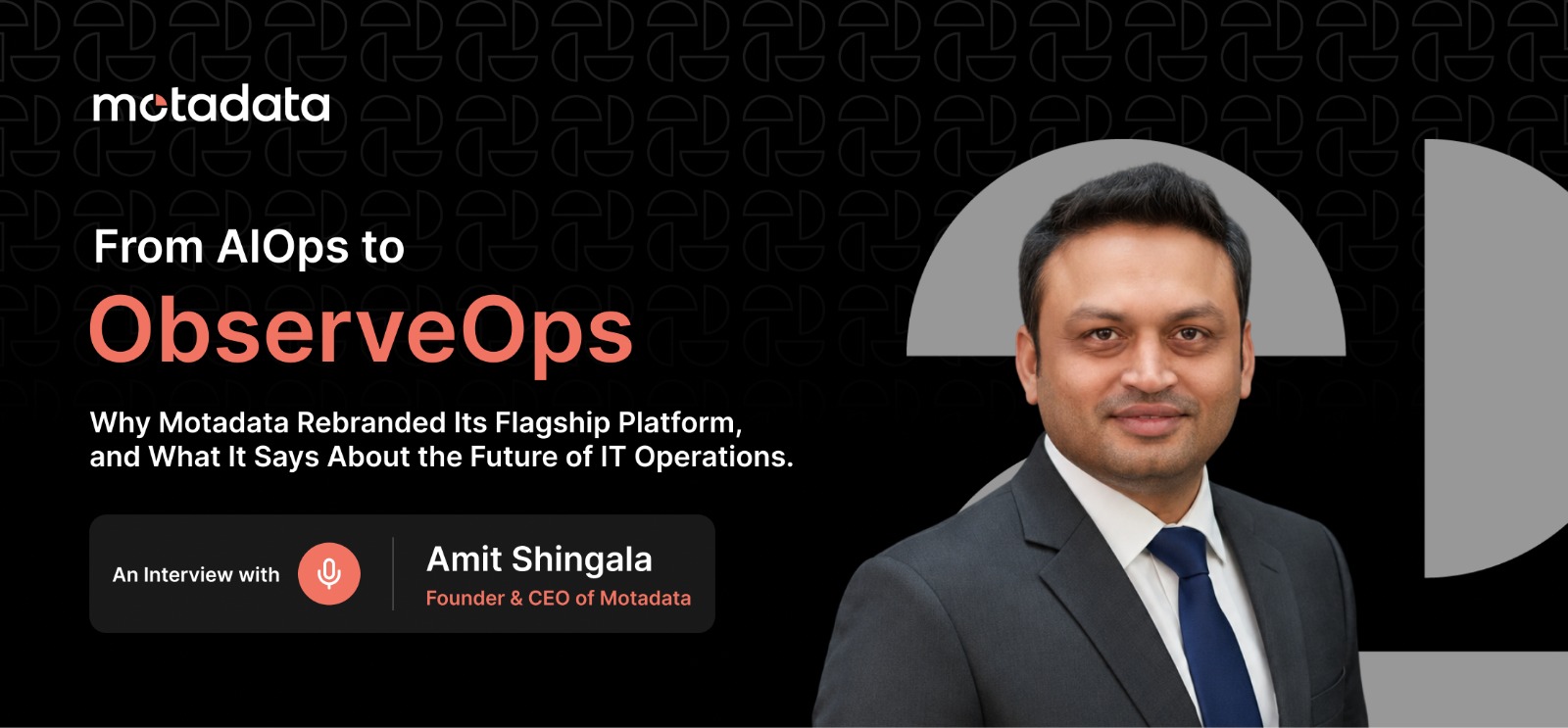
Motadata recently retired one of the most recognized product names in its portfolio. AIOps, the brand it had built for years, is now ObserveOps. On the surface, it is a name change. Underneath, it is a statement about where the entire IT operations category is heading. In this conversation, Amit Shingala, Founder and CEO of Motadata, explains the thinking behind the rebrand, why the term AIOps no longer captures what modern IT teams actually need, and how unified observability is becoming the foundation for the autonomous enterprise.
Q: Amit, let us start with the obvious one. Motadata recently renamed AIOps to ObserveOps. Why now, and why this name?
It is a fair question, and I want to answer it honestly because I know rebrands can look like marketing exercises from the outside.
The truth is, the product had outgrown its name. When we first launched AIOps several years ago, the category was new, the term was fresh, and it described what we were doing reasonably well. We were putting artificial intelligence on top of IT operations data. That was the conversation in the market at the time.
But over the last few years, two things have changed. First, AI has become table stakes. Every monitoring tool, every service desk, every infrastructure platform now claims to have AI inside it. So calling your product AIOps in 2026 is like calling your phone a smartphone. It tells the buyer almost nothing. Second, and this is more important, the actual problem our customers are solving has gotten much bigger than AIOps as a category was ever meant to cover.
Customers do not come to us asking for AIOps anymore. They come to us asking how to see everything that is happening across their hybrid infrastructure, in one place, with the context they need to act on it. That is observability in the full sense of the word. Metrics, logs, flows, traces, topology, all unified. AI is one part of how we deliver that, but it is not the whole product.
So we made the call. The platform is called ObserveOps because that is what it actually does. It gives operations teams real observability.
Q: Was there an internal debate about giving up the AIOps brand? It carried real recognition in the market.
Of course there was a debate. AIOps is a name we had invested in for years. There were people on my team, including some I respect deeply, who were nervous about walking away from that recognition.
But here is how I think about brand decisions. A brand should describe what you do today and where you are going tomorrow, not where you came from. If we held on to AIOps just because the name had equity, we would be telling customers a story that does not match what they buy from us. That is a bigger risk than losing some search traffic for a quarter or two.
And honestly, the AIOps category itself is shrinking in customer conversations. Analysts who used to publish AIOps market guides are increasingly folding that work into broader observability or IT operations platform research. We saw where the puck was going, and we did not want to be skating to where it used to be.
Q: Walk me through the practical difference. If a CIO had AIOps from Motadata last year, and now has ObserveOps, what actually changed for them?
The underlying product capability has not been ripped out and replaced. ObserveOps is the evolution of AIOps, not a different product. The same deep learning foundation, which we call DFIT, is still at the core. The same data backend, MotaStore, still holds everything. Existing customers continue to use the platform without disruption.
What has changed is the scope of what we put under one roof, and how we talk about it.
In the old AIOps framing, the conversation was mostly about anomaly detection, alert correlation, and noise reduction on top of monitoring data. Important capabilities, but narrow. In the ObserveOps framing, the conversation starts much earlier. It starts with the question, can you see everything? Metrics from servers, logs from applications, flow data from the network, traces from microservices, dependency maps across hybrid cloud, all of it ingested natively, all of it queryable from the same place.
The AI is still there. Anomaly detection, predictive alerting, dependency mapping, noise reduction, intelligent correlation, all of it. But it is no longer the headline. The headline is unified observability, and AI is the engine that makes that observability useful at enterprise scale.
For a CIO, the practical impact is that the platform now serves more of their team. The network team gets real flow analytics. The application team gets full APM with trace intelligence. The SRE team gets unified telemetry. The NOC gets one screen for everything. Under AIOps, parts of this were available but the brand kept positioning us as an AI add on to monitoring. Under ObserveOps, the platform shows up the way it actually works, as the primary observability layer.
Q: You mentioned that AI has become table stakes. Does that mean you are downplaying the AI capability in ObserveOps?
No, and I want to be careful here because the answer is more interesting than yes or no.
We are not downplaying AI. We are repositioning it. In the old story, AI was the product. In the new story, AI is the differentiator on top of a product that already has to be world class at the basics. If your observability platform cannot ingest data cleanly, scale across hybrid environments, handle high cardinality, and present it usefully, no amount of AI will save it. The AI sits on top of a strong foundation, not in place of one.
What we are also doing is being more honest about what our AI actually does. DFIT, our deep learning framework, does specific, measurable things. It correlates anomalies across metrics, logs, and flows. It builds dependency maps without manual configuration. It reduces alert noise dramatically. It forecasts capacity issues. It does not require weeks of training to be useful, because it is designed to adapt to your environment from day one.
I would much rather describe those concrete capabilities than wave the AI flag in the abstract. The market is tired of vague AI claims. Customers want to know exactly what the AI does, on what data, with what result.
Q: How does ObserveOps connect to Motadata ServiceOps, your IT service management product? Is the relationship between the two changing as well?
The relationship is becoming clearer, which I think is one of the underrated benefits of the rebrand.
When you had a product called AIOps sitting next to a product called ServiceOps, the natural question was, are these two different things or two flavors of the same thing? The answer was always that they are two products built on the same foundation, but the names did not make that obvious.
With ObserveOps and ServiceOps, the relationship reads correctly. One product observes. The other product services. Both run on the same brain, DFIT, and the same data layer, MotaStore. Together they give a customer the full loop from detecting a problem in the infrastructure to opening a ticket with full context, resolving it through a workflow, updating the asset record, and closing the loop back to monitoring.
This is the part I genuinely believe sets us apart. Most vendors in this space either do observability or do service management. The ones who claim to do both have usually acquired their way into the second category and stitched the products together with connectors. We built both halves on a shared foundation from the start. The rebrand makes that story easier to tell.
Q: Looking at the broader market, do you think other vendors will follow this kind of repositioning? Is AIOps as a category on its way out?
I do not think AIOps will disappear overnight, but I do think the term is past its peak as a standalone category. You can already see the signals. The big observability vendors barely mention AIOps as a separate product line anymore. They talk about observability with AI built in. The big ITSM vendors are doing the same on their side. The category labels are dissolving into broader platform stories.
That is healthy for the industry. AIOps as a term was useful when it was helping enterprises understand that AI could be applied to operations data. It served that purpose. Now the conversation has moved on to what you actually do with that capability, and that conversation belongs under bigger headings. Observability. IT service management. Autonomous operations.
I would expect other vendors to follow with their own repositioning over the next twelve to eighteen months. Some will do it cleanly. Others will keep the old brand running alongside a new one for a while. We chose to make the cut in one move because we believe in the new positioning fully, and I did not want to confuse customers with two names for the same thing.
Q: What should customers and prospects take away from this change? What is the one message you want them to hear?
The simplest way to say it is this. Motadata is not just adding AI to monitoring anymore. Motadata is delivering unified observability for the modern enterprise, with AI as the engine that makes it actually work at scale.
If you are a CIO or an infrastructure leader evaluating tools, what I would ask you to look at is not whether a vendor has AI. Everyone will say yes. Ask whether the vendor has brought metrics, logs, flows, traces, and topology together on one data foundation, with one query layer, one user experience, and one set of AI capabilities working across all of it. That is the bar now. That is what observability actually means in 2026.
The rebrand from AIOps to ObserveOps is our way of telling the market clearly that this is the bar we hold ourselves to. The product was already heading in this direction. The name now matches the product.
Q: Final question. For the IT leaders reading this, what is your one piece of advice as they think about their own observability strategy for the year ahead?
Stop buying tools by category, and start buying by outcome.
For too long, IT teams have been buying a monitoring tool, plus a log tool, plus a network analytics tool, plus an APM tool, plus an AIOps layer, plus a service desk. Six contracts, six data silos, six user experiences, six places your team has to look when something goes wrong. Every one of those tools is excellent in isolation. Together they create the problem they were each supposed to solve.
The outcome you actually want is simple. When something breaks, you want to know what broke, why it broke, what depends on it, and how to fix it, in one place, in one workflow, in minutes. If a vendor can show you that outcome on a single platform, with one data foundation underneath, you have found the right partner. If they cannot, no amount of category labels will save you.
That is the shift we are making with ObserveOps, and I believe it is the shift the entire industry needs to make.
Amit Shingala is the Founder and CEO of Motadata, an IT operations company that builds unified observability and IT service management platforms for enterprises. Motadata serves over 500 enterprises across more than 30 countries, with deep adoption in banking, telecom, government, and manufacturing. The company recently rebranded its flagship AIOps platform to ObserveOps, reflecting its evolution into a unified observability platform.






Comment