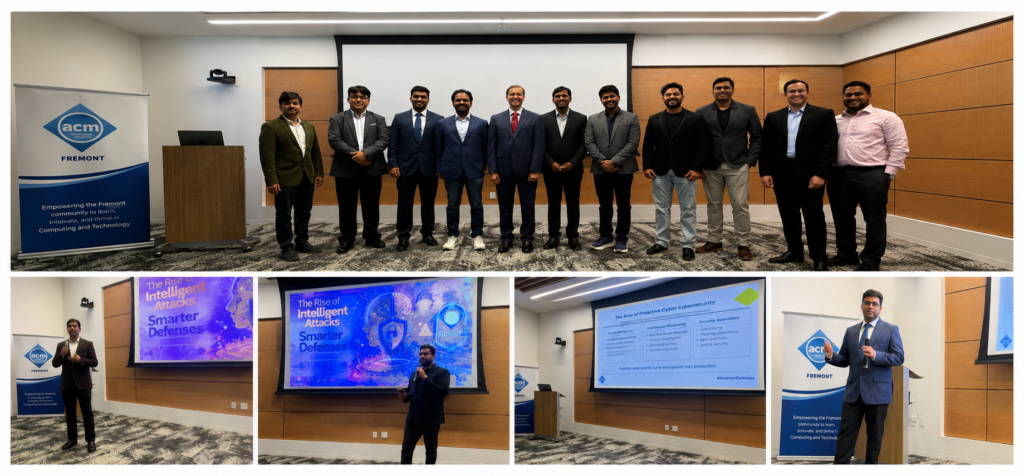
Technology leaders, cybersecurity practitioners, cloud architects, researchers, and engineers gathered at the Fremont Downtown Event Center in California on May 16, 2026 for a major ACM Fremont Chapter conference focused on one of the defining challenges facing modern digital infrastructure: the rise of intelligent attacks and the future of adaptive cyber defense.
Titled “The Rise of Intelligent Attacks and Smarter Defenses,” the in person conference brought together speakers from leading technology organizations to discuss artificial intelligence, resilient infrastructure, distributed systems, enterprise security, and the evolving threat landscape. The event created a platform for practical conversations around how modern systems can remain secure as attacks become increasingly autonomous, adaptive, and difficult to detect.
The conference was opened by Arun Kumar Elengovan, Vice Chair of the Fremont ACM Chapter, who discussed the rise of intelligent cyber-attacks, the operational challenges facing modern organizations, and the growing role of artificial intelligence in both cyber offense and defense. He emphasized the importance of building systems capable of adapting and recovering under evolving threats.
The keynote address of the conference was delivered by Isan Sahoo, who drove the conference as Keynote Speaker and Program Chair. In his keynote, Mr. Sahoo set the tone for the evening with a thoughtful framing of the conference theme, observing that the modern cybersecurity landscape is being reshaped by intelligent attacks that learn, adapt, and operate at machine speed. He emphasized that the resilient systems of the future will depend not only on stronger perimeters, but on AI driven defenses capable of reasoning, anticipating, and recovering in real time alongside the threats they face.
Mr. Sahoo is a Principal Member of Technical Staff at Oracle with over twelve years of experience in AI driven cloud infrastructure and healthcare systems. As Programme Chair of the ACM Fremont Chapter, Mr. Sahoo has played a pivotal role in expanding the chapter’s reach by organizing numerous tech talks and inviting leading industry professionals from across the United States.
The conference also featured Siva Prasad Nandi, Director of Software Development at Oracle, who was invited as a Distinguished Speaker by the Fremont ACM Chapter. In his address, Mr. Nandi focused on reliability, resilient cloud infrastructure, and large scale enterprise database systems supporting mission critical workloads. Drawing from his experience managing more than 25,000 production databases globally, he discussed the growing importance of dependable, auditable, and production ready architectures in modern enterprise environments, and underscored that engineering for trust at scale is now inseparable from engineering for security.
Additional sessions throughout the conference explored multiple dimensions of cybersecurity and artificial intelligence.
Bhaskar Rajbongshi presented “AI Augmented Secure Development: Using LLM Agents to Harden Code Before Attackers Find the Bugs,” demonstrating how large language model agents can identify logic flaws, authentication weaknesses, and cryptographic misconfigurations often missed by traditional static analysis tools.
Mayank Dwivedi delivered a session titled “The New Cyber Battlefield: AI Driven Attacks and the Future of Internet Resiliency,” focusing on layered defense architectures, edge infrastructure resilience, and modern approaches for defending against large scale internet threats.
Pavan Kadarla discussed “Building Smarter Defenses Against API Attacks,” covering secure API governance, microservices protection, and hybrid cloud security practices.
Ram Hibane presented “SAP Joule AI Powered Smart Security for the Era of Intelligent Attacks,” examining how artificial intelligence can strengthen enterprise risk scoring, anomaly detection, and secure business process automation across modern SAP ecosystems.
Abhijit Roy spoke on “Scalable Integration Design: MuleSoft Architecture and CI/CD Deployment,” highlighting API led connectivity, enterprise integration resilience, and modern deployment strategies for cloud first organizations.
Prasad Maderamitla addressed “From Prompt Injection to Agent Hijacking: Production Grade Defenses for Enterprise Agentic AI,” focusing on runtime authorization, hallucination detection, observability, and security guardrails for enterprise AI systems.
Kunal Shailesh Kannav presented “When the Agent Is the Target: Defending Autonomous Infrastructure Against AI Speed Attacks,” exploring cryptographic reasoning action binding and architectural approaches for securing autonomous AI driven infrastructure.
Vijayakumar Venganti delivered “Securing Wireless Networks in the AI Era,” examining intelligent wireless threats, Zero Trust principles, and the future of AI enhanced telecom security.
Siddhant Tanpure concluded the technical program with “Architecting the Live Machine,” discussing resilience engineering, large scale distributed systems, and fault tolerant AI infrastructure based on operational experience supporting hyperscale production environments.
The closing session of the conference was delivered by Deepak Kole, who reflected on the central themes of the evening and the path forward for the community. In his closing remarks, Mr. Kole observed that the conversations across the day reaffirmed a single, unifying truth: that security, resilience, and intelligence are no longer separate disciplines, but interdependent pillars of modern digital infrastructure. He thanked the speakers, attendees, and the organizing committee, and urged the community to continue building systems that earn trust through engineering excellence rather than assume it by default.
A seasoned software professional with over twelve years of experience architecting and delivering secure, scalable, and high performance systems, Mr. Kole has spent his career building infrastructure that most users never see, including real time platforms serving millions of people globally, cloud native applications built for sustained availability, and enterprise security systems where a single failure carries real consequences.
Organizing Committee
The event was supported by the Fremont ACM Chapter organizing committee, whose members coordinated the technical agenda, communications, operations, membership engagement, and strategic planning for the conference.
Committee Chairs
- Mr. Amit Kumar Padhy, Communications Chair — Directs end-to-end event communications and strategic outreach, fostering seamless engagement among speakers, sponsors, partners, and the wider Bay Area technology community.
- Mr. Arun Kumar Elengovan, Vice Chair — Provides engineering leadership across chapter wide programs and strengthens the technical rigor of every event, ensuring high impact content and operational excellence.
- Mr. Vinay Soni, Co-Chair and Digital Lead — Spearheads the chapter’s digital strategy, online platforms, and virtual operations, expanding reach and enabling inclusive participation across global communities.
- Mr. Pavan Nutalapati, Co-Chair and Treasurer — Oversees operational logistics and financial governance, safeguarding fiscal integrity and enabling sustainable, well executed chapter programs.
- Mr. Nandagopal Seshagiri, Secretary — Coordinates cross functional communications, governance documentation, and event readiness, ensuring disciplined execution across every chapter initiative.
- Mr. Rakesh Keshava, Chairman, Fremont ACM Chapter — Provides executive leadership and strategic vision for the chapter, championing community growth, industry partnerships, and the advancement of computing excellence in the Bay Area.
- Mr. Manjunatha Sughaturu Krishnappa, Membership Chair — Leads membership growth, retention, and engagement strategy, cultivating a vibrant professional network of engineers, researchers, and technology leaders while driving onboarding, recognition, and member value programs.
- Ms Madhushree Kumari, Communications Chair — Manages multi-channel communications, branding, and public messaging, amplifying chapter visibility and ensuring consistent, professional engagement with members, partners, and the broader tech community.
As artificial intelligence becomes increasingly integrated into critical infrastructure, financial systems, enterprise operations, and public services, conferences such as this reflect a growing industry priority: building systems that remain secure, resilient, and trustworthy under rapidly evolving conditions.
For attendees across the Bay Area technology community, the ACM Fremont Chapter conference highlighted an increasingly important reality for the modern digital era: cybersecurity is no longer only about preventing attacks, but about engineering systems capable of adapting, recovering, and sustaining trust at scale.