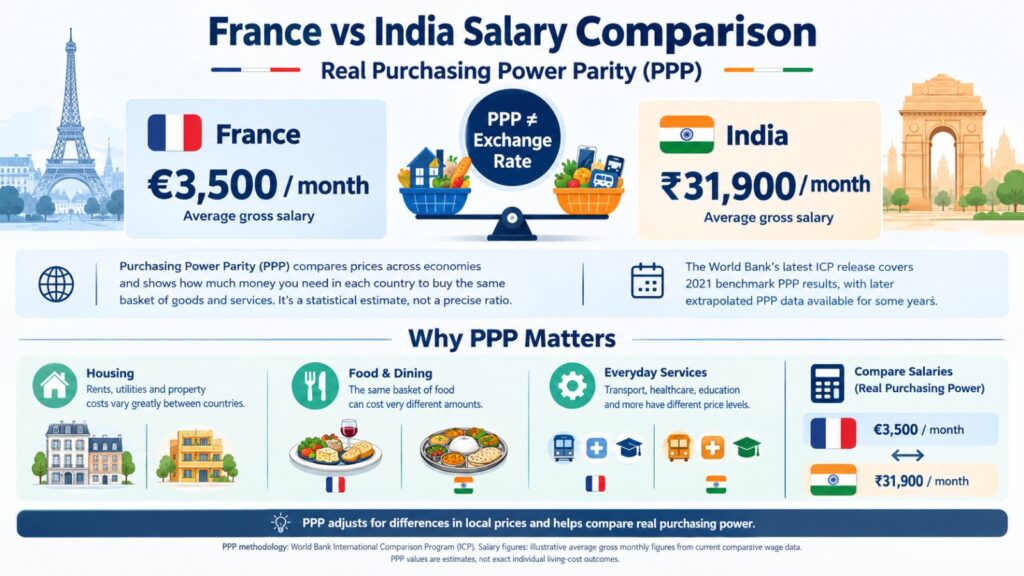
When you get your first job abroad you get very excited because of a higher salary in foreign than in India. While checking job offers between Europe and India, many professionals fall into the trap of direct currency conversion by live market rates available online for free and completely ignore purchasing power parity rates. An annual salary of €50,000 in France converts to roughly ₹55 Lakhs at nominal market exchange rates in India. On paper, that sounds like a rich executive income in India.
In reality, direct currency conversion measures financial market liquidity, not local living standards. Currency market rates give you the money but not the value of that salary in India. To understand what a paycheck actually buys, you must look through the lens of Purchasing Power Parity (PPP). Let’s look at a real-world salary comparison to see how PPP drastically changes the final math.
The Nominal Illusion vs. PPP Reality
Market exchange rates govern what currencies trade internationally, heavily influenced by exports, imports, and central bank rates not what ramesh cutting shops ask, and raju mithaiwala gives you mithai. However, day-to-day survival depends on non-traded goods and services—such as rent, local groceries, public transit, and domestic services.
Because labor and service costs are highly lower in India, the Indian Rupee retains far greater purchasing power domestically. According to World Bank PPP benchmarks, the real-world purchasing multiplier between Western Europe and India is approximately 3.5x to 4x.
This means that living on €50,000 in any city of France provides a lifestyle roughly equivalent to earning ₹12 to ₹15 Lakhs in an Indian metro cities or lower in rural cities, rather than the ₹55 Lakhs nominal figure.If you are evaluating an international job offer right now, using a dedicated PPP salary converter can help you run this exact math for your specific target city in minutes, giving you a realistic picture of your future standard of living
Key Expense Drivers: Paris vs. Indian Metros
Where does the money actually go? The divergence between nominal earnings and disposable wealth comes down to three major factors:
- Taxes and Social Contributions: France has one of the world’s most comprehensive social safety nets, but it comes at a high price. Gross salaries are subject to employee social contributions (cotisations sociales, ~20–23%) plus progressive income tax. A €60,000 gross salary typically yields a net take-home of roughly €36,000 to €39,000 per year (€3,000–€3,250/month).
- Housing Costs: Rent in major French employment hubs like Paris or Lyon consumes a massive chunk of post-tax earnings. A modest one-bedroom apartment in Paris routinely costs €1,100 to €1,600 per month, easily claiming 40% to 50% of a mid-level professional’s net income. In contrast, premium housing in Indian hubs (Bengaluru, Pune, or Hyderabad) rarely commands such a disproportionate share of an upper-middle-class salary.
- Labor and Service Costs: Routine conveniences that Indian professionals take for granted—cooks, maids, drivers, daily dining out, and low-cost doorstep deliveries—are luxury expenditures in France. A dinner for two at a standard French bistro costs €50 to €80, whereas an equivalent dining experience in India costs a fraction of that in PPP terms.
What France Offers in Return for Public
While India offers higher discretionary savings and affordable service-based living, France provides significant structural benefits:
- Public Infrastructure: Reliable, high-speed public transit eliminates the need for expensive private car ownership.
- Healthcare & Education: Heavily subsidized healthcare via the Sécurité Sociale and nearly free higher education remove the massive private reserves required for medical and educational funds in India.
- Work-Life Balance: Statutory 35-hour workweeks, coupled with 5 to 6 weeks of paid vacation, offer a non-monetary return on investment that few Indian corporate roles match.
Reality Check: How Rahul Patil Navigated Culture, Costs, and Career in France
Rahul Patil lived in pune and he got a job in Paris in 2025, he became the first family member who got a job in a European nation. His respect increases night by night due to the high salary in Paris. He got a € 100,000 package which means ₹ 1.1 Crore in India.
When he finally landed in Paris he faced major problems related to purchasing power and cultural differences. He thinks earning 1 Cr in India and France are the same but that misunderstanding was broken. He knew the living cost was higher in France than India. Rent, transport and travel expenses also income tax was high in France but he knows the government provides better services than India. You need ₹2,708,381 in India to live like €100,000 in France as per ppp but he got 1 crore package with high expenses also. If he lived in India and got 27 Lakhs package he would live a similar lifestyle like France. Because 1 EUR buys what ~27.08 INR buys locally, India has roughly a 3.7x PPP Multiplier against the Euro.
If you are calculating a lifestyle parity shift:
- To maintain a lifestyle that costs €1,000 per month in France, you only need to spend about ₹29,540 per month in India.
- If someone earns €50,000 in France, the raw nominal conversion is roughly ₹55.3 Lakhs. However, their real standard of living inside India is matched by a local salary of just ₹14.77 Lakhs
Overall Annual Cost of Living Comparision Between France and India As per PPP Rates
- France: €100,000
- India: ₹2,708,381
| Category | France (EUR) | India (INR) |
| Housing | €27,000 | ₹487,509 |
| Food | €16,000 | ₹677,095 |
| Entertainment | €16,000 | ₹460,425 |
| Transport | €13,000 | ₹325,006 |
| Utilities | €12,000 | ₹216,670 |
| Education | €9,000 | ₹325,006 |
| Healthcare | €7,000 | ₹216,670 |
| Total | €100,000 | ₹2,708,381 |
Suggestions for Everyone Who Want to Relocate their Location for Job
A gross salary of €75,000 to €85,000 in France is generally required to achieve the disposable income, personal savings rate, and lifestyle flexibility of ₹25 to ₹30 Lakhs in India.
Before accepting an international relocation or evaluating cross-border pay, look beyond bank conversion rates. Adjusting for purchasing power parity is the only reliable way to evaluate your true standard of living.