The final deprecation of third-party cookies in Chrome, completing a transition that Safari and Firefox initiated years earlier, has fundamentally altered how organisations build relationships with their audiences. Yet the brands navigating this shift most successfully are not the ones scrambling to find cookie replacements. They are the organisations that recognised first-party data as a strategic asset long before browser policies forced the issue. Consider a direct-to-consumer skincare brand that generates 73 percent of its digital revenue from customers who voluntarily shared their skin type, ingredient preferences, and routine goals through an interactive quiz. That brand does not need third-party cookies because its customers have provided something far more valuable: explicit, permission-based data that improves with every interaction.
The Economic Case for First-Party Data Investment
The financial argument for first-party data strategies has moved beyond theoretical projections into measurable reality. According to Boston Consulting Group, brands that use first-party data for key marketing functions achieve up to a 2.9 times revenue uplift and a 1.5 times increase in cost savings compared to those that do not. Google and BCG research further indicates that companies with mature first-party data strategies generate 1.5 times the incremental revenue from a single ad placement or communication.
The economics work because first-party data eliminates the intermediary tax embedded in third-party data acquisition. Brands historically paid data brokers and demand-side platforms for audience segments built from inferred behaviours. Those segments carried accuracy rates as low as 30 to 50 percent according to multiple industry audits. First-party data collected directly from customer interactions carries inherently higher accuracy because the customer themselves provided it.
| Metric | Value | Source |
|---|---|---|
| Revenue Uplift from First-Party Data | 2.9x | BCG / Google |
| Cost Savings Improvement | 1.5x | BCG / Google |
| Third-Party Data Accuracy Rate | 30-50% | Industry Audits |
| Marketers Prioritising First-Party Data | 87% | Salesforce State of Marketing |
| Consumers Willing to Share Data for Value | 73% | Accenture |
| First-Party Data Market Growth (CAGR) | 22.1% | Grand View Research |
Collection Architecture and Touchpoint Strategy
Building a robust first-party data strategy requires deliberate architecture across every customer touchpoint. The most effective approaches move beyond passive data collection through website analytics and transaction records to create active value exchanges that motivate customers to share richer information voluntarily.
Website and app interactions form the foundation layer. Event tracking captures page views, scroll depth, search queries, product interactions, and content consumption patterns. Server-side tagging has replaced client-side tracking for many organisations, routing data through the brand’s own infrastructure rather than relying on browser-based JavaScript tags that face increasing restrictions. Google Tag Manager’s server-side container and solutions from providers like Tealium and Snowplow have made this transition accessible to organisations without deep engineering resources.
Transactional data provides the highest-confidence signals in any first-party dataset. Purchase history, order frequency, average order value, product category preferences, and return patterns create a behavioural fingerprint that is both accurate and predictive. When combined with customer data platform infrastructure, these transactional signals enable real-time segmentation that adapts as customer behaviour evolves.
Interactive content represents the fastest-growing collection mechanism. Product recommendation quizzes, style assessments, preference centres, and gamified loyalty programmes create engaging experiences that customers actively seek out while simultaneously generating rich zero-party data. Brands like Sephora, Function of Beauty, and Stitch Fix have built entire business models around these interactive data collection moments.
Zero-Party Data as the Premium Tier
While first-party data encompasses all information collected directly from customer interactions, zero-party data represents a distinct and increasingly valuable subset. Coined by Forrester Research, zero-party data refers to information that customers intentionally and proactively share with a brand, including preferences, purchase intentions, personal context, and communication choices.
The distinction matters because zero-party data carries explicit intent. A customer who tells a travel brand they are planning a honeymoon in Greece next September has provided actionable intelligence that no amount of behavioural inference could match. This declared data eliminates the guesswork inherent in even the most sophisticated predictive models and creates opportunities for personalisation that feel helpful rather than intrusive.
Progressive profiling strategies collect zero-party data incrementally rather than overwhelming customers with lengthy forms. Each interaction requests one or two additional pieces of information, building comprehensive profiles over time while maintaining low friction. The key is ensuring that every data request is accompanied by a clear value proposition: share your preferences and receive better recommendations, exclusive access, or more relevant communications.
Privacy Compliance and Consent Architecture
First-party data strategies operate within a rapidly evolving regulatory landscape that demands sophisticated consent management. The European Union’s GDPR, California’s CCPA and CPRA, Brazil’s LGPD, and an expanding list of state and national privacy laws each impose specific requirements on data collection, storage, processing, and deletion.
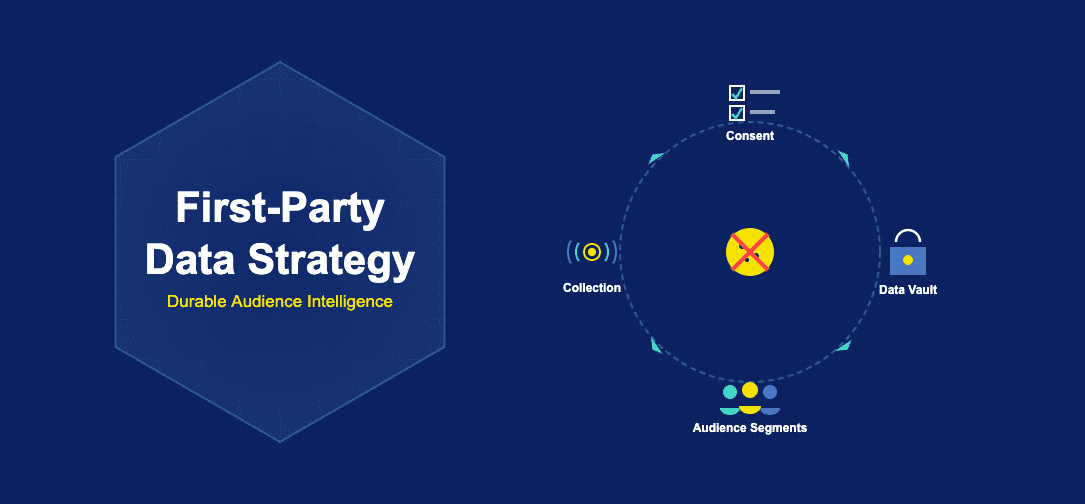
A compliant first-party data architecture begins with a consent management platform that captures granular permissions at the point of collection. Rather than relying on blanket consent, leading organisations implement purpose-specific consent that allows customers to approve data use for personalisation while declining it for analytics or third-party sharing. This granularity satisfies regulatory requirements while building customer trust through transparency.
Data minimisation principles guide what information to collect. Rather than hoarding every available data point, effective strategies focus on the specific attributes required to deliver measurable business outcomes. A subscription media company might need reading preferences, device types, and time-of-day patterns to optimise its content recommendation engine, but it does not need physical addresses or income levels. Collecting only what is necessary reduces compliance risk and storage costs simultaneously.
Activation Strategies Across the Customer Lifecycle
The value of first-party data is realised through activation, the process of translating raw data into actionable marketing decisions and personalised customer experiences. Activation strategies span the entire customer lifecycle from acquisition through retention and reactivation.
For acquisition, first-party data powers lookalike audience modelling through platforms like Meta, Google, and TikTok. Uploading hashed customer lists enables these platforms to identify prospects who share behavioural and demographic characteristics with existing high-value customers. Organisations with rich first-party profiles consistently report 30 to 50 percent lower customer acquisition costs compared to interest-based targeting alone.
Retention activation leverages first-party data to identify at-risk customers before they churn. Predictive analytics models trained on historical first-party data can flag declining engagement patterns, changes in purchase frequency, or shifts in product category interest that precede churn events. Triggered retention campaigns personalised with first-party insights achieve open rates 40 to 60 percent higher than generic re-engagement messages.
Cross-sell and upsell programmes benefit from the product affinity insights embedded in first-party transaction data. Rather than recommending products based on broad category associations, brands can identify specific complementary products based on actual purchase sequences observed across their customer base. A fitness equipment retailer that knows a customer purchased a rowing machine six weeks ago can recommend the specific accessories that other rowing machine buyers typically purchase within that timeframe.
Technology Stack for First-Party Data Operations
Building a functional first-party data stack requires coordinating several technology categories into a cohesive architecture.
| Layer | Function | Example Platforms |
|---|---|---|
| Collection | Event tracking and tag management | Snowplow, Tealium, GTM Server-Side |
| Storage | Centralised data warehouse | Snowflake, BigQuery, Databricks |
| Unification | Identity resolution and profile merging | Segment, mParticle, Amperity |
| Consent | Permission management and compliance | OneTrust, Osano, Cookiebot |
| Activation | Segment push to marketing channels | Hightouch, Census, Braze |
| Measurement | Attribution and incrementality testing | Measured, Rockerbox, Northbeam |
The integration between these layers determines the speed and accuracy of the entire system. Organisations that treat their first-party data stack as a unified architecture rather than a collection of independent tools achieve significantly faster time-to-activation and more consistent customer experiences across channels.
Measurement and Proving ROI
Demonstrating the return on first-party data investments requires measurement frameworks that connect data quality improvements to business outcomes. The most effective approaches combine marketing mix modelling with incrementality testing to isolate the specific contribution of first-party data activation from other marketing variables.
Key performance indicators should span both operational metrics and business outcomes. Operational metrics include data collection rates, consent opt-in percentages, profile completeness scores, and identity resolution match rates. Business metrics track the downstream impact: conversion rate improvements from personalised experiences, customer lifetime value increases among data-rich segments, and cost efficiency gains in paid media through better audience targeting.
Leading organisations report that customers with complete first-party profiles generate 3 to 5 times more revenue than anonymous visitors, validating the investment in collection and attribution infrastructure. This revenue differential provides the clearest justification for continued investment in first-party data capabilities.
Building Organisational Readiness
Technology alone cannot deliver a successful first-party data strategy. Organisations must develop cross-functional alignment between marketing, technology, legal, and product teams to establish data governance frameworks, collection standards, and activation priorities. A dedicated data stewardship function, whether a formal team or a distributed responsibility model, ensures that data quality, privacy compliance, and ethical use standards are maintained as the programme scales.
The organisations leading in first-party data maturity share a common trait: they view data collection not as an extraction exercise but as a value exchange. Every piece of information a customer shares is met with a tangible improvement in their experience. This reciprocal relationship creates a virtuous cycle where better data enables better experiences, which in turn motivate customers to share more, compounding the competitive advantage over time.
Related reading: Customer Data Platforms in 2026: Architecture, Integration and the Competitive Landscape
According to Deloitte’s industry outlook, more than 60 percent of large enterprises now allocate dedicated budgets to digital transformation initiatives, up from 35 percent in 2020.
Market analysis from Grand View Research projects that technology-driven market segments will continue expanding at compound annual growth rates between 15 and 25 percent through the end of the decade.